MRC Centre for Global Infectious Disease Analysis, Department of Infectious Disease Epidemiology, School of Public Health, Imperial College London, London, UK.
Grantham Institute-Climate Change and the Environment-Imperial College London, London, UK.
Nat Commun. 2019 Sep 20;10(1):4299. doi: 10.1038/s41467-019-12333-z.
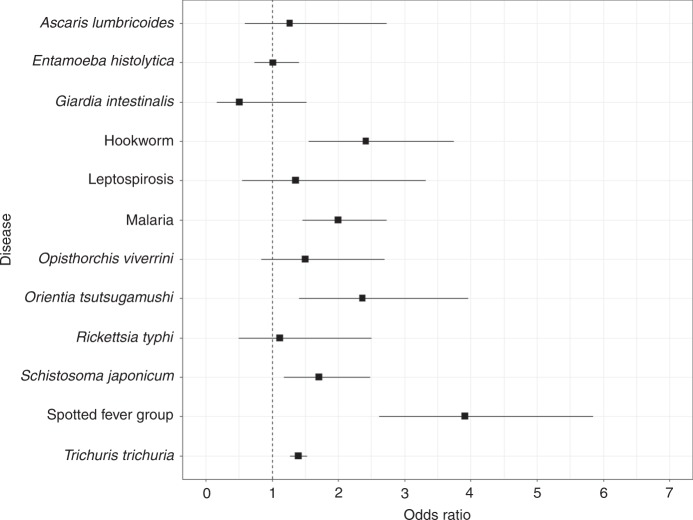
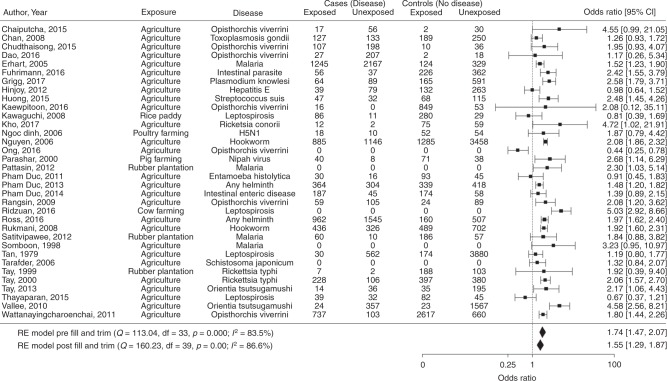
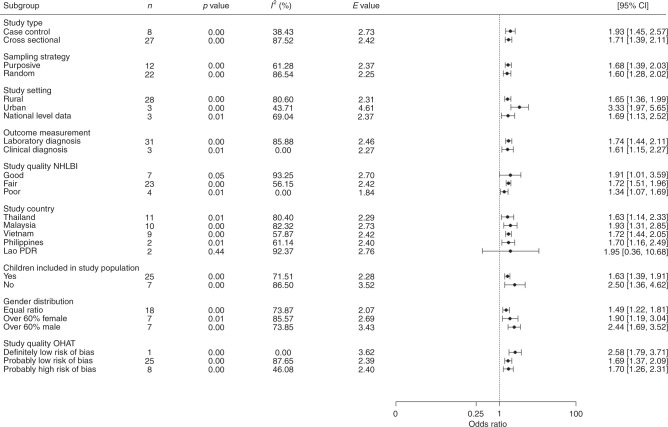
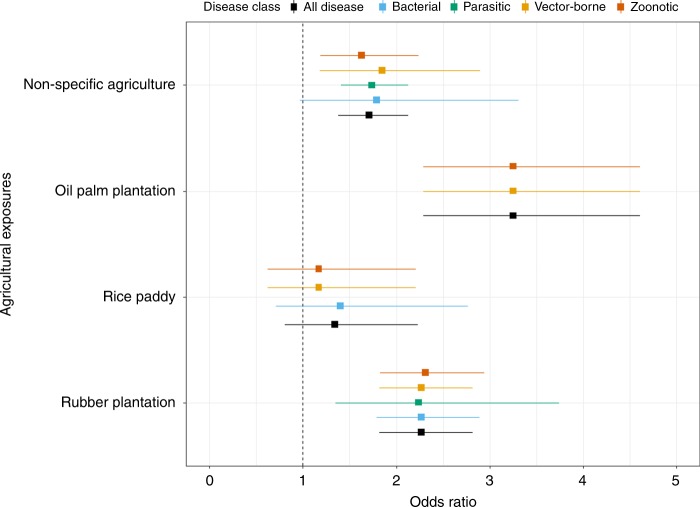
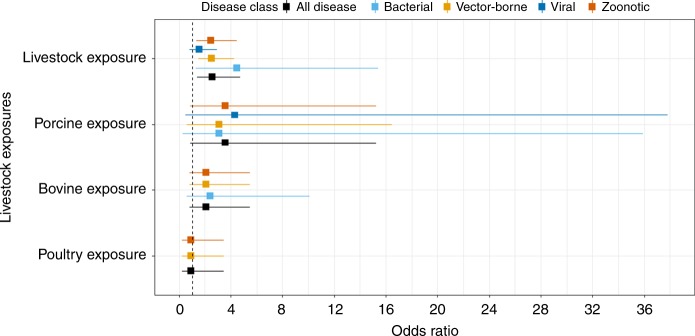
Agriculture has been implicated as a potential driver of human infectious diseases. However, the generality of disease-agriculture relationships has not been systematically assessed, hindering efforts to incorporate human health considerations into land-use and development policies. Here we perform a meta-analysis with 34 eligible studies and show that people who live or work in agricultural land in Southeast Asia are on average 1.74 (CI 1.47-2.07) times as likely to be infected with a pathogen than those unexposed. Effect sizes are greatest for exposure to oil palm, rubber, and non-poultry based livestock farming and for hookworm (OR 2.42, CI 1.56-3.75), malaria (OR 2.00, CI 1.46-2.73), scrub typhus (OR 2.37, CI 1.41-3.96) and spotted fever group diseases (OR 3.91, CI 2.61-5.85). In contrast, no change in infection risk is detected for faecal-oral route diseases. Although responses vary by land-use and disease types, results suggest that agricultural land-uses exacerbate many infectious diseases in Southeast Asia.
农业被认为是人类传染病的潜在驱动因素。然而,疾病与农业之间的普遍关系尚未得到系统评估,这阻碍了将人类健康因素纳入土地利用和发展政策的努力。在这里,我们进行了荟萃分析,纳入了 34 项符合条件的研究,结果表明,生活或工作在东南亚农业土地上的人感染病原体的平均风险是未暴露人群的 1.74 倍(95%CI:1.47-2.07)。在接触油棕、橡胶和非家禽养殖以及钩虫(OR 2.42,95%CI:1.56-3.75)、疟疾(OR 2.00,95%CI:1.46-2.73)、丛林斑疹伤寒(OR 2.37,95%CI:1.41-3.96)和斑点热群疾病(OR 3.91,95%CI:2.61-5.85)时,暴露的影响最大。相比之下,粪-口途径疾病的感染风险没有变化。尽管土地利用和疾病类型的反应有所不同,但结果表明,农业土地利用加剧了东南亚的许多传染病。