George Alexandra D, Paul Sudip, Wang Tingting, Huynh Kevin, Giles Corey, Mellett Natalie, Duong Thy, Nguyen Anh, Geddes Donna, Mansell Toby, Saffery Richard, Vuillermin Peter, Ponsonby Anne-Louise, Burgner David, Burugupalli Satvika, Meikle Peter J
Metabolomics Laboratory, Baker Heart and Diabetes Institute, Melbourne, VIC, Australia.
Baker Department of Cardiometabolic Health, University of Melbourne, Parkville, VIC, Australia.
Front Nutr. 2023 Aug 30;10:1227340. doi: 10.3389/fnut.2023.1227340. eCollection 2023.
Breastfed infants have lower disease risk compared to formula-fed infants, however, the mechanisms behind this protection are unknown. Human milk has a complex lipidome which may have many critical roles in health and disease risk. However, human milk lipidomics is challenging, and research is still required to fully understand the lipidome and to interpret and translate findings. This study aimed to address key human milk lipidome knowledge gaps and discuss possible implications for early life health.
Human milk samples from two birth cohorts, the Barwon Infant Study ( = 312) and University of Western Australia birth cohort ( = 342), were analysed using four liquid chromatography-mass spectrometry (LC-MS) methods (lipidome, triacylglycerol, total fatty acid, alkylglycerol). Bovine, goat, and soy-based infant formula, and bovine and goat milk were analysed for comparison. Composition was explored as concentrations, relative abundance, and infant lipid intake. Statistical analyses included principal component analysis, mixed effects modelling, and correlation, with false discovery rate correction, to explore human milk lipidome longitudinal trends and inter and intra-individual variation, differences between sample types, lipid intakes, and correlations between infant plasma and human milk lipids.
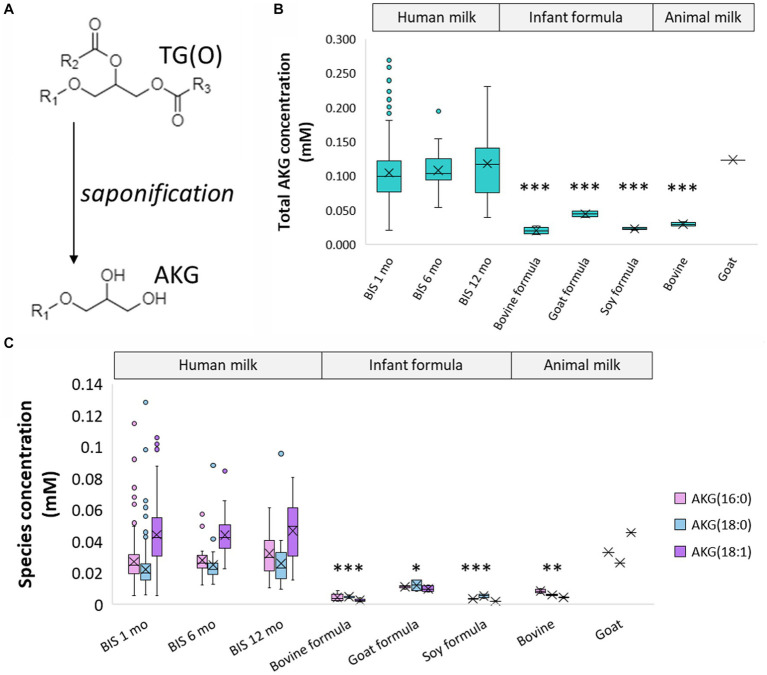
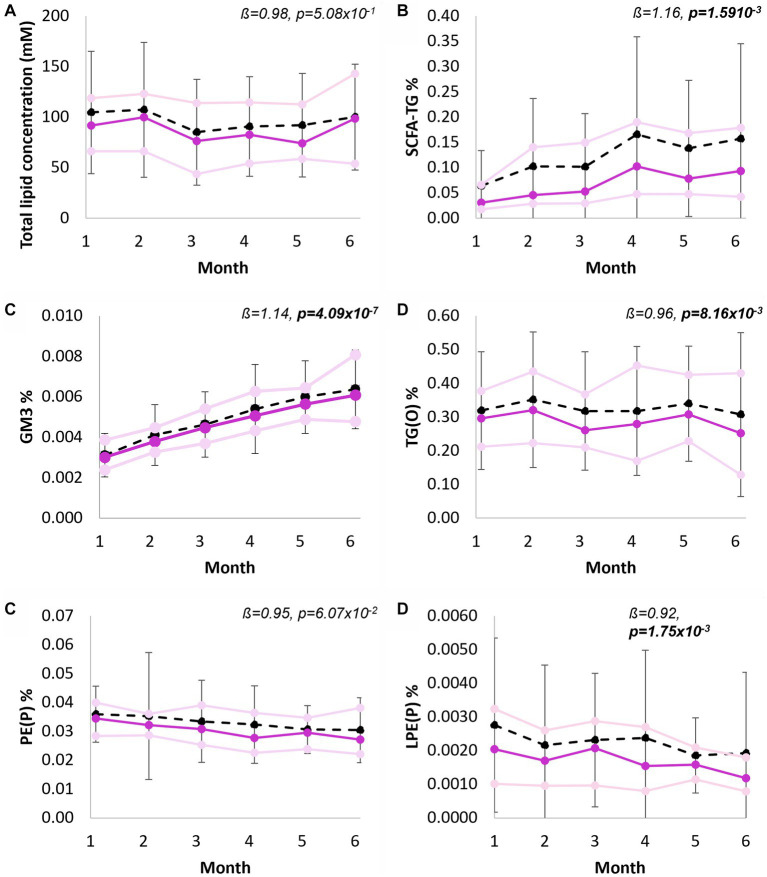
Lipidomics analysis identified 979 lipids. The human milk lipidome was distinct from that of infant formula and animal milk. Ether lipids were of particular interest, as they were significantly higher, in concentration and relative abundance, in human milk than in formula and animal milk, if present in the latter samples at all. Many ether lipids were highest in colostrum, and some changed significantly through lactation. Significant correlations were identified between human milk and infant circulating lipids (40% of which were ether lipids), and specific ether lipid intake by exclusively breastfed infants was 200-fold higher than that of an exclusively formula-fed infant.
There are marked differences between the lipidomes of human milk, infant formula, and animal milk, with notable distinctions between ether lipids that are reflected in the infant plasma lipidome. These findings have potential implications for early life health, and may reveal why breast and formula-fed infants are not afforded the same protections. Comprehensive lipidomics studies with outcomes are required to understand the impacts on infant health and tailor translation.
与配方奶喂养的婴儿相比,母乳喂养的婴儿患病风险更低,然而,这种保护背后的机制尚不清楚。母乳具有复杂的脂质组,可能在健康和疾病风险中发挥许多关键作用。然而,母乳脂质组学具有挑战性,仍需要开展研究以全面了解脂质组,并解读和转化研究结果。本研究旨在填补母乳脂质组的关键知识空白,并讨论其对早期生命健康的潜在影响。
使用四种液相色谱-质谱(LC-MS)方法(脂质组、三酰甘油、总脂肪酸、烷基甘油)分析了来自两个出生队列(Barwon婴儿研究,n = 312;西澳大利亚大学出生队列,n = 342)的母乳样本。对基于牛、山羊和大豆的婴儿配方奶粉以及牛奶和羊奶进行了分析以作比较。从浓度、相对丰度和婴儿脂质摄入量方面对成分进行了探究。统计分析包括主成分分析、混合效应建模和相关性分析,并进行了错误发现率校正,以探究母乳脂质组的纵向趋势以及个体间和个体内的差异、样本类型之间的差异、脂质摄入量以及婴儿血浆与母乳脂质之间的相关性。
脂质组学分析鉴定出979种脂质。母乳脂质组与婴儿配方奶粉和动物奶的脂质组不同。醚脂尤其引人关注,因为如果在后者样本中存在的话,母乳中醚脂的浓度和相对丰度显著高于配方奶粉和动物奶。许多醚脂在初乳中含量最高,并且有些在整个哺乳期会发生显著变化。在母乳和婴儿循环脂质之间发现了显著相关性(其中40%为醚脂),纯母乳喂养婴儿的特定醚脂摄入量比纯配方奶喂养婴儿高200倍。
母乳、婴儿配方奶粉和动物奶的脂质组存在显著差异,醚脂之间存在明显区别,这在婴儿血浆脂质组中有所体现。这些发现对早期生命健康具有潜在影响,可能揭示母乳喂养和配方奶喂养婴儿为何未得到相同保护的原因。需要开展具有结局指标的综合脂质组学研究,以了解对婴儿健康的影响并进行转化应用。