Branstad-Spates Emily H, Castano-Duque Lina, Mosher Gretchen A, Hurburgh Charles R, Owens Phillip, Winzeler Edwin, Rajasekaran Kanniah, Bowers Erin L
Department of Agricultural and Biosystems Engineering, Iowa State University, Ames, IA, United States.
USDA, Agriculture Research Service, Southern Regional Research Center, New Orleans, LA, United States.
Front Microbiol. 2023 Sep 1;14:1248772. doi: 10.3389/fmicb.2023.1248772. eCollection 2023.
Aflatoxin (AFL), a secondary metabolite produced from filamentous fungi, contaminates corn, posing significant health and safety hazards for humans and livestock through toxigenic and carcinogenic effects. Corn is widely used as an essential commodity for food, feed, fuel, and export markets; therefore, AFL mitigation is necessary to ensure food and feed safety within the United States (US) and elsewhere in the world. In this case study, an Iowa-centric model was developed to predict AFL contamination using historical corn contamination, meteorological, satellite, and soil property data in the largest corn-producing state in the US.
We evaluated the performance of AFL prediction with gradient boosting machine (GBM) learning and feature engineering in Iowa corn for two AFL risk thresholds for high contamination events: 20-ppb and 5-ppb. A 90%-10% training-to-testing ratio was utilized in 2010, 2011, 2012, and 2021 ( = 630), with independent validation using the year 2020 ( = 376).
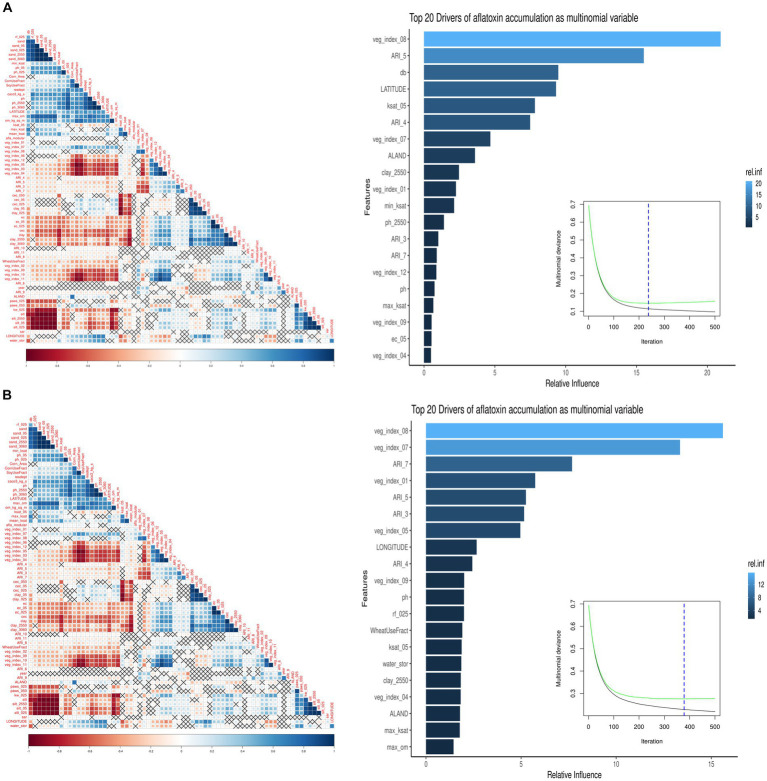
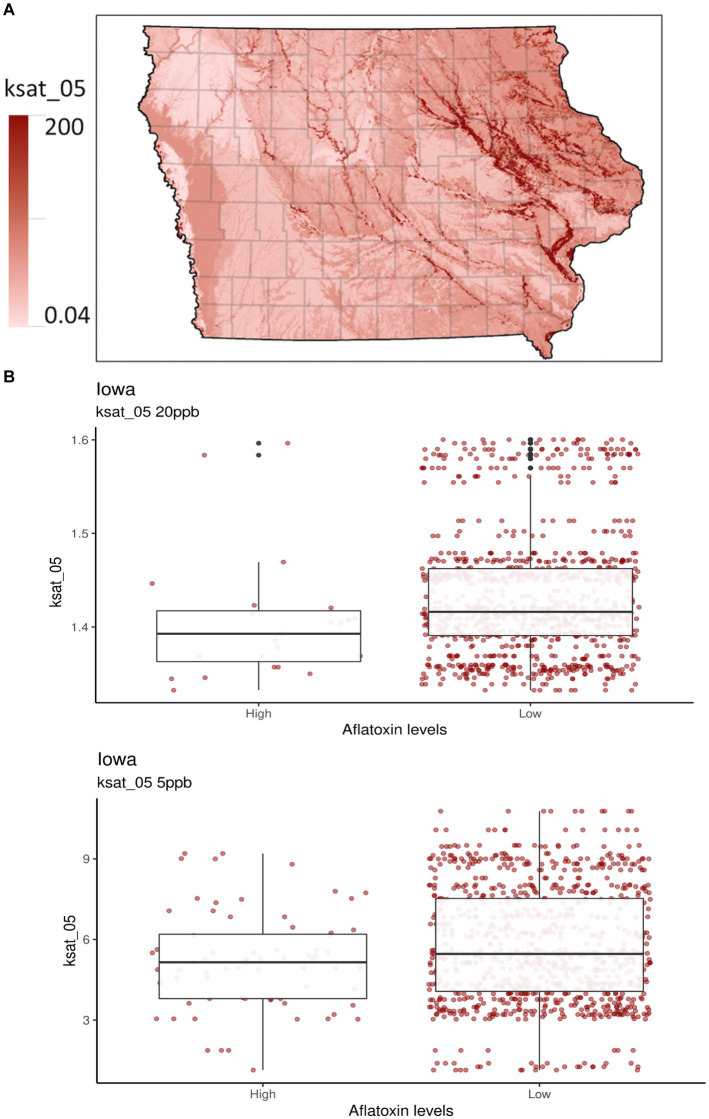
The GBM model had an overall accuracy of 96.77% for AFL with a balanced accuracy of 50.00% for a 20-ppb risk threshold, whereas GBM had an overall accuracy of 90.32% with a balanced accuracy of 64.88% for a 5-ppb threshold. The GBM model had a low power to detect high AFL contamination events, resulting in a low sensitivity rate. Analyses for AFL showed satellite-acquired vegetative index during August significantly improved the prediction of corn contamination at the end of the growing season for both risk thresholds. Prediction of high AFL contamination levels was linked to aflatoxin risk indices (ARI) in May. However, ARI in July was an influential factor for the 5-ppb threshold but not for the 20-ppb threshold. Similarly, latitude was an influential factor for the 20-ppb threshold but not the 5-ppb threshold. Furthermore, soil-saturated hydraulic conductivity (Ksat) influenced both risk thresholds.
Developing these AFL prediction models is practical and implementable in commodity grain handling environments to achieve the goal of preventative rather than reactive mitigations. Finding predictors that influence AFL risk annually is an important cost-effective risk tool and, therefore, is a high priority to ensure hazard management and optimal grain utilization to maximize the utility of the nation's corn crop.
黄曲霉毒素(AFL)是丝状真菌产生的次生代谢产物,会污染玉米,通过产毒和致癌作用对人类和牲畜构成重大健康和安全危害。玉米被广泛用作食品、饲料、燃料和出口市场的重要商品;因此,减轻黄曲霉毒素污染对于确保美国和世界其他地区的食品和饲料安全至关重要。在本案例研究中,开发了一个以爱荷华州为中心的模型,利用美国最大玉米生产州的历史玉米污染、气象、卫星和土壤特性数据来预测黄曲霉毒素污染。
我们使用梯度提升机(GBM)学习和特征工程评估了爱荷华州玉米中黄曲霉毒素预测的性能,针对高污染事件的两个黄曲霉毒素风险阈值:20 ppb和5 ppb。在2010年、2011年、2012年和2021年(n = 630)采用了90%-10%的训练与测试比例,并使用2020年(n = 376)进行独立验证。
对于20 ppb的风险阈值,GBM模型对黄曲霉毒素的总体准确率为96.77%,平衡准确率为50.00%;而对于5 ppb的阈值,GBM的总体准确率为90.32%,平衡准确率为64.88%。GBM模型检测高黄曲霉毒素污染事件的能力较低,导致灵敏度较低。对黄曲霉毒素的分析表明,8月期间卫星获取的植被指数在两个风险阈值下均显著提高了生长季末玉米污染的预测。高黄曲霉毒素污染水平的预测与5月的黄曲霉毒素风险指数(ARI)相关。然而,7月的ARI是5 ppb阈值的影响因素,但不是20 ppb阈值的影响因素。同样,纬度是20 ppb阈值的影响因素,但不是5 ppb阈值的影响因素。此外,土壤饱和导水率(Ksat)对两个风险阈值均有影响。
开发这些黄曲霉毒素预测模型在商品谷物处理环境中是切实可行的,以实现预防性而非反应性缓解的目标。找到每年影响黄曲霉毒素风险的预测因子是一种重要的具有成本效益的风险工具,因此,这是确保危害管理和优化谷物利用以最大化美国玉米作物效用的高度优先事项。