Liu Ningjing, Liu Cheng, Dudaš Tatjana N, Loc Marta Č, Bagi Ferenc F, van der Fels-Klerx H J
Wageningen Food Safety Research, Wageningen, Netherlands.
Faculty of Agriculture, University of Novi Sad, Novi Sad, Serbia.
Front Microbiol. 2021 Apr 13;12:643604. doi: 10.3389/fmicb.2021.643604. eCollection 2021.
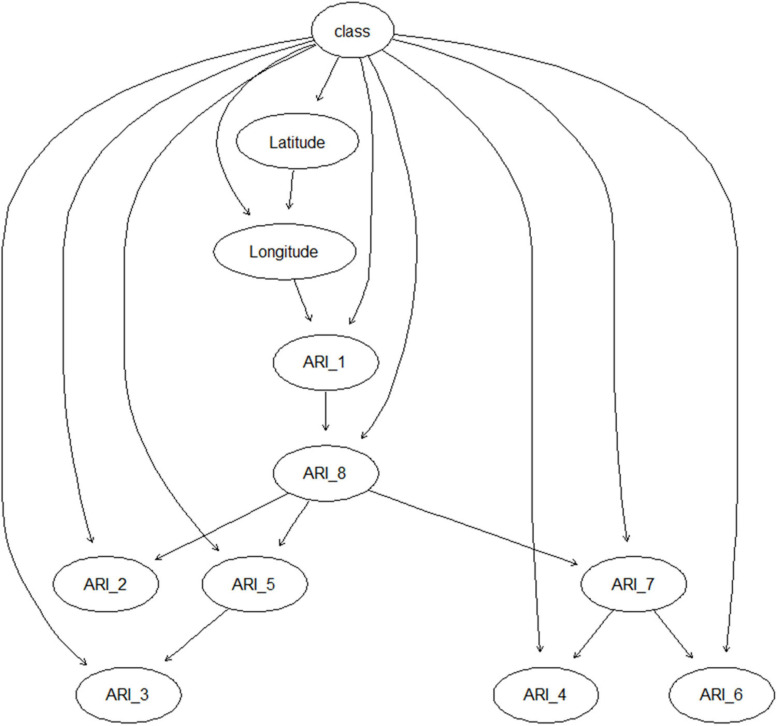
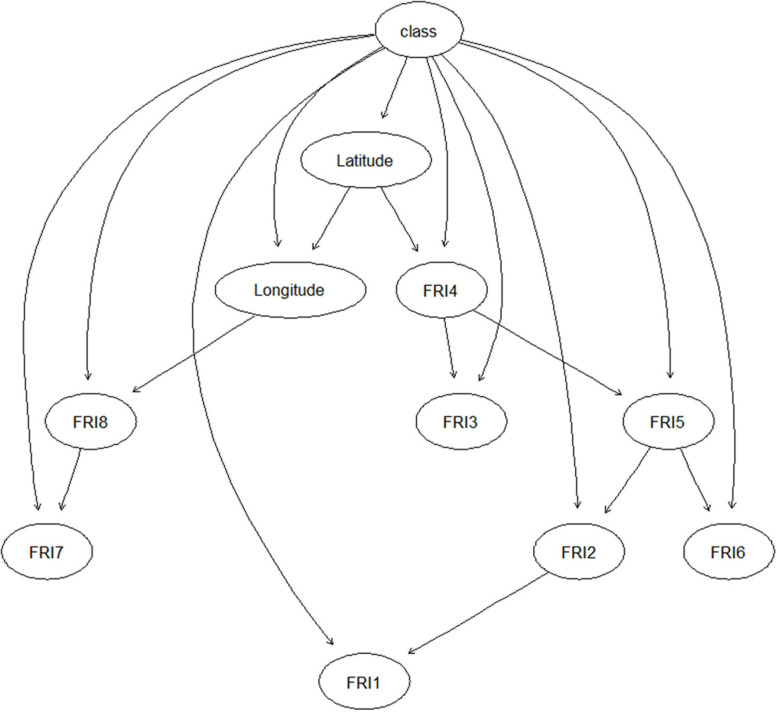
Contamination of maize with aflatoxins and fumonisins is one of the major food safety concerns worldwide. Knowing the contamination in advance can help to reduce food safety risks and related health issues and economic losses. The current study aimed to develop forecasting models for the contamination of maize grown in Serbia with aflatoxins and fumonisins. An integrated modeling approach was used, linking mechanistic modeling with artificial intelligence, in particular Bayesian network (BN) modeling. Two of such combined models, i.e., the prediction model for aflatoxins (PREMA) and for fumonisins (PREFUM) in maize, were developed. Data used for developing PREMA were from 867 maize samples, collected in Serbia during the period from 2012 to 2018, of which 190 were also used for developing PREFUM. Both datasets were split randomly in a model training set and a model validation set. With corresponding geographical and meteorological data, the so-called risk indices for total aflatoxins and total fumonisins were calculated using existing mechanistic models. Subsequently, these risk indices were used as input variables for developing the BN models, together with the longitudes and latitudes of the sites at which the samples were collected and related weather data. PREMA and PREFUM were internally and externally validated, resulting in a prediction accuracy of PREMA of, respectively, 83 and 70%, and of PREFUM of 76% and 80%. The capability of PREMA and PREFUM for predicting aflatoxins and fumonisins contamination using data from the early maize growth stages only was explored as well, and promising results were obtained. The integrated approach combining two different modeling techniques, as developed in the current study, was able to overcome the obstacles of unbalanced data and deficiency of the datasets, which are often seen in historical observational data from the food safety domain. The models provide predictions for mycotoxin contamination at the field level; this information can assist stakeholders of the maize supply chain, including farmers, buyers/collectors, and food safety authorities, to take timely decisions for improved mycotoxin control. The developed models can be further validated by applying them into practice, and they can be extended to other European maize growing areas.
玉米被黄曲霉毒素和伏马毒素污染是全球主要的食品安全问题之一。提前了解污染情况有助于降低食品安全风险以及相关的健康问题和经济损失。当前研究旨在开发塞尔维亚种植玉米中黄曲霉毒素和伏马毒素污染的预测模型。采用了一种综合建模方法,将机理建模与人工智能,特别是贝叶斯网络(BN)建模相结合。开发了两个这样的组合模型,即玉米中黄曲霉毒素的预测模型(PREMA)和伏马毒素的预测模型(PREFUM)。用于开发PREMA的数据来自2012年至2018年期间在塞尔维亚采集的867个玉米样本,其中190个样本也用于开发PREFUM。两个数据集都随机分为模型训练集和模型验证集。利用相应的地理和气象数据,使用现有机理模型计算总黄曲霉毒素和总伏马毒素的所谓风险指数。随后,这些风险指数与样本采集地点的经度和纬度以及相关气象数据一起用作开发BN模型的输入变量。对PREMA和PREFUM进行了内部和外部验证,结果PREMA的预测准确率分别为83%和70%,PREFUM的预测准确率为76%和80%。还探索了PREMA和PREFUM仅使用玉米生长早期阶段的数据预测黄曲霉毒素和伏马毒素污染的能力,并获得了有前景的结果。本研究中开发的结合两种不同建模技术 的综合方法能够克服数据不平衡和数据集不足的障碍,这些障碍在食品安全领域的历史观测数据中经常出现。这些模型可在田间层面预测霉菌毒素污染;该信息可协助玉米供应链的利益相关者,包括农民、买家/收购商和食品安全当局,及时做出决策以加强霉菌毒素控制。所开发的模型可通过实际应用进一步验证,并可扩展到其他欧洲玉米种植区。