Exner Anna, Kampa Miriam, Finke Johannes B, Stalder Tobias, Klapperich Holger, Hassenzahl Marc, Kleinke Kristian, Klucken Tim
Department of Clinical Psychology and Psychotherapy, University of Siegen, Siegen, Germany.
Bender Institute of Neuroimaging, Justus Liebig University Giessen, Giessen, Germany.
Front Psychol. 2023 Sep 1;14:1196481. doi: 10.3389/fpsyg.2023.1196481. eCollection 2023.
Previous research suggested differential stress reactivity depending on individuals' coping style, e.g., as classified by the model of coping modes. Specifically, stronger physiological reactivity and weaker subjective stress ratings were found for repressors than for sensitizers. However, it remains to be investigated (i) whether these findings, which are largely based on social stress induction protocols, also generalize to other stressors, (ii) whether repressors vs. sensitizers also exhibit differential stress recovery following the application of a relaxation method, and (iii) which stress reactivity and recovery patterns are seen for the two remaining coping styles, i.e., fluctuating, and non-defensive copers. The current study thus examines stress reactivity in physiology and subjective ratings to a non-social stressor and the subsequent ability to relax for the four coping groups of repressors, sensitizers, fluctuating, and non-defensive copers.
A total of 96 healthy participants took part in a stress induction (Mannheim Multicomponent Stress Test) and a subsequent relaxation intervention. Subjective ratings of stress and relaxation, heart rate (HR), heart rate variability (HRV), and blood pressure were assessed during the experiment. HR and blood pressure are markers of the sympathetic stress response that can be regulated by relaxation, while HRV should increase with relaxation. To investigate long-term relaxation effects, subjective ratings were also assessed on the evening of testing.
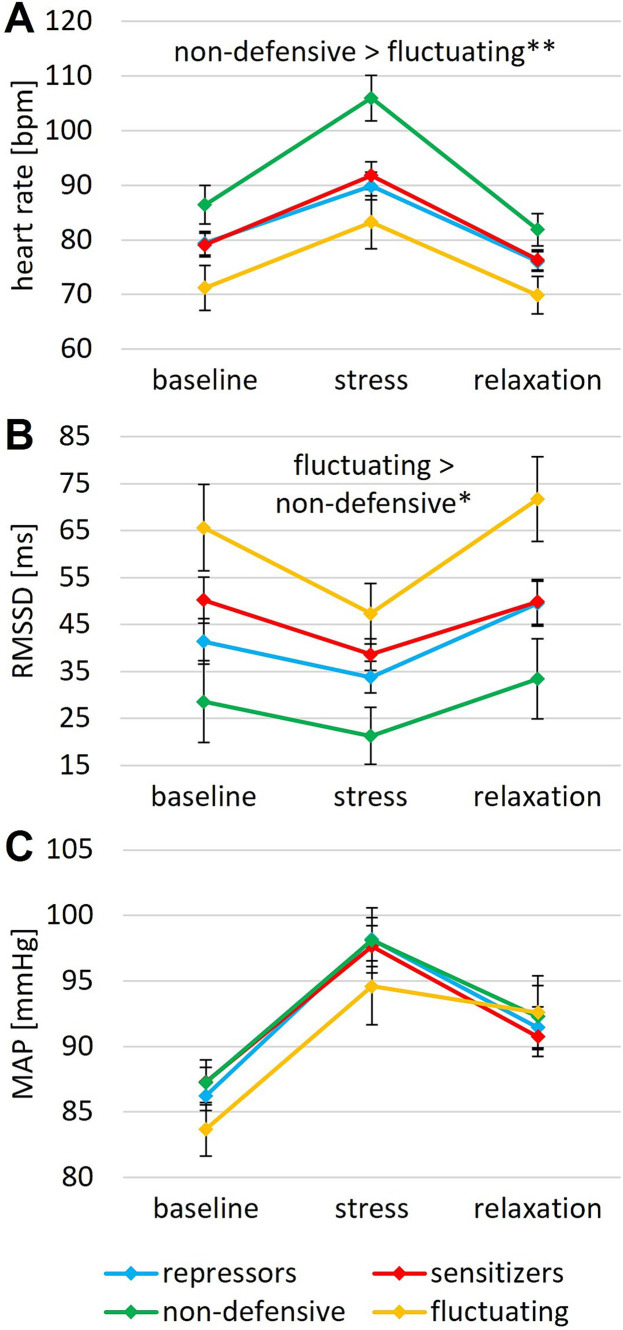
Despite successful stress induction, no differential responses (baseline to stress, stress to relaxation) were observed between the different coping groups on any of the measures. In contrast, a strong baseline effect was observed that persisted throughout the experiment: In general, fluctuating copers showed lower HR and higher HRV than non-defensive copers, whereas repressors reported lower subjective stress levels and higher levels of relaxation during all study phases. No differences in subjective ratings were observed in the evening of testing.
Contrary to previous research, no differential stress reactivity pattern was observed between coping groups, which could be due to the non-social type of stressor employed in this study. The novel finding of physiological baseline differences between fluctuating and non-defensive individuals is of interest and should be further investigated in other stressor types in future research.
先前的研究表明,根据个体的应对方式,如通过应对模式模型分类,应激反应存在差异。具体而言,与敏感者相比,压抑者表现出更强的生理反应性和更低的主观应激评分。然而,仍有待研究:(i)这些主要基于社会应激诱导方案的研究结果是否也适用于其他应激源;(ii)压抑者与敏感者在应用放松方法后是否也表现出不同的应激恢复情况;(iii)其余两种应对方式,即波动型和非防御型应对者,其应激反应性和恢复模式是怎样的。因此,本研究考察了压抑者、敏感者、波动型和非防御型应对者这四类应对方式的个体,对非社会应激源的生理和主观应激反应性,以及随后的放松能力。
共有96名健康参与者参加了一次应激诱导(曼海姆多成分应激测试)和随后的放松干预。在实验过程中评估了应激和放松的主观评分、心率(HR)、心率变异性(HRV)和血压。心率和血压是交感神经应激反应的指标,可通过放松进行调节,而心率变异性应随着放松而增加。为了研究长期放松效果,在测试当晚也评估了主观评分。
尽管成功诱导了应激,但在任何测量指标上,不同应对组之间均未观察到差异反应(从基线到应激、从应激到放松)。相反,观察到一个贯穿整个实验的强烈基线效应:总体而言,波动型应对者的心率低于非防御型应对者,心率变异性高于非防御型应对者,而压抑者在所有研究阶段报告的主观应激水平较低,放松水平较高。在测试当晚,主观评分未观察到差异。
与先前的研究相反,应对组之间未观察到差异应激反应模式,这可能是由于本研究中使用的非社会类型的应激源。波动型和非防御型个体之间生理基线差异这一新发现很有趣,应在未来研究中对其他应激源类型进行进一步研究。