Cognitive Neurophysiology, Department of Child and Adolescent Psychiatry, Faculty of Medicine of the TU Dresden, Dresden, Germany.
University Neuropsychology Center, Faculty of Medicine, TU Dresden, Dresden, Germany.
Hum Brain Mapp. 2023 Dec 1;44(17):5936-5952. doi: 10.1002/hbm.26486. Epub 2023 Sep 20.
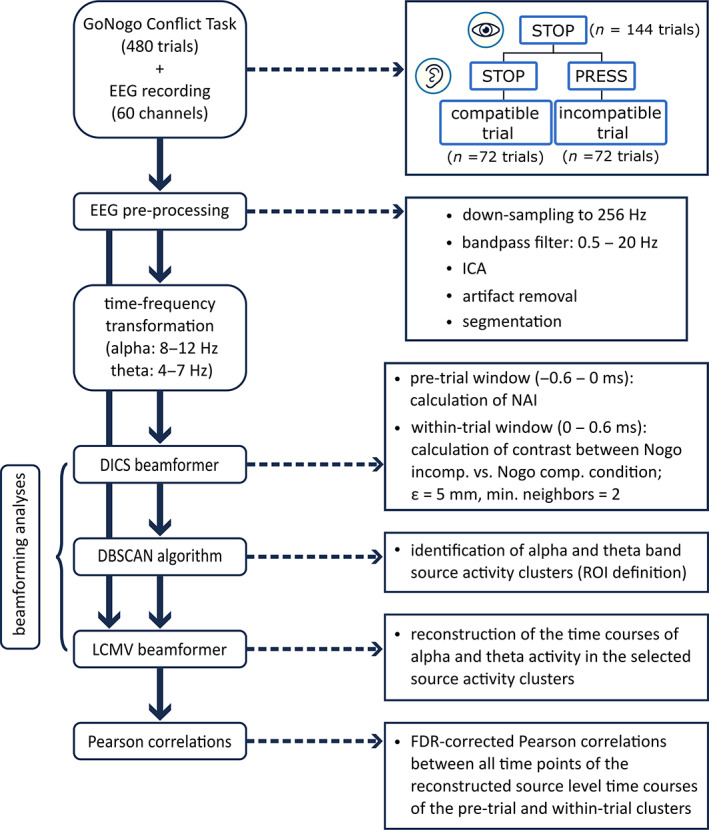
Response inhibition is an important instance of cognitive control and can be complicated by perceptual conflict. The neurophysiological mechanisms underlying these processes are still not understood. Especially the relationship between neural processes directly preceding cognitive control (proactive control) and processes underlying cognitive control (reactive control) has not been examined although there should be close links. In the current study, we investigate these aspects in a sample of N = 50 healthy adults. Time-frequency and beamforming approaches were applied to analyze the interrelation of brain states before (pre-trial) and during (within-trial) cognitive control. The behavioral data replicate a perceptual conflict-dependent modulation of response inhibition. During the pre-trial period, insular, inferior frontal, superior temporal, and precentral alpha activity was positively correlated with theta activity in the same regions and the superior frontal gyrus. Additionally, participants with a stronger pre-trial alpha activity in the primary motor cortex showed a stronger (within-trial) conflict effect in the theta band in the primary motor cortex. This theta conflict effect was further related to a stronger theta conflict effect in the midcingulate cortex until the end of the trial. The temporal cascade of these processes suggests that successful proactive preparation (anticipatory information gating) entails a stronger reactive processing of the conflicting stimulus information likely resulting in a realization of the need to adapt the current action plan. The results indicate that theta and alpha band activity share and transfer aspects of information when it comes to the interrelationship between proactive and reactive control during conflict-modulated motor inhibition.
反应抑制是认知控制的一个重要实例,它可能会受到知觉冲突的影响。但是,这些过程的神经生理机制仍未被理解。特别是在直接影响认知控制的神经过程(前摄控制)和认知控制本身的神经过程(反应控制)之间的关系,尽管它们之间应该有密切的联系,但尚未被研究过。在当前的研究中,我们在 50 名健康成年人的样本中研究了这些方面。时频和波束形成方法被应用于分析认知控制之前(前测)和期间(在测)的脑状态之间的关系。行为数据复制了依赖知觉冲突的反应抑制的调制。在前测期间,岛叶、额下回、颞上回和中央前回的α活动与同一区域和额上回的θ活动呈正相关。此外,初级运动皮层前测α活动较强的参与者,在初级运动皮层的θ频段中表现出更强的(在测)冲突效应。这种θ冲突效应进一步与中扣带回皮质中的更强的θ冲突效应相关,直到试验结束。这些过程的时间级联表明,成功的前摄性准备(预期性信息门控)需要更强的反应性处理冲突刺激信息,这可能导致需要适应当前行动计划的认识。结果表明,在冲突调节运动抑制期间,当涉及前摄性和反应性控制之间的相互关系时,θ 和α 频段活动共享和传递信息。