Department of Physical Education & Sport Sciences, Faculty of Humanities, Tarbiat Modares University, Tehran, 14117-13116, Iran.
Institute for Health and Sport, Victoria University, Melbourne, VIC, Australia.
BMC Cancer. 2023 Sep 20;23(1):889. doi: 10.1186/s12885-023-11391-3.
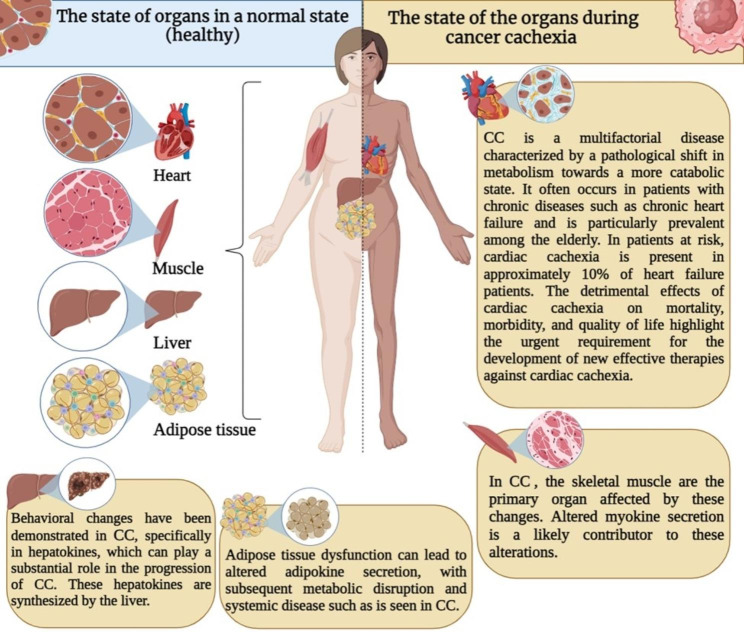
Exerkines are all peptides, metabolites, and nucleic acids released into the bloodstream during and after physical exercise. Exerkines liberated from skeletal muscle (myokines), the heart (cardiokines), liver (hepatokines), white adipose tissue (adipokines), brown adipose tissue (batokines), and neurons (neurokines) may benefit health and wellbeing. Cancer-related cachexia is a highly prevalent disorder characterized by weight loss with specific skeletal muscle and adipose tissue loss. Many studies have sought to provide exercise strategies for managing cachexia, focusing on musculoskeletal tissue changes. Therefore, understanding the responses of musculoskeletal and other tissue exerkines to acute and chronic exercise may provide novel insight and recommendations for physical training to counteract cancer-related cachexia.
For the purpose of conducting this study review, we made efforts to gather relevant studies and thoroughly discuss them to create a comprehensive overview. To achieve this, we conducted searches using appropriate keywords in various databases. Studies that were deemed irrelevant to the current research, not available in English, or lacking full-text access were excluded. Nevertheless, it is important to acknowledge the limited amount of research conducted in this specific field.
In order to obtain a comprehensive understanding of the findings, we prioritized human studies in order to obtain results that closely align with the scope of the present study. However, in instances where human studies were limited or additional analysis was required to draw more robust conclusions, we also incorporated animal studies. Finally, 295 studies, discussed in this review.
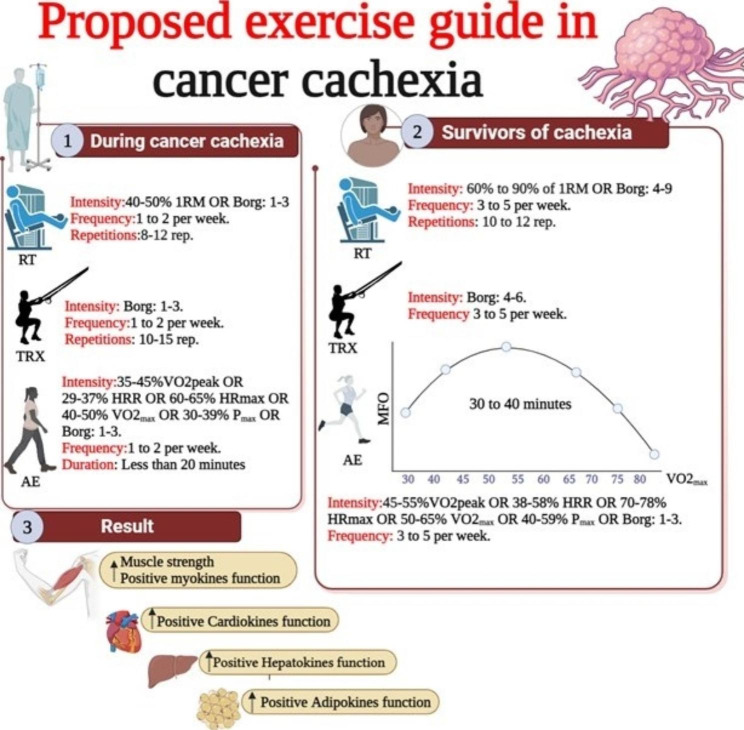
Our understanding of the underlying physiological mechanisms related to the significance of investigating exerkines in cancer cachexia is currently quite basic. Nonetheless, this demonstrated that resistance and aerobic exercise can contribute to the reduction and control of the disease in individuals with cancer cachexia, as well as in survivors, by inducing changes in exerkines.
细胞因子是指在运动期间和之后释放到血液中的所有肽、代谢物和核酸。从骨骼肌(肌因子)、心脏(心脏因子)、肝脏(肝因子)、白色脂肪组织(脂肪因子)、棕色脂肪组织(棕色脂肪因子)和神经元(神经因子)中释放的细胞因子可能有益于健康和幸福。与癌症相关的恶病质是一种高度普遍的疾病,其特征是体重减轻,伴有特定的骨骼肌和脂肪组织减少。许多研究都试图提供运动策略来管理恶病质,重点是肌肉骨骼组织的变化。因此,了解肌肉骨骼和其他组织细胞因子对急性和慢性运动的反应,可能为对抗与癌症相关的恶病质的身体训练提供新的见解和建议。
为了进行这项研究综述,我们努力收集相关研究,并进行了深入讨论,以创建一个全面的概述。为此,我们在各种数据库中使用适当的关键词进行了搜索。那些被认为与当前研究不相关、无法获得英文版本或无法获取全文的研究被排除在外。然而,必须承认,在这个特定领域进行的研究数量有限。
为了全面了解研究结果,我们优先考虑了人类研究,以获得与本研究范围密切相关的结果。然而,在人类研究有限或需要进一步分析以得出更有力的结论的情况下,我们也纳入了动物研究。最后,共讨论了 295 项研究。
我们对与癌症恶病质中调查细胞因子的重要性相关的潜在生理机制的理解目前还相当基础。尽管如此,这表明阻力和有氧运动可以通过诱导细胞因子的变化,有助于减少和控制癌症恶病质患者以及幸存者的疾病。