The Third Affiliated Hospital of Anhui Medical University, Hefei, 230061, China.
Bengbu Medical College, Bengbu, 233030, China.
BMC Pulm Med. 2023 Sep 20;23(1):355. doi: 10.1186/s12890-023-02649-4.
Community-acquired pneumonia (CAP) patients usually present with parapneumonic pleural effusion (PPE), which complicates the treatment of pneumonia. This study aims to investigate the clinical characteristics and risk factors of elderly CAP patients hospitalised with PPE.
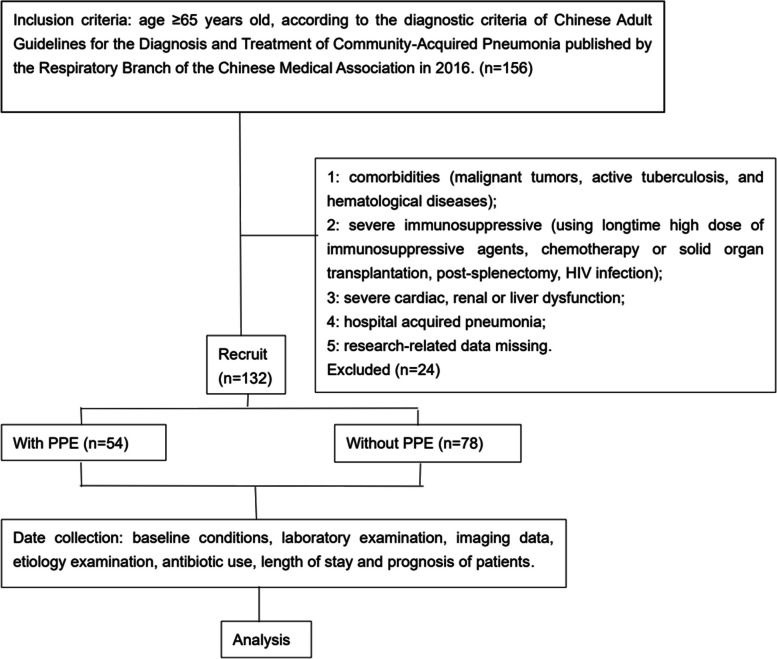
The clinical data of 132 elderly patients with CAP were retrospectively analysed. A total of 54 patients with PPE (PPE group) and 78 patients without PPE (NPPE group) were included in this study. Clinical data, laboratory examinations, treatments and other relevant indicators were collected. Univariate analysis and multivariate logistic regression analysis will be used to explore the possible risk factors for PPE.
The proportion of PPE in elderly patients with CAP was 40.9%. PPE patients were significantly more likely to be older, have comorbid neurological diseases, experience chest tightness, and have a lasting fever (P < 0.05). In contrast to NPPE patients, the total number of lymphocytes, serum albumin and blood sodium levels in the PPE group were significantly lower (P < 0.05). The blood D-dimer, C-reactive protein and CURB-65 score of PPE patients were significantly higher (P < 0.05) than those of NPPE patients. Multivariate logistic regression identified chest tightness (OR = 3.964, 95% CI: 1.254-12.537, P = 0.019), long duration of fever (OR = 1.108, 95%CI: 1.009-1.217, P = 0.03), low serum albumin (OR = 0.876, 95%CI: 0.790- 0.971, P = 0.012) or low blood sodium (OR = 0.896, 95%CI: 0.828-0.969, P = 0.006) as independently associated with the development of parapneumonic pleural effusion in the elderly.
This study has identified several clinical factors, such as chest tightness, long duration of fever, low serum albumin, and low blood sodium, as risk factors for the development of pleural effusion in elderly patients with CAP. Early identification and prompt management of these patients can prevent inappropriate treatment and reduce morbidity and mortality.
社区获得性肺炎(CAP)患者通常会出现类肺炎性胸腔积液(PPE),这会使肺炎的治疗复杂化。本研究旨在探讨老年 CAP 患者合并 PPE 的临床特征和危险因素。
回顾性分析 132 例老年 CAP 患者的临床资料。共纳入 54 例合并 PPE(PPE 组)和 78 例未合并 PPE(NPPE 组)的患者。收集临床资料、实验室检查、治疗等相关指标。采用单因素分析和多因素 logistic 回归分析探讨 PPE 的可能危险因素。
老年 CAP 患者中 PPE 的比例为 40.9%。PPE 患者年龄更大、合并神经系统疾病、有胸闷症状、持续发热的比例更高(P<0.05)。与 NPPE 患者相比,PPE 组患者的总淋巴细胞数、血清白蛋白和血钠水平明显更低(P<0.05)。PPE 患者的血 D-二聚体、C 反应蛋白和 CURB-65 评分明显更高(P<0.05)。多因素 logistic 回归分析显示,胸闷(OR=3.964,95%CI:1.254-12.537,P=0.019)、持续发热时间长(OR=1.108,95%CI:1.009-1.217,P=0.03)、血清白蛋白低(OR=0.876,95%CI:0.790-0.971,P=0.012)或血钠低(OR=0.896,95%CI:0.828-0.969,P=0.006)是老年 CAP 患者发生 PPE 的独立危险因素。
本研究发现胸闷、持续发热时间长、血清白蛋白低和血钠低等临床因素可能是老年 CAP 患者发生胸腔积液的危险因素。早期识别并及时处理这些患者可避免不恰当的治疗,并降低发病率和死亡率。