National Institute for Public Health and the Environment (RIVM), Bilthoven, the Netherlands.
Public Health Service of Amsterdam (GGD), Amsterdam, the Netherlands.
BMC Public Health. 2023 Sep 20;23(1):1829. doi: 10.1186/s12889-023-16725-1.
During the COVID-19 pandemic, social distancing measures were imposed to protect the population from exposure, especially older adults and people with frailty, who have the highest risk for severe outcomes. These restrictions greatly reduced contacts in the general population, but little was known about behaviour changes among older adults and people with frailty themselves. Our aim was to quantify how COVID-19 measures affected the contact behaviour of older adults and how this differed between older adults with and without frailty.
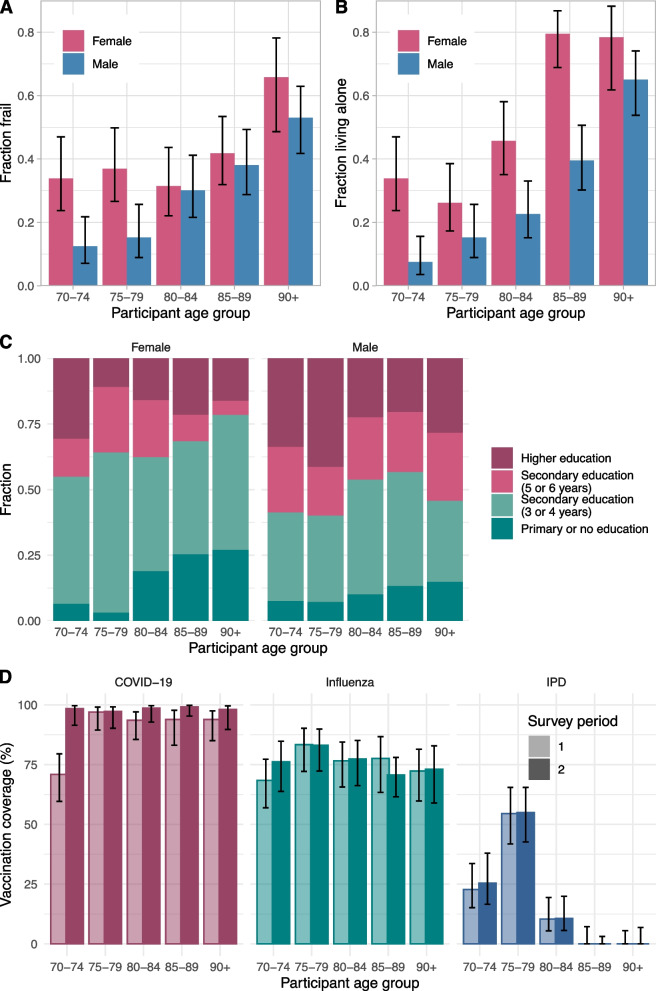
In 2021, a contact survey was carried out among people aged 70 years and older in the Netherlands. A random sample of persons per age group (70-74, 75-79, 80-84, 85-89, and 90 +) and gender was invited to participate, either during a period with stringent (April 2021) or moderate (October 2021) measures. Participants provided general information on themselves, including their frailty, and they reported characteristics of all persons with whom they had face-to-face contact on a given day over the course of a full week.
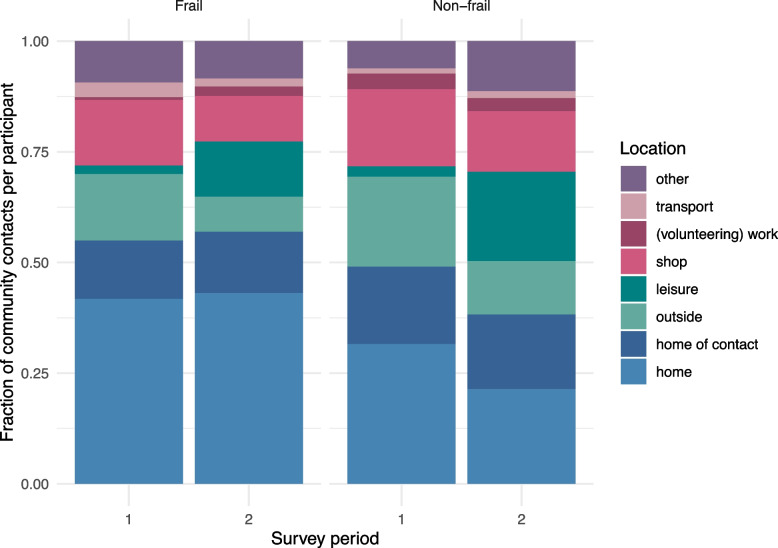
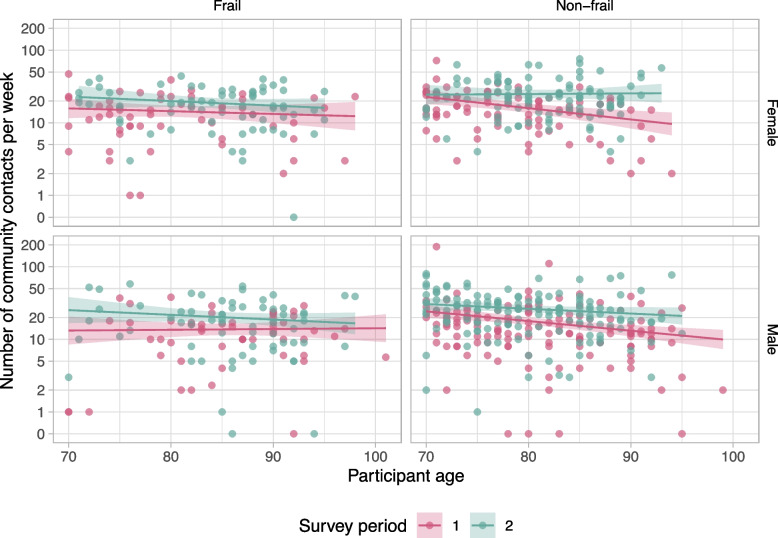
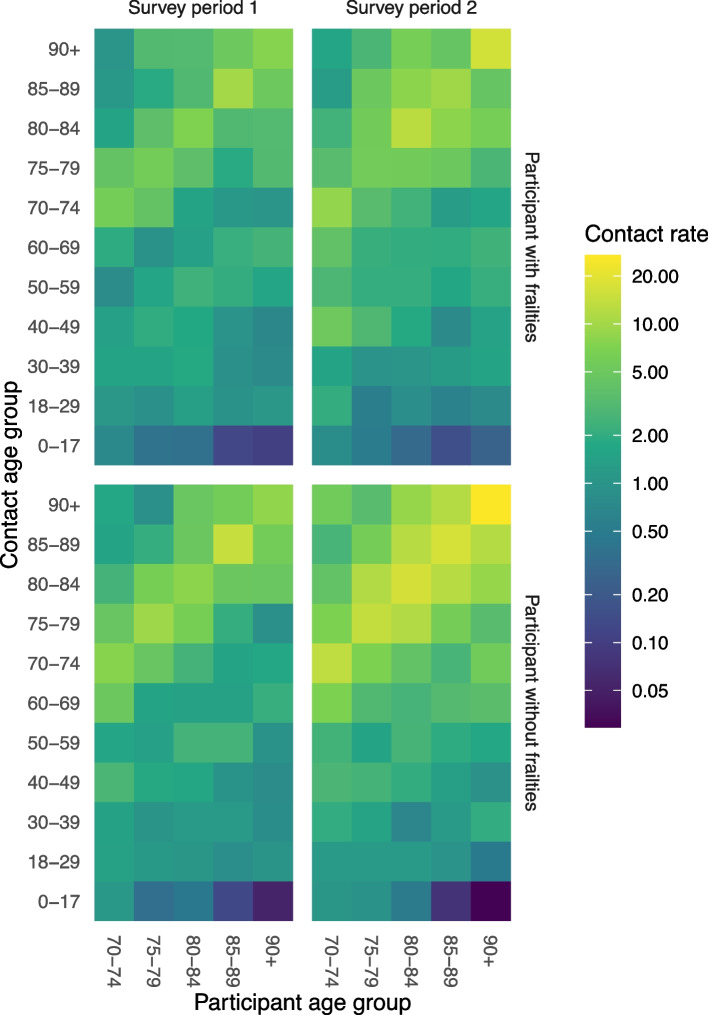
In total, 720 community-dwelling older adults were included (overall response rate of 15%), who reported 16,505 contacts. During the survey period with moderate measures, participants without frailty had significantly more contacts outside their household than participants with frailty. Especially for females, frailty was a more informative predictor of the number of contacts than age. During the survey period with stringent measures, participants with and without frailty had significantly lower numbers of contacts compared to the survey period with moderate measures. The reduction of the number of contacts was largest for the eldest participants without frailty. As they interact mostly with adults of a similar high age who are likely frail, this reduction of the number of contacts indirectly protects older adults with frailty from SARS-CoV-2 exposure.
The results of this study reveal that social distancing measures during the COVID-19 pandemic differentially affected the contact patterns of older adults with and without frailty. The reduction of contacts may have led to the direct protection of older adults in general but also to the indirect protection of older adults with frailty.
在 COVID-19 大流行期间,实施了社交距离措施以保护人群免受感染,尤其是老年人和体弱人群,他们面临严重后果的风险最高。这些限制大大减少了普通人群中的接触,但对于老年人和体弱人群自身的行为变化知之甚少。我们的目的是量化 COVID-19 措施如何影响老年人的接触行为,以及这种影响在体弱老年人和非体弱老年人之间有何不同。
2021 年,在荷兰对 70 岁及以上人群进行了一项接触调查。按年龄组(70-74 岁、75-79 岁、80-84 岁、85-89 岁和 90+岁)和性别对人员进行随机抽样邀请参加调查,调查时间分别为严格措施期(2021 年 4 月)和适度措施期(2021 年 10 月)。参与者提供了有关自身的一般信息,包括其虚弱状况,并报告了在给定一周的一整天内与所有面对面接触者的特征。
共纳入 720 名居住在社区的老年人(总体回应率为 15%),他们报告了 16505 次接触。在适度措施调查期间,无虚弱状况的参与者与有虚弱状况的参与者相比,家庭以外的接触明显更多。特别是对于女性,虚弱状况比年龄更能预测接触人数。在严格措施调查期间,与适度措施调查期间相比,有和无虚弱状况的参与者的接触人数明显减少。无虚弱状况的最年长参与者的接触人数减少幅度最大。由于他们主要与年龄相仿的成年人互动,这些成年人可能很虚弱,因此接触人数的减少间接保护了体弱的老年人免受 SARS-CoV-2 感染。
本研究结果表明,COVID-19 大流行期间的社交距离措施对有和无虚弱状况的老年人的接触模式产生了不同的影响。接触人数的减少可能直接保护了一般老年人,也间接保护了体弱的老年人。