Faculty of Medicine and Health Sciences, Department of Primary Health Care Sciences, Occupational Therapy Programme, Rehabilitation Sciences Unit, University of Zimbabwe, Harare, Zimbabwe.
Faculty of Medicine and Health Sciences, Division of Occupational Therapy, Stellenbosch University, Cape Town, Western Cape, South Africa.
PLoS One. 2023 Sep 21;18(9):e0291869. doi: 10.1371/journal.pone.0291869. eCollection 2023.
To review the evidence of supported employment interventions in low-to-middle income countries, documents their impact for persons with mental disorders in the open labour market and well as support decision making for its wider implementation in the workplace.
The scoping review is conducted following guidelines in the Arksey and O'Malley (2005) Framework.
Eleven databases which are PubMed, Scopus, Academic Search Premier, the Cumulative Index to Nursing and Allied Health Literature, Africa-Wide Information, Humanities International Complete, Web of Science, PsychInfo, SocINDEX, Open Grey and Sabinet were searched for articles published between January 2006 and January 2022. Both peer-reviewed articles and grey literature were eligible if they were on supported employment interventions in low-to-middle income countries. Only articles published in English were included.
Articles were screened at title, abstract and full article levels by two independent teams with the use of Rayyan software. Deductive thematic analysis was used to synthesize evidence on the supported employment interventions implemented in LMICs, capturing evidence of their outcomes for persons with mental disabilities securing competitive work.
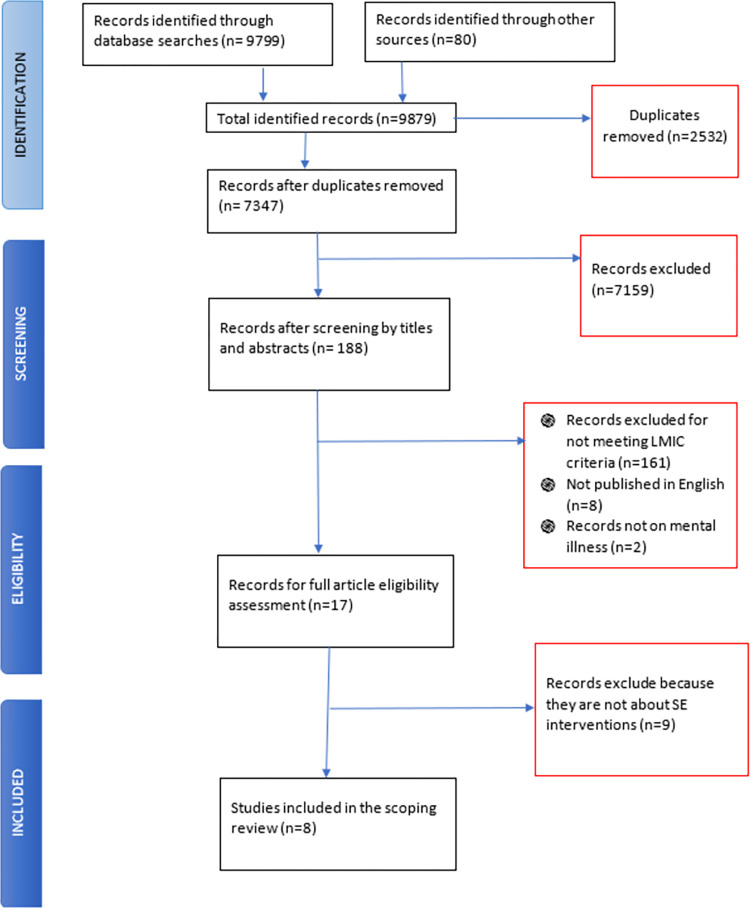
The search yielded 7347 records and after screening by title and abstract, 188 studies were eligible for full article screening. Eight studies were included in this scoping review. Thematic descriptions of the findings were based on the availability of supported employment interventions within the context, the type of supported employment interventions as well as mental health and vocational outcomes in the workplace.
There is limited evidence of supported employment interventions in low-to-middle income countries despite the promising potential it has as an intervention to address mental health problems in the workplace and facilitate work participation by persons with mental disabilities.
综述中低收入国家支持性就业干预措施的证据,证明其对开放式劳动力市场精神障碍患者的影响,并为在工作场所更广泛地实施该措施提供决策支持。
本研究采用阿斯基和奥马利(2005 年)框架中的范围综述指南进行。
在 2006 年 1 月至 2022 年 1 月期间,从 11 个数据库(PubMed、Scopus、Academic Search Premier、护理学及相关健康文献累积索引、非洲广泛信息、人文国际完整、Web of Science、PsychInfo、社会索引、Open Grey 和 Sabinet)中搜索发表的文章。只要是关于中低收入国家支持性就业干预措施的同行评审文章和灰色文献,均符合入选条件。只有英文发表的文章才被纳入。
使用 Rayyan 软件,由两个独立的团队在标题、摘要和全文层面筛选文章。采用演绎主题分析综合中低收入国家实施的支持性就业干预措施的证据,捕捉其为精神残疾人士获得竞争性工作的结果的证据。
搜索共产生了 7347 条记录,经过标题和摘要筛选后,有 188 项研究符合全文筛选标准。本范围综述共纳入了 8 项研究。根据支持性就业干预措施在背景中的可用性、支持性就业干预措施的类型以及精神健康和工作场所的职业结果,对研究结果进行了主题描述。
尽管支持性就业干预措施作为一种解决工作场所精神健康问题和促进精神残疾人士工作参与的干预措施具有很大的潜力,但在中低收入国家,其证据有限。