Department of Epidemiology and Biostatistics, School of Public Health, Tianjin Medical University, Tianjin, China.
Department of Epidemiology, College of Preventive Medicine, The Army Medical University (Third Military Medical University), Chongqing, China.
J Alzheimers Dis. 2023;96(1):125-134. doi: 10.3233/JAD-230483.
The association of anemia with cognitive function and dementia remains unclear.
We aimed to investigate the association of anemia with cognitive function and dementia risk and to explore the role of inflammation in these associations.
Within the UK Biobank, 207,203 dementia-free participants aged 60+ were followed for up to 16 years. Hemoglobin (HGB) and C-creative protein (CRP) were measured from blood samples taken at baseline. Anemia was defined as HGB <13 g/dL for males and <12 g/dL for females. Inflammation was categorized as low or high according to the median CRP level (1.50 mg/L). A subset of 18,211 participants underwent cognitive assessments (including global and domain-specific cognitive). Data were analyzed using linear mixed-effects model, Cox regression, and Laplace regression.
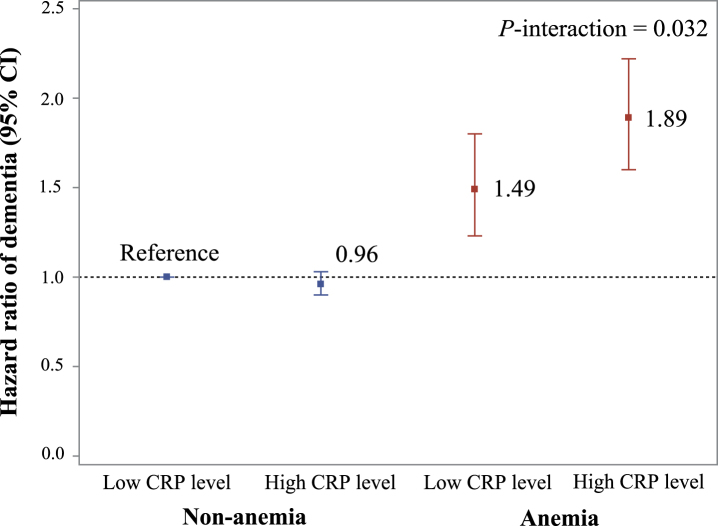
Anemia was associated with faster declines in global cognition (β= -0.08, 95% confidence interval [CI]: -0.14, -0.01) and processing speed (β= -0.10, 95% CI: -0.19, -0.01). During the follow-up of 9.76 years (interquartile range 7.55 to 11.39), 6,272 developed dementia. The hazard ratio of dementia was 1.57 (95% CI: 1.38, 1.78) for people with anemia, and anemia accelerated dementia onset by 1.53 (95% CI: 1.08, 1.97) years. The risk of dementia tended to be higher in people with both anemia and high CRP (1.89, 95% CI: 1.60, 2.22). There was a statistically significant interaction between anemia and CRP on dementia risk (p-interaction = 0.032).
Anemia is associated with cognitive decline (specifically for processing speed) and increased risk of dementia, especially in people with high inflammation.
贫血与认知功能和痴呆的关系仍不清楚。
我们旨在研究贫血与认知功能和痴呆风险的关系,并探讨炎症在这些关系中的作用。
在英国生物银行中,对 207203 名无痴呆症的 60 岁以上参与者进行了长达 16 年的随访。在基线时采集血样测量血红蛋白(HGB)和 C-反应蛋白(CRP)。男性贫血定义为 HGB<13g/dL,女性贫血定义为 HGB<12g/dL。根据 CRP 中位数(1.50mg/L)将炎症分为低或高两类。18211 名参与者的认知评估(包括整体和特定领域认知)的一个子集。使用线性混合效应模型、Cox 回归和拉普拉斯回归分析数据。
贫血与整体认知(β=-0.08,95%置信区间[CI]:-0.14,-0.01)和处理速度(β=-0.10,95% CI:-0.19,-0.01)的下降速度更快有关。在 9.76 年(四分位距 7.55 至 11.39)的随访期间,有 6272 人患上痴呆症。贫血患者痴呆症的风险比为 1.57(95% CI:1.38,1.78),贫血使痴呆症的发病提前了 1.53 年(95% CI:1.08,1.97)。在同时患有贫血和高 CRP 的人群中,痴呆症的风险更高(1.89,95% CI:1.60,2.22)。贫血和 CRP 对痴呆症风险的交互作用具有统计学意义(p 交互=0.032)。
贫血与认知能力下降(特别是处理速度)和痴呆风险增加有关,尤其是在炎症水平较高的人群中。