Taylor Euan W, Ugbolue U Chris, Gao Yang, Gu Yaodong, Baker Julien S, Dutheil Frédéric
Faculty of Sports Science, Ningbo University, Ningbo, Zhejiang Province, China.
School of Health and Life Sciences, Institute for Clinical Exercise & Health Science, University of the West of Scotland, South Lanarkshire, United Kingdom.
Arch Rehabil Res Clin Transl. 2023 Jul 14;5(3):100280. doi: 10.1016/j.arrct.2023.100280. eCollection 2023 Sep.
To investigate the differences between erector spinae muscle activation in healthy individuals and patients with Chronic Lower Back Pain (CLBP) by conducting (a) systematic review and (b) meta-analysis.
PubMed, ScienceDirect, SPORTDiscus, and Google Scholar were used to conduct the searches, which included studies up to the 31st of March 2023 with no start date specified.
Any study otherwise meeting eligibility criteria was included if it reported either (1) a standard mean difference effect size; or (2) the means, SDs, and sample sizes for both the patient group and the comparator group.
A total of 7 case control trials were used for the systematic review and meta-analysis.
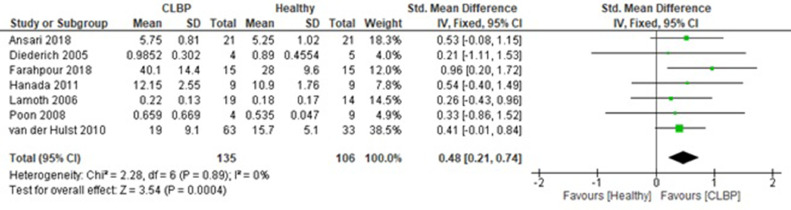
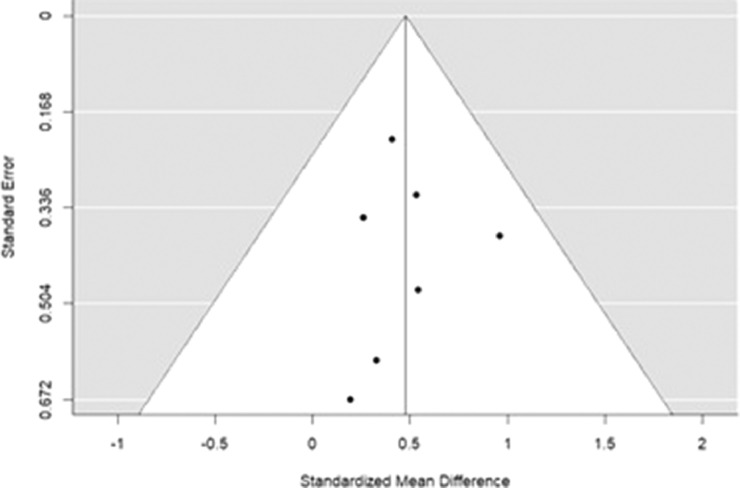
The systematic review and meta-analysis revealed that total standardized mean difference in erector spinae muscle activation between healthy individuals vs patients with CLBP expressed in % maximum voluntary isometric contraction was 0.48 (95% confidence interval=0.21-0.74; <.001) with the heterogeneity being I=0% (=.890). The electromyography (EMG) outputs showed significant differences in activation levels between the healthy and CLBP cohorts (<.001).
A small effect size was found in the meta-analysis. The muscle activation levels of the erector spinae during forward propulsion were higher in CLBP individuals compared with healthy cohorts. The findings provide more clarity about the muscles that were the focus of previous research, what procedures were used to evaluate muscular contributions and what speeds the participants were moving at during the test sessions. Given the limited methodological quality of the included studies, the findings should be interpreted with caution. Future research should evaluate the effect of other factors such as walking distance and any changes in walking surfaces and gradients (ie, non-flat surfaces).
通过进行(a)系统评价和(b)荟萃分析,研究健康个体与慢性下腰痛(CLBP)患者竖脊肌激活情况的差异。
使用PubMed、ScienceDirect、SPORTDiscus和谷歌学术进行检索,检索范围包括截至2023年3月31日且未指定开始日期的研究。
任何符合纳入标准的研究,若报告了以下内容之一则纳入:(1)标准平均差效应量;或(2)患者组和对照组的均值、标准差及样本量。
共7项病例对照试验用于系统评价和荟萃分析。
系统评价和荟萃分析显示,以最大自主等长收缩百分比表示的健康个体与CLBP患者之间竖脊肌激活的总标准化平均差为0.48(95%置信区间=0.21 - 0.74;P<.001),异质性I=0%(P=.890)。肌电图(EMG)输出显示健康组与CLBP组在激活水平上存在显著差异(P<.001)。
荟萃分析发现效应量较小。与健康队列相比,CLBP个体在向前推进过程中竖脊肌的肌肉激活水平更高。这些发现为先前研究的重点肌肉、用于评估肌肉贡献的程序以及测试过程中参与者的运动速度提供了更清晰的信息。鉴于纳入研究的方法学质量有限,对这些发现应谨慎解读。未来研究应评估其他因素的影响,如步行距离以及步行表面和坡度的任何变化(即非平坦表面)。