Liu Silin, Jiang Zhihui, Zhao Jing, Li Zhensheng, Li Ruixin, Qiu Yunyi, Peng Hua
Department of Otolaryngology Head and Neck Surgery, General Hospital of Southern Theater Command, Guangzhou, China.
The First School of Clinical Medicine, Southern Medical University, Guangzhou, China.
Front Aging Neurosci. 2023 Sep 7;15:1249512. doi: 10.3389/fnagi.2023.1249512. eCollection 2023.
There are discrepancies of olfactory impairment between Alzheimer's disease (AD) and other neurodegenerative disorders. Olfactory deficits may be a potential marker for early and differential diagnosis of AD. We aimed to assess olfactory functions in patients with AD and other neurodegenerative disorders, to further evaluate the smell tests using subgroup analysis, and to explore moderating factors affecting olfactory performance.
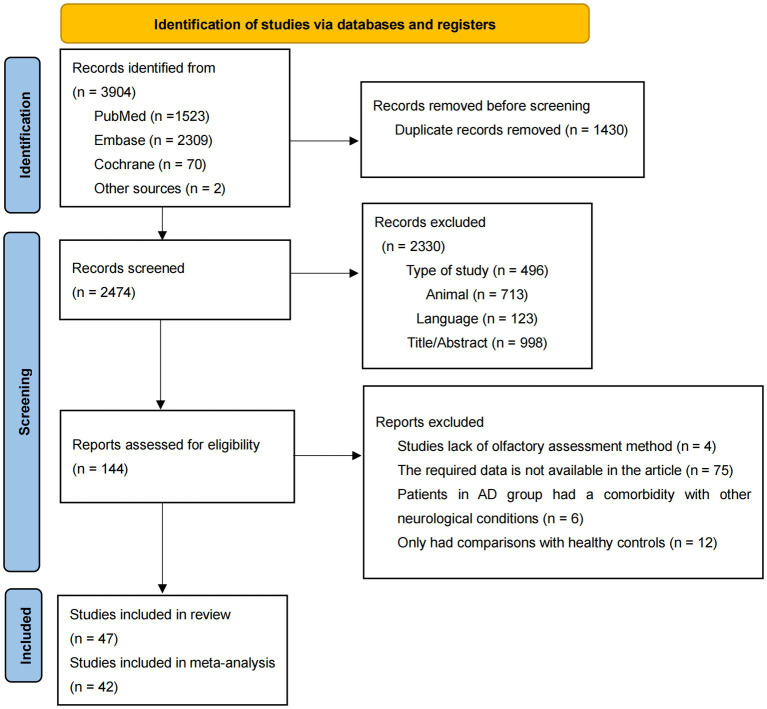
Cross-sectional studies relating to olfactory assessment for both AD and other neurodegenerative disorders published before 27 July 2022 in English, were searched on PubMed, Embase and Cochrane. After literature screening and quality assessment, meta-analyses were conducted using stata14.0 software.
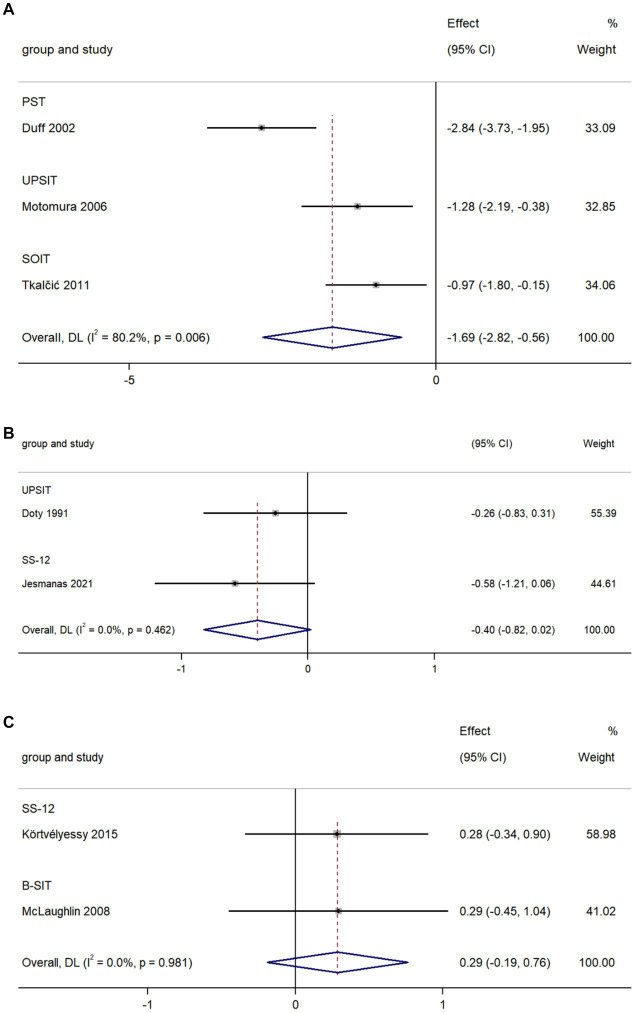
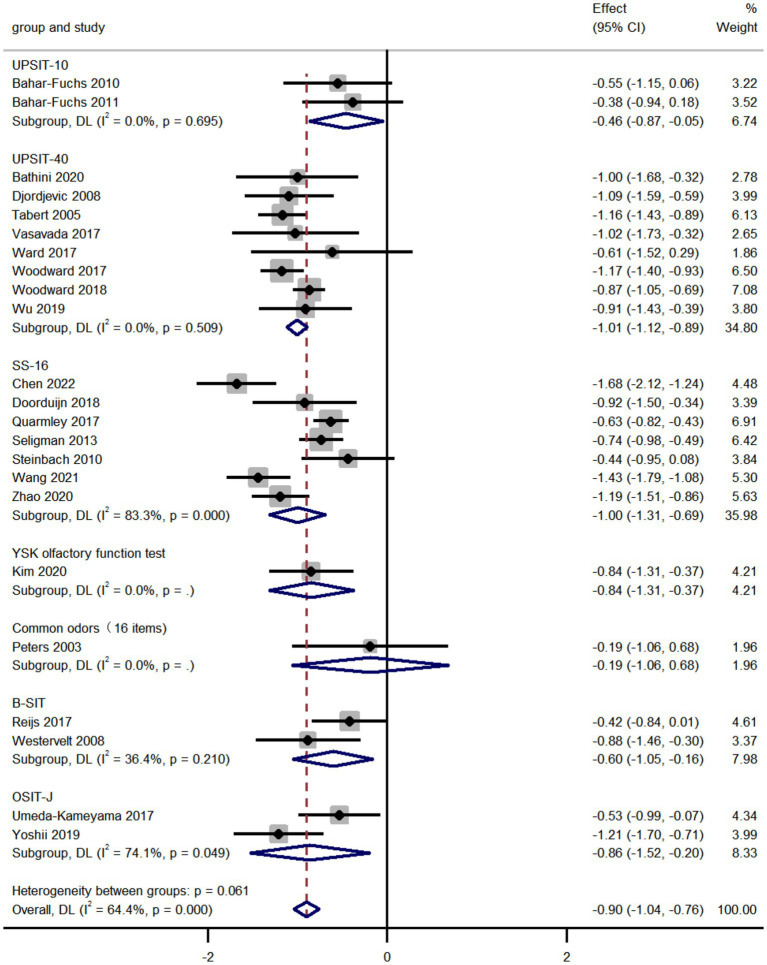
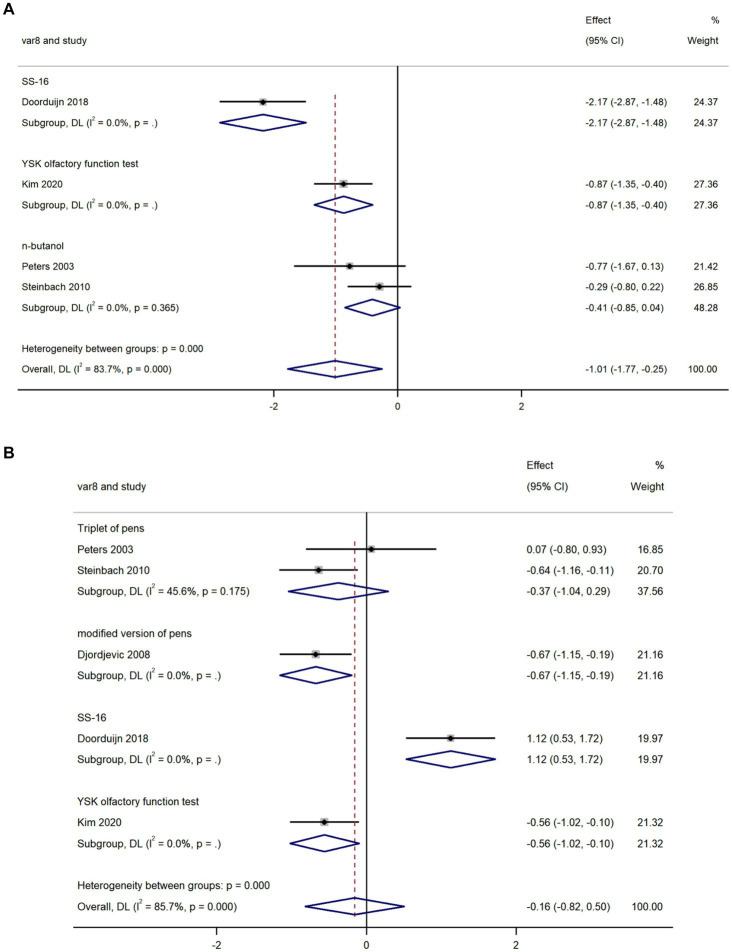
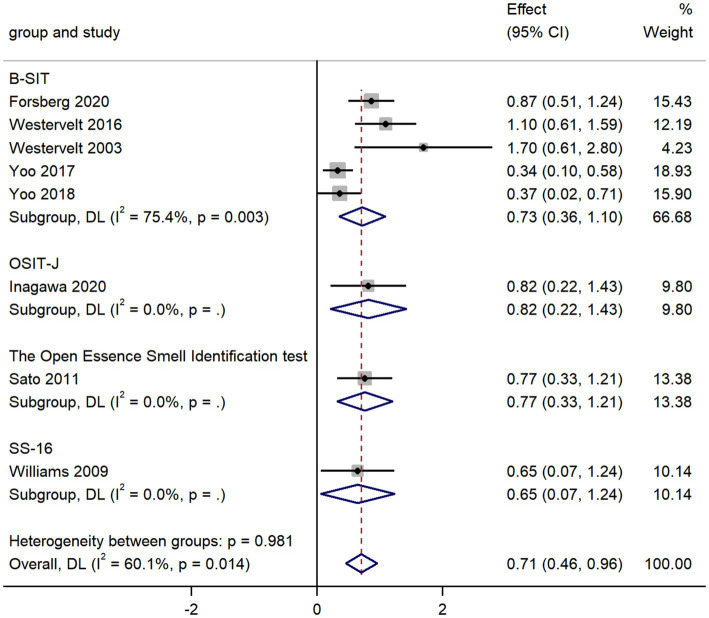
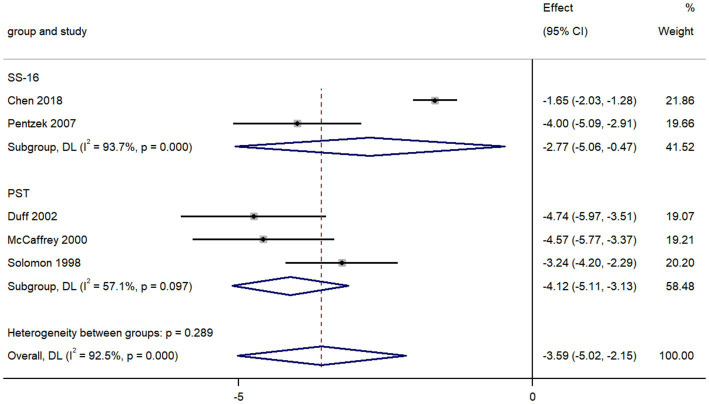
Forty-two articles involving 12 smell tests that evaluated 2,569 AD patients were included. It was revealed that smell tests could distinguish AD from mild cognitive impairment (MCI), Lewy body disease (LBD), depression, and vascular dementia (VaD), but not from diseases such as frontotemporal dementia (FTD). Our finding indicated that in discriminating AD from MCI, the University of Pennsylvania Smell Identification Test (UPSIT) was most frequently used (95%CI: -1.12 to -0.89), while the Brief Smell Identification Test (B-SIT), was the most widely used method in AD vs. LBD group. Further subgroup analyses indicated that the methods of smell test used contributed to the heterogeneity in olfactory threshold and discrimination scores in group AD vs. MCI. While the moderating variables including age, MMSE scores, education years in AD vs. LBD, were account for heterogeneity across studies.
Our finding suggests smell tests have potential value in early differential diagnosis of AD. UPSIT and its simplified variant, B-SIT, are widely used methods in the analyses.
https://www.crd.york.ac.uk/PROSPERO/display_record.php? RecordID = 357970 (PROSPERO, registration number CRD42022357970).
阿尔茨海默病(AD)与其他神经退行性疾病在嗅觉障碍方面存在差异。嗅觉减退可能是AD早期诊断和鉴别诊断的潜在标志物。我们旨在评估AD患者和其他神经退行性疾病患者的嗅觉功能,通过亚组分析进一步评估嗅觉测试,并探索影响嗅觉表现的调节因素。
在PubMed、Embase和Cochrane上检索2022年7月27日前发表的关于AD和其他神经退行性疾病嗅觉评估的横断面研究。经过文献筛选和质量评估,使用stata14.0软件进行荟萃分析。
纳入了42篇涉及12项嗅觉测试的文章,共评估了2569例AD患者。结果显示,嗅觉测试可以将AD与轻度认知障碍(MCI)、路易体病(LBD)、抑郁症和血管性痴呆(VaD)区分开来,但不能与额颞叶痴呆(FTD)等疾病区分开来。我们的研究结果表明,在区分AD与MCI时,最常使用的是宾夕法尼亚大学嗅觉识别测试(UPSIT)(95%CI:-1.12至-0.89),而在AD与LBD组中,简短嗅觉识别测试(B-SIT)是使用最广泛的方法。进一步的亚组分析表明,所使用的嗅觉测试方法导致了AD与MCI组嗅觉阈值和辨别分数的异质性。而包括年龄、MMSE评分、AD与LBD组的受教育年限等调节变量则解释了不同研究之间的异质性。
我们的研究结果表明,嗅觉测试在AD的早期鉴别诊断中具有潜在价值。UPSIT及其简化变体B-SIT是分析中广泛使用的方法。
https://www.crd.york.ac.uk/PROSPERO/display_record.php?RecordID = 357970(PROSPERO,注册号CRD42022357970)。