Xie Qian, Zhang Xiaoran, Zhou Qian, Xu Yumei, Sun Lisha, Wen Qing, Wang Wei, Chen Qiu
Hospital of Chengdu University of Traditional Chinese Medicine, Chengdu, China.
School of Clinical Medicine, Chengdu University of Traditional Chinese Medicine, Chengdu, China.
Front Pharmacol. 2023 Sep 8;14:1179705. doi: 10.3389/fphar.2023.1179705. eCollection 2023.
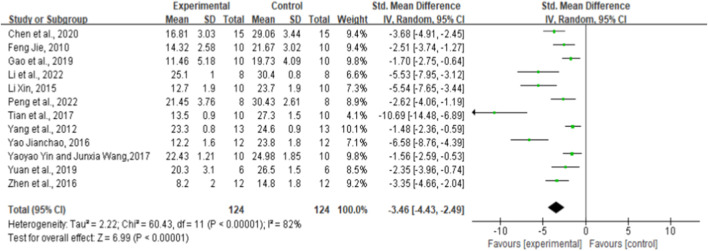
According to existing laboratory data, ginsenoside Rg1 may help cure diabetes and its complications by reducing oxidative stress (OS) and managing inflammation. However, this conclusion lacks reliability and is unclear. As a result, the purpose of this systematic review and meta-analysis was to evaluate the antioxidant and anti-inflammatory effects of ginsenoside Rg1 in the treatment of diabetes and its complications. We searched for relevant studies published through December 2022, including electronic bibliographic databases such as PubMed, EMBASE, Web of Science, CNKI, and Wanfang. The SYstematic Review Center for Laboratory Animal Experimentation Risk of Bias (SYRCLE RoB) tool was used to conduct a meta-analysis to assess the methodological quality of animal research. The meta-analysis was conducted using RevMan5.4 software, following the Cochrane Handbook for Systematic Reviews of Interventions. This study is registered in the International Systems Review Prospective Registry (PROSPERO) as CRD42023386830. Eighteen eligible studies involving 401 animals were included. Ginsenoside Rg1 was significantly correlated with blood glucose (BG), insulin levels, body weight, superoxide dismutase (SOD), malondialdehyde (MDA), tumor necrosis factor-α (TNF-α), and interleukin-6 (IL-6) levels. In addition, according to subgroup analysis, the hypoglycemic, anti-inflammatory, and antioxidant effects of ginsenoside Rg1 in type 2 diabetic animals were not affected by experimental species, modeling, experimental drug dosage, or course of treatment. This meta-analysis presents a summary of the hypoglycemic effects of ginsenoside Rg1, which are achieved through anti-inflammatory and antioxidant mechanisms. These findings provide evidence-based support for the medical efficacy of ginsenoside Rg1. Specifically, ginsenoside Rg1 reduced MDA levels and restored SOD activity to exert its antioxidant activity. It had a positive effect on the reduction of IL-6 and TNF-α levels. However, the inclusion of studies with low methodological quality and the presence of publication bias may undermine the validity of the results. Further investigation with a more rigorous experimental design and comprehensive studies is necessary to fully understand the specific glycemic mechanisms of ginsenosides. https://www.crd.york.ac.uk/PROSPERO/, identifier https://CRD42023386830.
根据现有实验室数据,人参皂苷Rg1可能通过降低氧化应激(OS)和控制炎症来帮助治疗糖尿病及其并发症。然而,这一结论缺乏可靠性且尚不清楚。因此,本系统评价和荟萃分析的目的是评估人参皂苷Rg1在治疗糖尿病及其并发症中的抗氧化和抗炎作用。我们检索了截至2022年12月发表的相关研究,包括电子文献数据库,如PubMed、EMBASE、Web of Science、中国知网和万方。使用实验室动物实验偏倚风险系统评价中心(SYRCLE RoB)工具进行荟萃分析,以评估动物研究的方法学质量。荟萃分析使用RevMan5.4软件进行,遵循Cochrane干预系统评价手册。本研究已在国际系统评价前瞻性注册库(PROSPERO)中注册,注册号为CRD42023386830。纳入了18项符合条件的研究,涉及401只动物。人参皂苷Rg1与血糖(BG)、胰岛素水平、体重、超氧化物歧化酶(SOD)、丙二醛(MDA)、肿瘤坏死因子-α(TNF-α)和白细胞介素-6(IL-6)水平显著相关。此外,根据亚组分析,人参皂苷Rg1在2型糖尿病动物中的降血糖、抗炎和抗氧化作用不受实验物种、建模、实验药物剂量或治疗疗程的影响。本荟萃分析总结了人参皂苷Rg1的降血糖作用,这些作用是通过抗炎和抗氧化机制实现的。这些发现为人参皂苷Rg1的医学疗效提供了循证支持。具体而言,人参皂苷Rg1降低了MDA水平并恢复了SOD活性以发挥其抗氧化活性。它对降低IL-6和TNF-α水平有积极作用。然而,纳入方法学质量较低的研究以及存在发表偏倚可能会削弱结果的有效性。需要通过更严格的实验设计和全面的研究进行进一步调查,以充分了解人参皂苷的具体降糖机制。https://www.crd.york.ac.uk/PROSPERO/,标识符https://CRD42023386830 。