Neumann Natalie R, du Plessis Arina, van Hoving Daniël J, Hoyte Christopher O, Lermer Anné, Wittels Stephen, Marks Carine
Department of Emergency Medicine, Yale University School of Medicine, New Haven CT, USA.
Rocky Mountain Poison and Drug Safety, Denver CO, USA.
Afr J Emerg Med. 2023 Dec;13(4):245-249. doi: 10.1016/j.afjem.2023.08.002. Epub 2023 Sep 19.
Snakebites are a neglected tropical disease. In many areas, envenoming incidence and antivenom administration rates are unknown. This study compared antivenom (AV) availability to rates of envenoming and recommendations to treat (RTT) in South Africa.
This retrospective study identified, extracted, and reviewed all cases of envenoming (snake bites and spits) reported to the Poisons Information Helpline of the Western Cape of South Africa (PIHWC) from June 1, 2015 to May 31, 2020 by public hospitals in the Western Cape. A standardized interview was administered to the pharmacies of the 40 hospitals in winter and summer to determine how many vials of monovalent and polyvalent AV they had on hand at the time of the call and their expiration dates Descriptive analysis was used to compare rates of envenoming and recommendations to treat to antivenom stock in winter and summer and by hospital type and location.
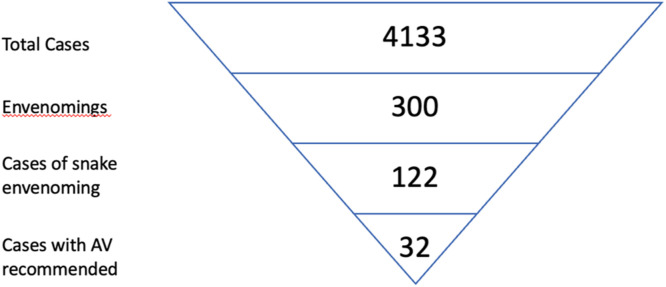
Public hospitals reported 300 envenomings, 122 from snakes. The PIHWC recommended antivenom administration in 26% of cases ( = 32). All hospital pharmacies queried answered our questions. Our study demonstrates urban district hospitals have higher ratios of AV vials compared to mean annual rates of envenoming and RTT than rural district hospitals at both the winter and summer timepoints.
This study evaluates antivenom supply and demand in a province of South Africa. The findings suggest South African urban hospitals have a relative excess of antivenom, and thus more capacity to meet demand, than their rural counterparts. It supports consideration of a redistribution of antivenom supply chains to match seasonal and local rates of envenoming. It indicates a need for higher quality, prospective data characterizing envenoming incidence and treatment.
蛇咬伤是一种被忽视的热带疾病。在许多地区,中毒发病率和抗蛇毒血清的使用比率尚不清楚。本研究比较了南非抗蛇毒血清(AV)的可获得性与中毒发病率以及治疗建议(RTT)。
这项回顾性研究对2015年6月1日至2020年5月31日期间南非西开普省公立医院向该省毒物信息热线(PIHWC)报告的所有中毒(蛇咬伤和蛇喷毒)病例进行了识别、提取和审查。在冬季和夏季对40家医院的药房进行了标准化访谈,以确定在打电话时他们手头有多少瓶单价和多价抗蛇毒血清及其保质期。采用描述性分析来比较冬季和夏季以及不同医院类型和地点的中毒发病率、治疗建议与抗蛇毒血清库存情况。
公立医院报告了300例中毒病例,其中122例是蛇咬伤。PIHWC在26%的病例中(n = 32)建议使用抗蛇毒血清。所有接受询问的医院药房都回答了我们的问题。我们的研究表明,在冬季和夏季两个时间点,与农村地区医院相比,城市地区医院的抗蛇毒血清瓶数与年平均中毒发病率和治疗建议的比率更高。
本研究评估了南非一个省份的抗蛇毒血清供需情况。研究结果表明,南非城市医院的抗蛇毒血清相对过剩,因此比农村医院更有能力满足需求。这支持考虑重新分配抗蛇毒血清供应链,以匹配季节性和当地的中毒发病率。这表明需要更高质量的前瞻性数据来描述中毒发病率和治疗情况。