Gheibi Zahra, Boroomand Mitra, Soltani Aboozar
Department of Epidemiology, School of Health, Shiraz University of Medical Sciences, Shiraz, Iran.
Department of Medical Entomology and Vector Control, School of Health, Shiraz University of Medical Sciences, Shiraz, Iran.
J Trop Med. 2023 Sep 15;2023:7697421. doi: 10.1155/2023/7697421. eCollection 2023.
We aimed to model and predict the changes in the trend of vector-borne diseases (VBDs) before and after the COVID-19 pandemic in a high-risk area of Iran.
This case-series study was conducted in Fars province, south of Iran, between April 2016 and July 2021. All referred cases of VBDs were considered during the five years to investigate the effect of the lockdown on the epidemiological profile of these diseases. We used time-series autoregressive integrated moving average (ARIMA) and seasonal ARIMA (SARIMA) models.
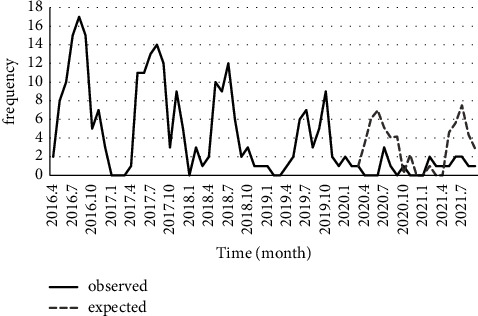
Pediculosis incidence trend was rising with a peak of 1,146 per 100,000 in 2018, followed by a dramatic decrease reached to the minimum amount of 157.8 per 100,000 in 2021. In contrast, malaria and scabies had a smooth decreasing trend ranging from 2.2 per 100,000 and 7.3 per 100,000 in 2016 to a minimum of 0.2 per 100,000 in 2021, respectively. Likewise, leishmaniasis had a falling trend, with a maximum rate of 82.9 per 100,000 in 2016 to the lowest rate of 9.4 per 100,000 in 2021. However, the difference between observed and expected values revealed that the consequences of the COVID-19 pandemic had increased the number of leishmaniasis cases.
Tropical regions of Iran, including Fars province, are the favorite destinations for travelers. During COVID-19 outbreaks, some reasons, such as quarantine, movement restrictions, and social distancing, reduced human-vector contact and finally led to the reduction of VBDs in this area.
我们旨在对伊朗一个高风险地区在新冠疫情前后媒介传播疾病(VBDs)趋势的变化进行建模和预测。
本病例系列研究于2016年4月至2021年7月在伊朗南部的法尔斯省进行。在这五年期间考虑了所有转诊的VBDs病例,以调查封锁对这些疾病流行病学特征的影响。我们使用了时间序列自回归积分滑动平均(ARIMA)和季节性ARIMA(SARIMA)模型。
头虱病发病率呈上升趋势,2018年达到每10万人1146例的峰值,随后急剧下降,2021年降至每10万人157.8例的最低水平。相比之下,疟疾和疥疮呈平稳下降趋势,分别从2016年的每10万人2.2例和7.3例降至2021年的每10万人最低0.2例。同样,利什曼病也呈下降趋势,从2016年的每10万人最高82.9例降至2021年的每10万人最低9.4例。然而,观察值与预期值之间的差异表明,新冠疫情的后果增加了利什曼病病例数。
伊朗的热带地区,包括法尔斯省,是旅行者喜爱的目的地。在新冠疫情爆发期间,诸如检疫、行动限制和社交距离等一些原因减少了人与媒介的接触,最终导致该地区VBDs的减少。