Center for Applied Statistics, School of Statistics, Renmin University of China, Beijing, 100872, China.
College of Statistics and Data Science, Faculty of Science, Beijing University of Technology, Beijing, 100124, China.
Parasit Vectors. 2022 Mar 5;15(1):78. doi: 10.1186/s13071-022-05187-w.
This study explored the effect of a continuous mitigation and containment strategy for coronavirus disease 2019 (COVID-19) on five vector-borne diseases (VBDs) in China from 2020 to 2021.
Data on VBDs from 2015 to 2021 were obtained from the National Health Commission of the People's Republic of China, and the actual trend in disease activity in 2020-2021 was compared with that in 2015-2019 using a two-ratio Z-test and two proportional tests. Similarly, the estimated trend in disease activity was compared with the actual trend in disease activity in 2020.
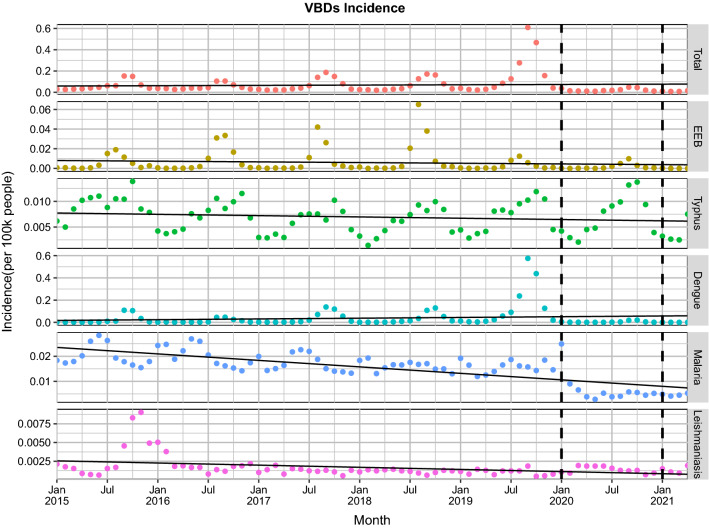
There were 13,456 and 3684 average yearly cases of VBDs in 2015-2019 and 2020, respectively. This represents a decrease in the average yearly incidence of total VBDs of 72.95% in 2020, from 0.9753 per 100,000 population in 2015-2019 to 0.2638 per 100,000 population in 2020 (t = 75.17, P < 0.001). The observed morbidity rates of the overall VBDs were significantly lower than the predicted rates (47.04% reduction; t = 31.72, P < 0.001). The greatest decline was found in dengue, with a 77.13% reduction (observed rate vs predicted rate: 0.0574 vs. 0.2510 per 100,000; t = 41.42, P < 0.001). Similarly, the average yearly mortality rate of total VBDs decreased by 77.60%, from 0.0064 per 100,000 population in 2015-2019 to 0.0014 per 100,000 population in 2020 (t = 6.58, P < 0.001). A decreasing trend was also seen in the monthly incidence of total VBDs in 2021 compared to 2020 by 43.14% (t = 5.48, P < 0.001).
The results of this study verify that the mobility and mortality rates of VBDs significantly decreased from 2015-2019 to 2020-2021, and that they are possibly associated to the continuous COVID-19 mitigation and contamination strategy implemented in China in 2020-2021.
本研究探讨了 2020 年至 2021 年中国针对 2019 年冠状病毒病(COVID-19)实施的持续缓解和遏制策略对五种虫媒病(VBD)的影响。
从中国国家卫生健康委员会获得了 2015 年至 2021 年 VBD 的数据,并使用双比 Z 检验和两个比例检验比较了 2020-2021 年与 2015-2019 年实际疾病活动趋势的差异。同样,将疾病活动的估计趋势与 2020 年疾病活动的实际趋势进行了比较。
2015-2019 年和 2020 年分别有 13456 和 3684 例平均年发病的 VBD。这意味着 2020 年 VBD 的平均年发病率下降了 72.95%,从 2015-2019 年的每 10 万人 0.9753 例降至 2020 年的每 10 万人 0.2638 例(t=75.17,P<0.001)。观察到的总体 VBD 发病率明显低于预测发病率(下降 47.04%;t=31.72,P<0.001)。登革热的下降幅度最大,下降了 77.13%(观察率与预测率:每 10 万人 0.0574 与 0.2510;t=41.42,P<0.001)。同样,2015-2019 年每 10 万人 0.0064 的总 VBD 死亡率下降到 2020 年的每 10 万人 0.0014(t=6.58,P<0.001)。2021 年与 2020 年相比,总 VBD 的月发病率也呈下降趋势,下降了 43.14%(t=5.48,P<0.001)。
本研究结果证实,2020 年至 2021 年 VBD 的流动性和死亡率显著下降,这可能与中国 2020 年至 2021 年持续实施的 COVID-19 缓解和污染控制策略有关。