Kilian Alex Sandre, de Siervo Abner, Landers Richard, Abreu Guilherme Jean P, Castro Mayron S, Back Tyson, Pancotti Alexandre
Instituto de Ciências Exatas e Tecnológicas/Grupo de Física de Materiais, Universidade Federal de Jataí BR 364, km 195, No. 3800 75801-615 Jataí Goias Brazil
Instituto de Física "Gleb Wataghin", Universidade Estadual de Campinas Campinas 13083-859 SP Brazil.
RSC Adv. 2023 Sep 21;13(40):28042-28050. doi: 10.1039/d3ra04682f. eCollection 2023 Sep 18.
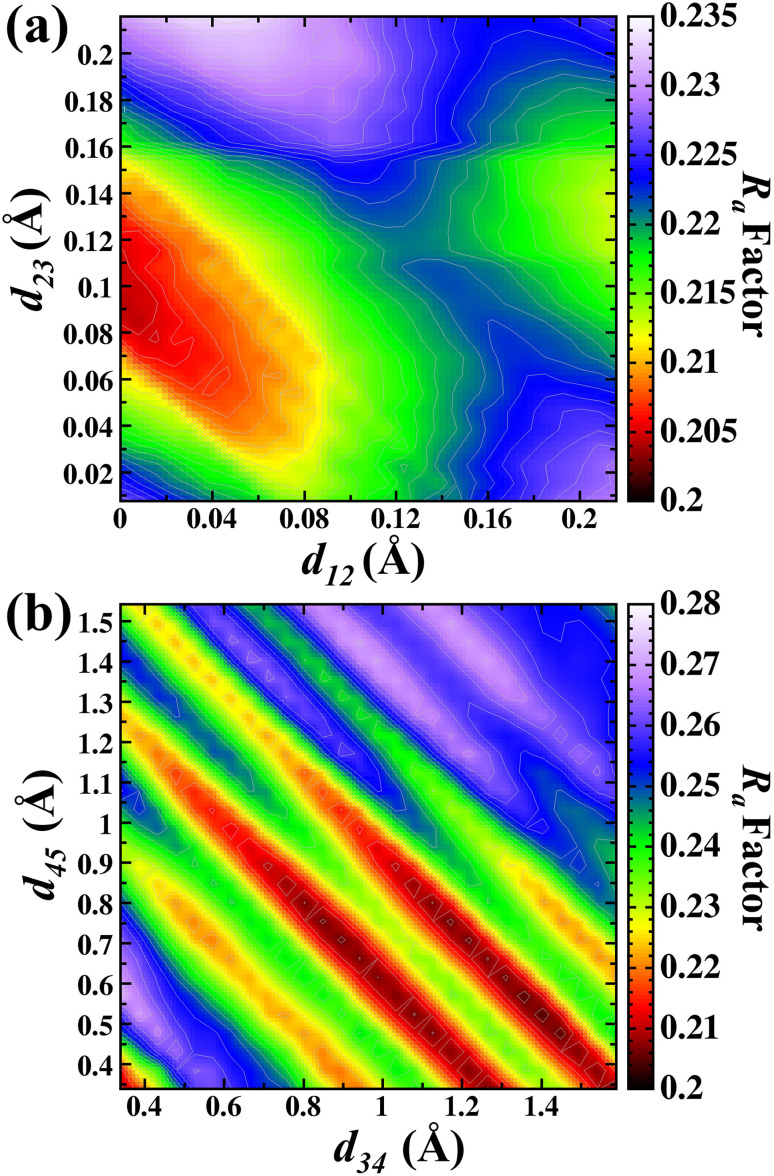
The present work is on a comprehensive surface atomic structure investigation of β-GaO (100). The β-GaO single crystal was studied by a structural model system in the simulations and characterization X-ray photoelectron spectroscopy (XPS), low-energy electron diffraction (LEED) and X-ray photoelectron diffraction (XPD) allowed for probing the outermost layers' properties. XPD characterization allows for the collection of valuable element-specific short-range information from the β-GaO surface, and the results were compared to a systematic and precise multiple scattering simulation approach. The experiments, characterizations, and simulations indicated strong evidence of considerable structural variations in the interatomic layer's distances. Such atomic displacement could clarify the electronic phenomena observed in theoretical studies. The comparison between experimental and theoretical XPD results involving multiple scattering calculations indicated that the β-GaO surface has two possible terminations. The best fits to the photoelectron diffraction curves are used to calculate the interplanar relaxation in the first five atomic layers. The results show good agreement with previous density functional theory calculations, establishing XPD as a useful tool for probing the atomic structure of oxide surfaces.
目前的工作是对β-GaO(100)进行全面的表面原子结构研究。在模拟中,通过一个结构模型系统对β-GaO单晶进行了研究,X射线光电子能谱(XPS)、低能电子衍射(LEED)和X射线光电子衍射(XPD)用于探测最外层的性质。XPD表征能够从β-GaO表面收集有价值的特定元素短程信息,并将结果与系统且精确的多重散射模拟方法进行比较。实验、表征和模拟结果有力地证明了原子层间距存在显著的结构变化。这种原子位移可以解释理论研究中观察到的电子现象。涉及多重散射计算的实验和理论XPD结果之间的比较表明,β-GaO表面有两种可能的终止方式。利用对光电子衍射曲线的最佳拟合来计算前五个原子层中的面间弛豫。结果与先前的密度泛函理论计算结果吻合良好,确立了XPD作为探测氧化物表面原子结构的有用工具。