The Comparative Health Outcomes, Policy, and Economics Institute, Department of Pharmacy, University of Washington, Seattle, Washington, USA.
HCD Economics, Daresbury, UK.
J Int AIDS Soc. 2023 Sep;26(9):e26170. doi: 10.1002/jia2.26170.
Curative therapies (CTx) to achieve durable remission of HIV disease without the need for antiretroviral therapy (ART) are currently being explored. Our objective was to model the long-term health and cost outcomes of HIV in various countries, the impact of future CTx on those outcomes and the country-specific value-based prices (VBPs) of CTx.
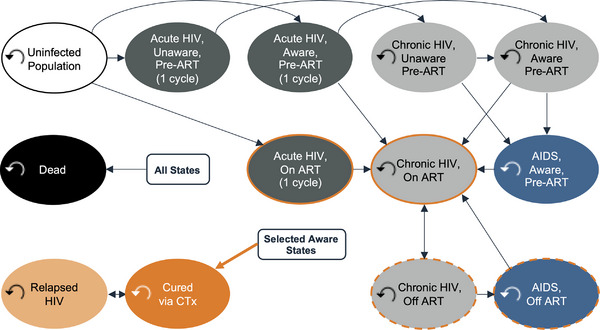
We developed a decision-analytic model to estimate the future health economic impacts of a hypothetical CTx for HIV in countries with pre-existing access to ART (CTx+ART), compared to ART alone. We modelled populations in seven low-and-middle-income countries and five high-income countries, accounting for localized ART and other HIV-related costs, and calibrating variables for HIV epidemiology and ART uptake to reproduce historical HIV outcomes before projecting future outcomes to year 2100. Health was quantified using disability-adjusted life-years (DALYs). Base case, pessimistic and optimistic scenarios were modelled for CTx+ART and ART alone. Based on long-term outcomes and each country's estimated health opportunity cost, we calculated the country-specific VBP of CTx.
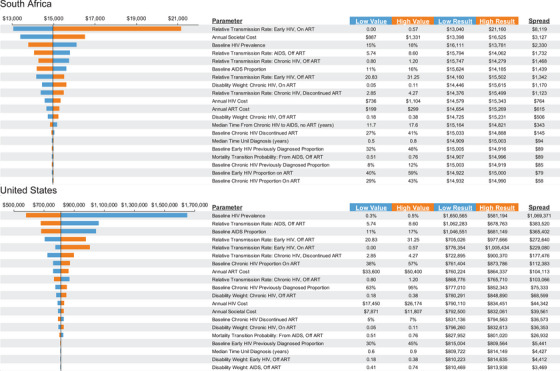
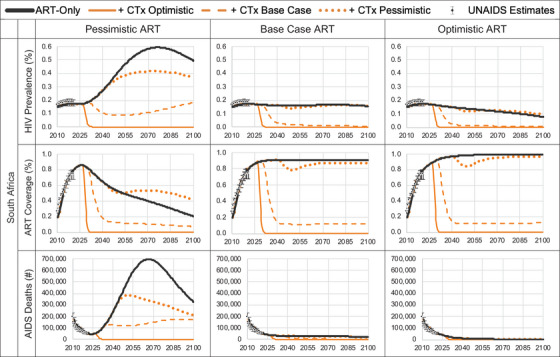
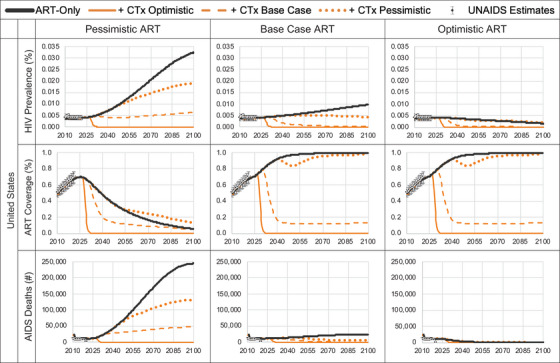
The introduction of a hypothetical CTx lowered HIV prevalence and prevented future infections over time, which increased life-years, reduced the number of individuals on ART, reduced AIDS-related deaths, and ultimately led to fewer DALYs versus ART-alone. Our base case estimates for the VBP of CTx ranged from $5400 (Kenya) up to $812,300 (United States). Within each country, the VBP was driven to be greater primarily by lower ART coverage, lower HIV incidence and prevalence, and higher CTx cure probability. The VBP estimates were found to be greater in countries where HIV prevalence was higher, ART coverage was lower and the health opportunity cost was greater.
Our results quantify the VBP for future curative CTx that may apply in different countries and under different circumstances. With greater CTx cure probability, durability and scale up, CTx commands a higher VBP, while improvements in ART coverage may mitigate its value. Our framework can be utilized for estimating this cost given a wide range of scenarios related to the attributes of a given CTx as well as various parameters of the HIV epidemic within a given country.
目前正在探索能够实现艾滋病毒疾病持久缓解而无需抗逆转录病毒治疗(ART)的治愈疗法(CTx)。我们的目标是对不同国家的艾滋病毒的长期健康和成本结果进行建模,预测未来 CTx 对这些结果的影响,以及 CTx 的基于价值的国家特定价格(VBP)。
我们开发了一种决策分析模型,以估计在已经获得 ART (CTx+ART)的国家中,与单独使用 ART 相比,一种假设的 CTx 对艾滋病毒的未来健康经济影响。我们对七个中低收入国家和五个高收入国家的人群进行了建模,考虑了局部 ART 和其他与 HIV 相关的成本,并对 HIV 流行病学和 ART 使用率进行了校准,以复制历史 HIV 结果,然后预测到 2100 年的未来结果。健康状况采用残疾调整生命年(DALY)进行量化。对 CTx+ART 和单独使用 ART 进行了基本情况、悲观情况和乐观情况的建模。根据长期结果和每个国家估计的健康机会成本,我们计算了 CTx 的国家特定 VBP。
引入一种假设的 CTx 会随着时间的推移降低 HIV 流行率并预防未来的感染,从而增加生命年数,减少接受 ART 的人数,减少艾滋病相关死亡,并最终减少与单独使用 ART 相比的 DALY。我们对 CTx 的 VBP 的基本情况估计范围从 5400 美元(肯尼亚)到 812300 美元(美国)不等。在每个国家内部,VBP 的主要驱动因素是较低的 ART 覆盖率、较低的 HIV 发病率和流行率以及较高的 CTx 治愈率。在 HIV 流行率较高、ART 覆盖率较低和健康机会成本较高的国家,VBP 估计值更高。
我们的结果量化了未来可能适用于不同国家和不同情况下的治愈性 CTx 的 VBP。随着 CTx 治愈率、耐久性和规模的提高,CTx 的 VBP 更高,而 ART 覆盖率的提高可能会降低其价值。我们的框架可以用于估算给定 CTx 的属性以及给定国家内 HIV 流行的各种参数相关的各种情况下的这种成本。