Department of Minimally Invasive Surgery, Hernias and Abdominal Wall Surgery, People's Hospital of Xinjiang Uygur Autonomous Region, Xinjiang Uygur Autonomous Region, Urumqi, China.
Xinjiang Clinical Research Center for Gastroesophageal Reflux Disease and Bariatric Metabolic Surgery, Xinjiang Uygur Autonomous Region, Urumqi, China.
BMC Surg. 2023 Sep 26;23(1):293. doi: 10.1186/s12893-023-02184-3.
Massive hiatal hernias may result in extraoesophageal symptoms, including iron-deficiency anaemia. However, the role played by hiatal hernias in iron-deficiency anaemia is not clearly understood. We examined the prevalence of anaemia in patients with massive hiatal hernias and the frequency of anaemia resolution after laparoscopic hiatal hernia repair at long term follow-up.
Patients who underwent laparoscopic hiatal hernia repair from June 2008 to June 2019 were enrolled in this study. We collected the patients' demographic and clinical data from their medical records, and compared the pre-surgical and post-surgical findings (at 1 week and 3 months post-surgery). All patients with adequate documentation underwent post-surgical follow-up to evaluate improvements in clinical symptoms and signs.
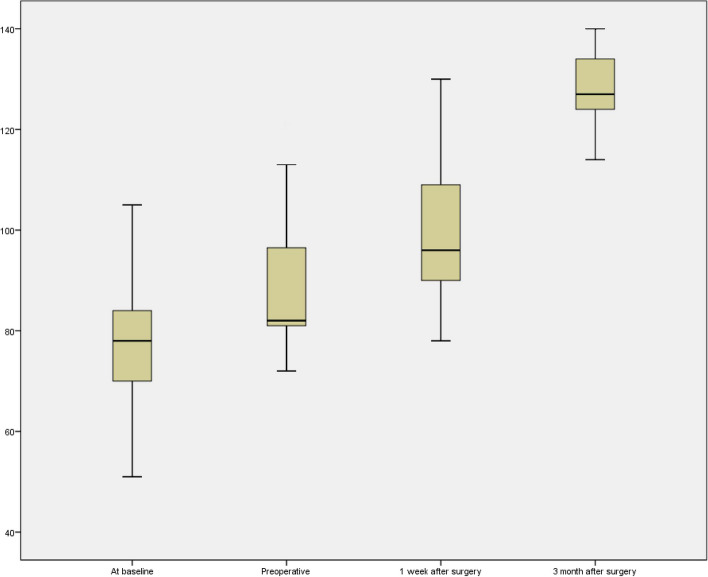
A total of 126 patients with massive hiatal hernias underwent laparoscopic hiatal hernia repair. Of these, 35 (27.8%) had iron-deficiency anaemia. Anaemia was resolution in all the patients and they had significantly reduced GERD-Q scores at 3 months postoperatively (P<0.01) .The mean follow-up period was 60 months. Iron-deficiency anaemia resolution after hiatal hernia repair was achieved in 93.9% of the patients.
Anaemia is common in patients with massive hiatal hernias, and most of our patients were symptomatic because of their anaemia. Moreover, in patients with massive hiatal hernias, iron-deficiency anaemia resolution is likely after laparoscopic hiatal hernia repair.
巨大的食管裂孔疝可能导致食管外症状,包括缺铁性贫血。然而,食管裂孔疝在缺铁性贫血中的作用尚不清楚。我们检查了巨大食管裂孔疝患者的贫血患病率以及腹腔镜食管裂孔疝修补术后长期随访中贫血缓解的频率。
本研究纳入了 2008 年 6 月至 2019 年 6 月期间接受腹腔镜食管裂孔疝修补术的患者。我们从病历中收集了患者的人口统计学和临床数据,并比较了术前和术后(术后 1 周和 3 个月)的发现。所有有充分记录的患者均进行术后随访,以评估临床症状和体征的改善情况。
共有 126 例巨大食管裂孔疝患者接受了腹腔镜食管裂孔疝修补术,其中 35 例(27.8%)患有缺铁性贫血。所有患者的贫血均得到缓解,并且术后 3 个月 GERD-Q 评分显著降低(P<0.01)。平均随访时间为 60 个月。食管裂孔疝修补术后,93.9%的患者缺铁性贫血得到缓解。
贫血在巨大食管裂孔疝患者中很常见,我们的大多数患者因贫血而出现症状。此外,在巨大食管裂孔疝患者中,腹腔镜食管裂孔疝修补术后缺铁性贫血可能得到缓解。