Institute for Control of Chinese Traditional Medicine and Ethnic Medicine (ICCTMEM), National Institutes for Food and Drug Control (NIFDC), Beijing 100050, China.
Institute for the Control of Agrochemicals, Ministry of Agriculture and Rural Affairs, Beijing 100125, China.
Molecules. 2023 Sep 18;28(18):6675. doi: 10.3390/molecules28186675.
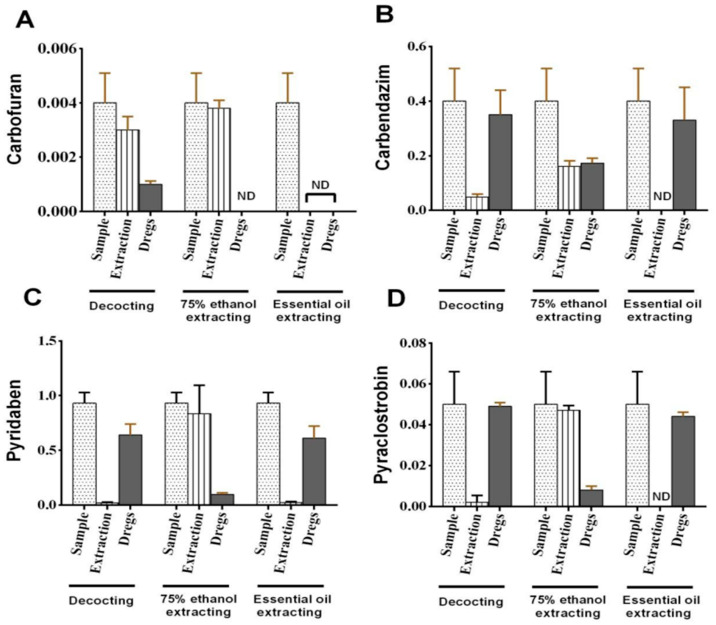
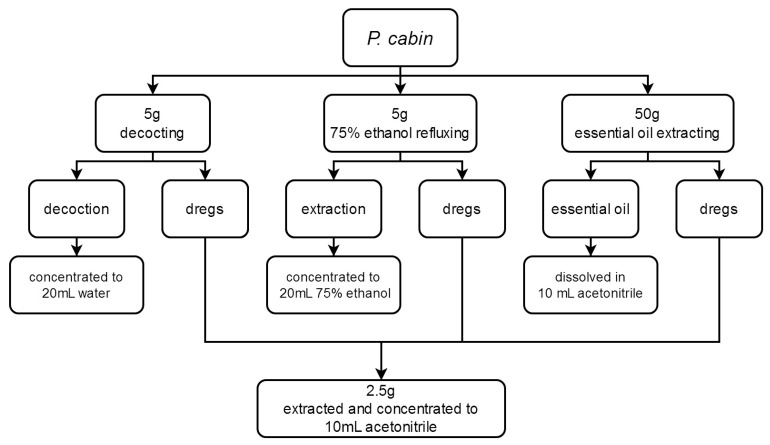
Before use as medicines, most traditional Chinese medicine (TCM) plants are processed and decocted. During processing, there may be some changes in pesticide residues in TCM. In recent years, reports have studied the changes of pesticides during the processes of boiling, drying and peeling of TCM materials but have rarely involved special processing methods for TCM, such as ethanol extraction and volatile oil extraction. The changes of carbendazim, carbofuran, pyridaben and tebuconazole residues in common processing methods for products were systemically assessed in this study. After each processing step, the pesticides were quantitated by UPLC-MS/MS. The results showed amount decreases in various pesticides to different extents after each processing procedure. Processing factor (PF) values for the four pesticides after decoction, 75% ethanol extraction and volatile oil extraction were 0.020.75, 0.400.98 and 0~0.02, respectively, which indicated that residual pesticide concentrations may depend on the processing technique. A risk assessment according to the hazard quotient with PF values showed that residual pesticide amounts in were substantially lower than levels potentially posing a health risk. Overall, these findings provide insights into the safety assessment of .
在被用作药物之前,大多数中药(TCM)植物都需要经过加工和煎煮。在加工过程中,TCM 中的农药残留可能会发生一些变化。近年来,有报道研究了农药在中药材料煮沸、干燥和去皮过程中的变化,但很少涉及中药的特殊加工方法,如乙醇提取和挥发油提取。本研究系统评估了常见加工方法中苯菌灵、克百威、哒螨灵和戊唑醇残留量的变化。在每个处理步骤后,通过 UPLC-MS/MS 定量分析了农药。结果表明,每种处理程序后,各种农药的含量都不同程度地减少。煎煮、75%乙醇提取和挥发油提取后四种农药的加工系数(PF)值分别为 0.020.75、0.400.98 和 0~0.02,表明残留农药浓度可能取决于加工技术。根据 PF 值的危害商进行风险评估显示,残留农药量大大低于可能对健康造成危害的水平。总体而言,这些发现为中药的安全性评估提供了依据。