Charoenwoodhipong Prae, Holt Roberta R, Keen Carl L, Hedayati Nasim, Sato Tomoyuki, Sone Teruo, Hackman Robert M
Department of Nutrition, University of California Davis, Davis, CA 95616, USA.
Department of Internal Medicine, University of California Davis, Sacramento, CA 95817, USA.
Nutrients. 2023 Sep 19;15(18):4054. doi: 10.3390/nu15184054.
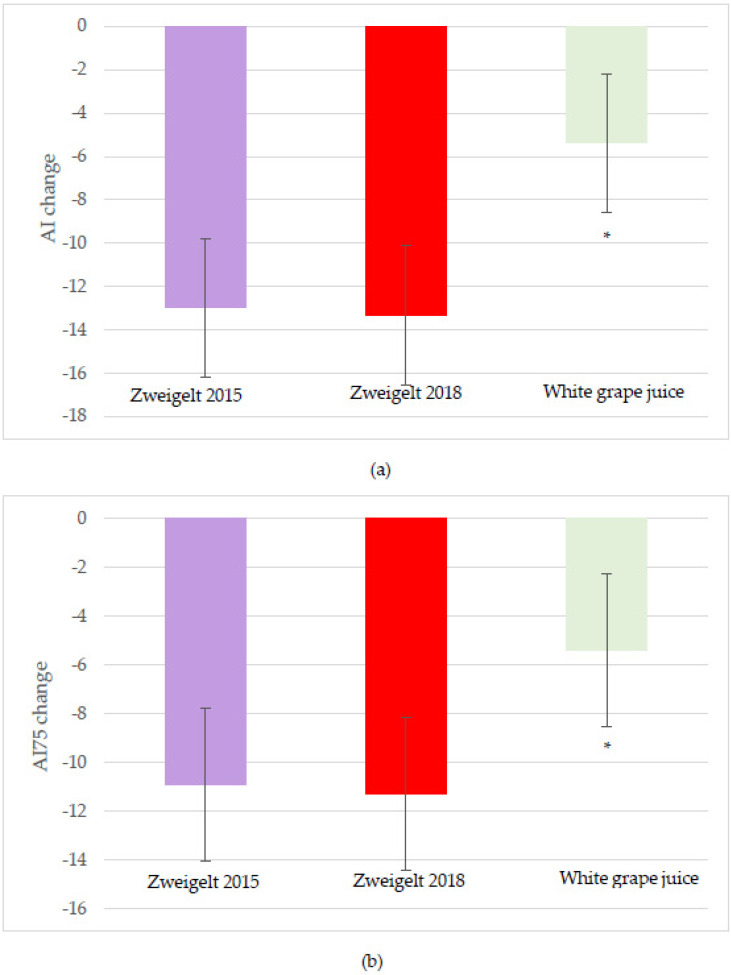
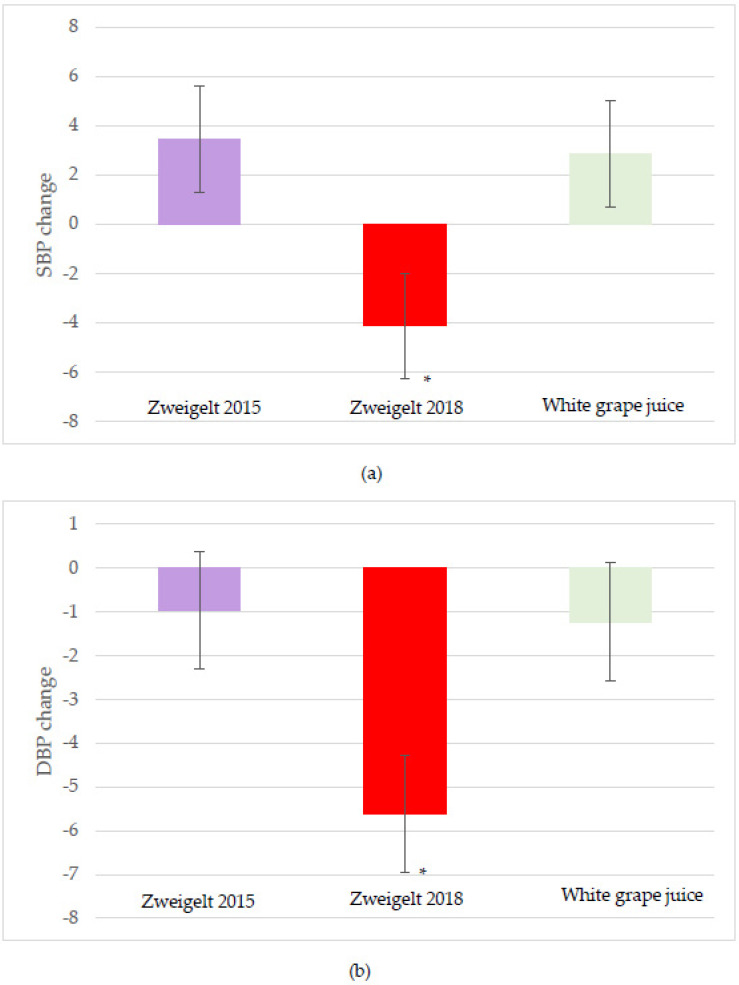
Moderate red wine intake has been associated with lower cardiovascular mortality, due in part to the intake of polyphenols and anthocyanins, whose content can vary from varietal and year of harvest. This study assessed the vascular effects in response to a single intake of 2015 and 2018 Zweigelt red wines from Hokkaido, Japan. Healthy men were randomly assigned to consume 240 mL each of a red wine, or a sparkling white grape juice as a control in a randomized three-arm cross-over design with a 7 day washout between arms. The augmentation index (AI; a measure of arterial stiffness) and AI at 75 beats/min (AI75), reactive hyperemia index, systolic and diastolic blood pressure (SBP and DBP, respectively), and platelet reactivity were assessed at baseline and two and four hours after each beverage intake. Changes from the baseline were analyzed using a linear mixed model. Significant treatment effects ( = 0.02) were observed, with AI 13% lower after the intake of the 2015 or 2018 vintages compared to the control. Intake of the 2018 vintage reduced SBP and DBP (-4.1 mmHg and -5.6 mmHg, respectively; = 0.02) compared to the 2015 wine and the control drink. The amount of hydroxytyrosol in the 2018 wine was almost twice the amount as in the 2015 wine, which may help explain the variable blood pressure results. Future studies exploring the vascular effects of the same red wine from different vintage years and different phenolic profiles are warranted.
适度饮用红酒与较低的心血管疾病死亡率相关,部分原因是摄入了多酚和花青素,其含量会因葡萄品种和收获年份而有所不同。本研究评估了单次摄入来自日本北海道的2015年和2018年茨威格特红酒后的血管效应。健康男性被随机分配,在随机三臂交叉设计中,每人饮用240毫升红酒或起泡白葡萄汁作为对照,每组之间有7天的洗脱期。在基线以及每次饮用饮料后两小时和四小时,评估增强指数(AI;动脉僵硬度的一种测量指标)和75次心跳/分钟时的AI(AI75)、反应性充血指数、收缩压和舒张压(分别为SBP和DBP)以及血小板反应性。使用线性混合模型分析与基线相比的变化。观察到显著的治疗效果(P = 0.02),与对照组相比,摄入2015年或2018年葡萄酒后AI降低了13%。与2015年葡萄酒和对照饮料相比,摄入2018年葡萄酒可降低SBP和DBP(分别降低-4.1 mmHg和-5.6 mmHg;P = 0.02)。2018年葡萄酒中羟基酪醇的含量几乎是2015年葡萄酒的两倍,这可能有助于解释血压变化的结果。有必要开展进一步研究,探索不同年份和不同酚类成分的同一种红酒的血管效应。