Ju Wen, Bagger Alexander, Saharie Nastaran Ranjbar, Möhle Sebastian, Wang Jingyi, Jaouen Frederic, Rossmeisl Jan, Strasser Peter
Chemical Engineering Division, Department of Chemistry, Technical University Berlin, Berlin, Germany.
Department of Physics, Technical University of Denmark, Lyngby, Denmark.
Commun Chem. 2023 Sep 30;6(1):212. doi: 10.1038/s42004-023-01008-y.
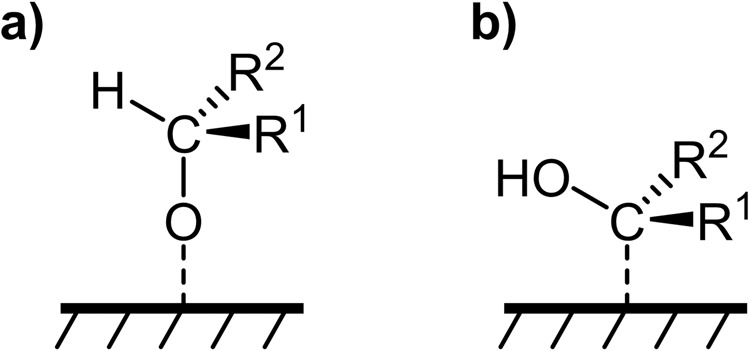
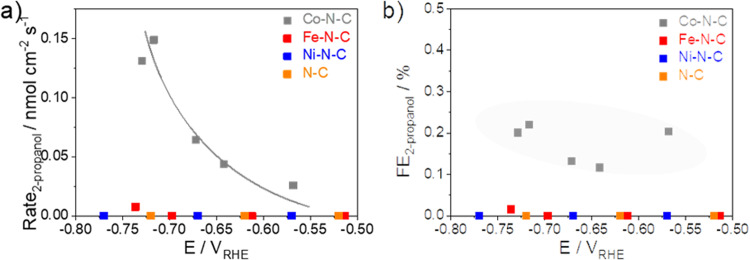
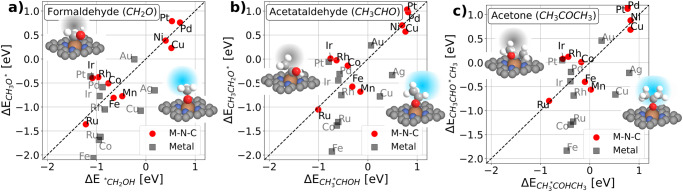
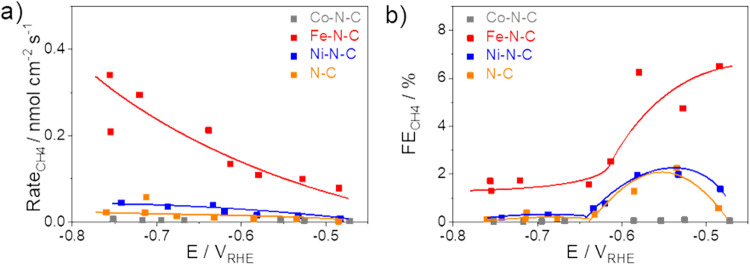
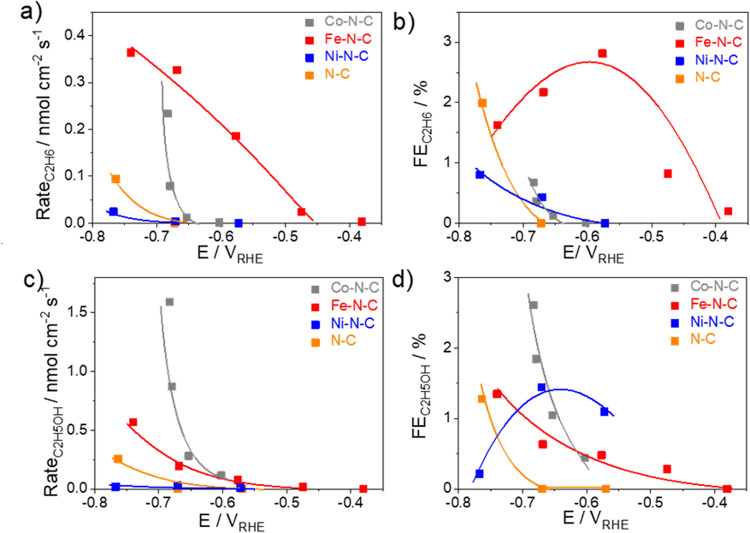
Electrochemical conversion of organic compounds holds promise for advancing sustainable synthesis and catalysis. This study explored electrochemical carbonyl hydrogenation on single-site M-N-C (Metal Nitrogen-doped Carbon) catalysts using formaldehyde, acetaldehyde, and acetone as model reactants. We strive to correlate and understand the selectivity dependence on the nature of the metal centers. Density Functional Theory calculations revealed similar binding energetics for carbonyl groups through oxygen-down or carbon-down adsorption due to oxygen and carbon scaling. Fe-N-C exhibited specific oxyphilicity and could selectively reduce aldehydes to hydrocarbons. By contrast, the carbophilic Co-N-C selectively converted acetaldehyde and acetone to ethanol and 2-propanol, respectively. We claim that the oxyphilicity of the active sites and consequent adsorption geometry (oxygen-down vs. carbon-down) are crucial in controlling product selectivity. These findings offer mechanistic insights into electrochemical carbonyl hydrogenation and can guide the development of efficient and sustainable electrocatalytic valorization of biomass-derived compounds.
有机化合物的电化学转化有望推动可持续合成与催化的发展。本研究以甲醛、乙醛和丙酮为模型反应物,探索了单原子M-N-C(金属氮掺杂碳)催化剂上的电化学羰基氢化反应。我们致力于关联并理解选择性对金属中心性质的依赖性。密度泛函理论计算表明,由于氧和碳的标度关系,羰基通过氧向下或碳向下吸附具有相似的结合能。Fe-N-C表现出特定的亲氧性,能够选择性地将醛还原为烃类。相比之下,亲碳的Co-N-C分别将乙醛和丙酮选择性地转化为乙醇和2-丙醇。我们认为,活性位点的亲氧性以及由此产生的吸附几何结构(氧向下与碳向下)对于控制产物选择性至关重要。这些发现为电化学羰基氢化反应提供了机理见解,并可指导生物质衍生化合物高效可持续电催化增值的发展。