Montupil Javier, Cardone Paolo, Staquet Cécile, Bonhomme Arthur, Defresne Aline, Martial Charlotte, Alnagger Naji L N, Gosseries Olivia, Bonhomme Vincent
Anesthesia and Perioperative Neuroscience Laboratory, Liege, Belgium.
Department of Anesthesia and Intensive Care Medicine, Liege, Belgium.
BJA Open. 2023 Sep 26;8:100224. doi: 10.1016/j.bjao.2023.100224. eCollection 2023 Dec.
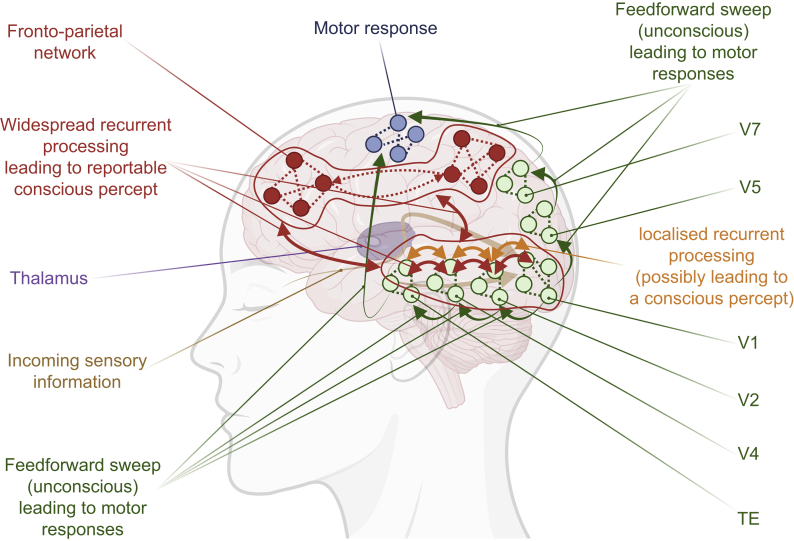
Neuroscientists agree on the value of locating the source of consciousness within the brain. Anaesthesiologists are no exception, and have their own operational definition of consciousness based on phenomenological observations during anaesthesia. The full functional correlates of consciousness are yet to be precisely identified, however rapidly evolving progress in this scientific domain has yielded several theories that attempt to model the generation of consciousness. They have received variable support from experimental observations, including those involving anaesthesia and its ability to reversibly modulate different aspects of consciousness. Aside from the interest in a better understanding of the mechanisms of consciousness, exploring the functional tenets of the phenomenological consciousness states of general anaesthesia has the potential to ultimately improve patient management. It could facilitate the design of specific monitoring devices and approaches, aiming at reliably detecting each of the possible states of consciousness during an anaesthetic procedure, including total absence of mental content (unconsciousness), and internal awareness (sensation of self and internal thoughts) with or without conscious perception of the environment (connected or disconnected consciousness, respectively). Indeed, it must be noted that unresponsiveness is not sufficient to infer absence of connectedness or even absence of consciousness. This narrative review presents the current knowledge in this field from a system-level, underlining the contribution of anaesthesia studies in supporting theories of consciousness, and proposing directions for future research.
神经科学家们对于在大脑中定位意识来源的价值达成了共识。麻醉医生也不例外,他们基于麻醉期间的现象学观察,对意识有自己的操作性定义。然而,意识的完整功能关联尚未被精确确定,不过在这一科学领域快速发展的进程已经产生了一些试图对意识产生过程进行建模的理论。这些理论从实验观察中获得了不同程度的支持,包括那些涉及麻醉及其可逆调节意识不同方面能力的观察。除了对更好地理解意识机制的兴趣之外,探索全身麻醉现象学意识状态的功能原则最终有可能改善患者管理。它可以促进特定监测设备和方法的设计,旨在可靠地检测麻醉过程中意识的每种可能状态,包括完全没有心理内容(无意识),以及有无对环境的有意识感知(分别为相连或不相连意识)的内省(自我感觉和内心想法)。确实,必须指出的是,无反应并不足以推断没有意识相连甚至没有意识。这篇叙述性综述从系统层面介绍了该领域的当前知识,强调了麻醉研究在支持意识理论方面的贡献,并提出了未来研究的方向。