Hua Yaqi, Yuan Yi, Wang Xin, Liu Liping, Zhu Jianting, Li Dongying, Tu Ping
Department of Critical Care Medicine, The Second Affiliated Hospital of Nanchang University, Nanchang, Jiangxi, China.
School of Nursing, Nanchang University, Nanchang, Jiangxi, China.
Front Med (Lausanne). 2023 Sep 15;10:1226473. doi: 10.3389/fmed.2023.1226473. eCollection 2023.
To systematically evaluate the risk prediction models for postoperative delirium in older adult hip fracture patients.
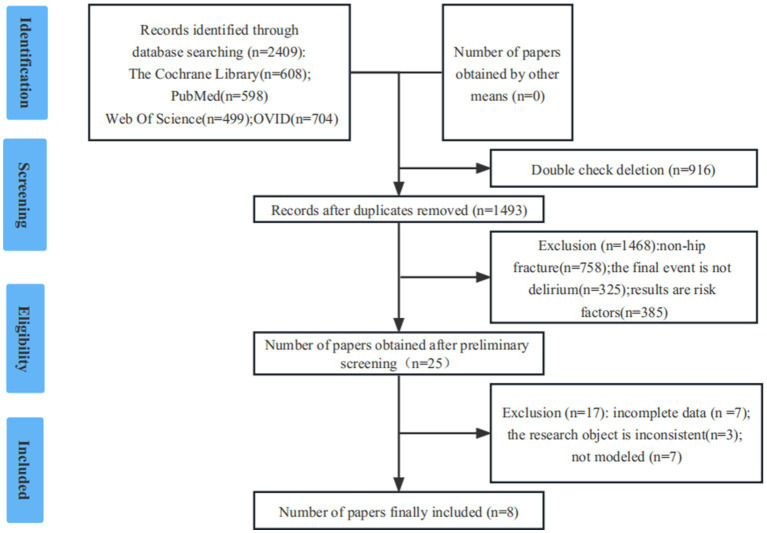
Risk prediction models for postoperative delirium in older adult hip fracture patients were collected from the Cochrane Library, PubMed, Web of Science, and Ovid via the internet, covering studies from the establishment of the databases to March 15, 2023. Two researchers independently screened the literature, extracted data, and used Stata 13.0 for meta-analysis of predictive factors and the Prediction Model Risk of Bias Assessment Tool (PROBAST) to evaluate the risk prediction models for postoperative delirium in older adult hip fracture patients, evaluated the predictive performance.
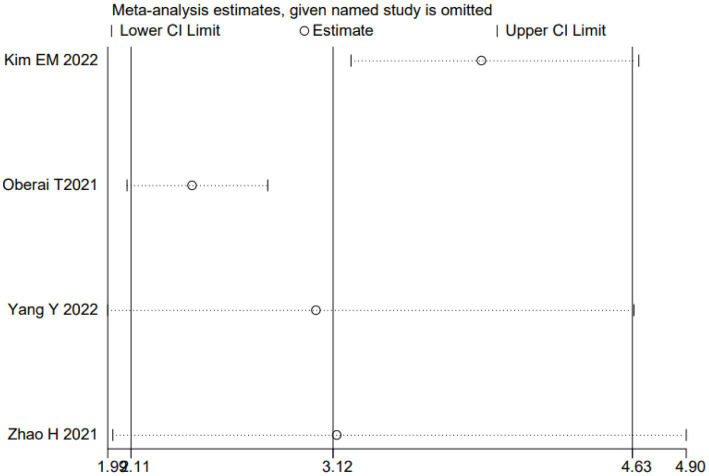
This analysis included eight studies. Six studies used internal validation to assess the predictive models, while one combined both internal and external validation. The Area Under Curve (AUC) for the models ranged from 0.67 to 0.79. The most common predictors were preoperative dementia or dementia history (OR = 3.123, 95% CI 2.108-4.626, < 0.001), American Society of Anesthesiologists (ASA) classification (OR = 2.343, 95% CI 1.146-4.789, < 0.05), and age (OR = 1.615, 95% CI 1.387-1.880, < 0.001). This meta-analysis shows that these were independent risk factors for postoperative delirium in older adult patients with hip fracture.
Research on the risk prediction models for postoperative delirium in older adult hip fracture patients is still in the developmental stage. The predictive performance of some of the established models achieve expectation and the applicable risk of all models is low, but there are also problems such as high risk of bias and lack of external validation. Medical professionals should select existing models and validate and optimize them with large samples from multiple centers according to their actual situation. It is more recommended to carry out a large sample of prospective studies to build prediction models.
The protocol for this systematic review was published in the International Prospective Register of Systematic Reviews (PROSPERO) under the registered number CRD42022365258.
系统评价老年髋部骨折患者术后谵妄的风险预测模型。
通过互联网从考克兰图书馆、PubMed、科学网和Ovid收集老年髋部骨折患者术后谵妄的风险预测模型,涵盖从数据库建立至2023年3月15日的研究。两名研究人员独立筛选文献、提取数据,并使用Stata 13.0对预测因素进行荟萃分析,以及使用预测模型偏倚风险评估工具(PROBAST)评估老年髋部骨折患者术后谵妄的风险预测模型,评估预测性能。
本分析纳入八项研究。六项研究使用内部验证来评估预测模型,一项研究同时结合了内部和外部验证。模型的曲线下面积(AUC)范围为0.67至0.79。最常见的预测因素为术前痴呆或痴呆病史(OR = 3.123,95%CI 2.108 - 4.626,P < 0.001)、美国麻醉医师协会(ASA)分级(OR = 2.343,95%CI 1.146 - 4.789,P < 0.05)和年龄(OR = 1.615,95%CI 1.387 - 1.880,P < 0.001)。本荟萃分析表明,这些是老年髋部骨折患者术后谵妄的独立危险因素。
老年髋部骨折患者术后谵妄风险预测模型的研究仍处于发展阶段。一些已建立模型的预测性能达到预期,所有模型的适用风险较低,但也存在偏倚风险高和缺乏外部验证等问题。医学专业人员应根据实际情况选择现有模型,并通过多中心大样本进行验证和优化。更建议开展大样本前瞻性研究来构建预测模型。
本系统评价方案已发表于国际前瞻性系统评价注册库(PROSPERO),注册号为CRD42022365258。