Wanjau Mary Njeri, Möller Holger, Haigh Fiona, Milat Andrew, Hayek Rema, Lucas Peta, Veerman J Lennert
Public Health & Economics Modelling Group, School of Medicine and Dentistry, Griffith University, Gold Coast, Australia.
Medicine & Health, School of Population Health, University of New South Wales, Sydney, Australia.
AJPM Focus. 2022 Sep 12;2(2):100030. doi: 10.1016/j.focus.2022.100030. eCollection 2023 Jun.
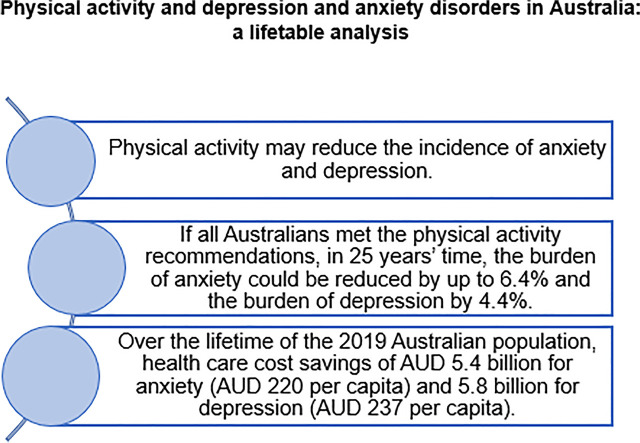
Mental disorders, in particular, depressive and anxiety disorders, are a leading cause of disability in Australia and globally. Physical activity may reduce the incidence of anxiety and depression, and this supports the inclusion of physical activity in strategies for the prevention of mental ill health. Policy makers need to know the potential impact and cost savings of such strategies. We aimed to quantify the impact of changes in physical activity on the burden of anxiety and depression and healthcare costs in Australia.
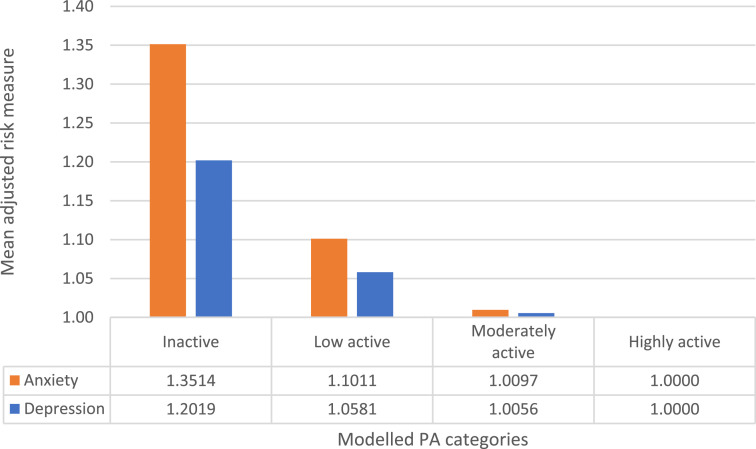
We used a proportional multistate lifetable model to estimate the impact of changes in physical activity levels on anxiety and depression burdens for the 2019 Australian population (numbering 24.6 million) over their remaining lifetime. The changes in physical activity were modeled through 3 counterfactual scenarios informed by policy targets: attainment of the Australian Physical Activity Guidelines and achievement of the WHO Global Action Plan on Physical Activity targets of a 10% relative reduction in the prevalence of insufficient physical activity by 2025 and a 15% relative reduction by 2030.
If all Australians adhered to the recommended minimum physical activity levels, in 25 years' time, the burden of anxiety could be reduced by up to 6.4% (95% uncertainty intervals=2.5, 10.6), and that of depression could be reduced by 4.4% (95% uncertainty intervals=2.3, 6.5). Over the lifetime of the 2019 Australian population, the gains could add up to 640,592 health-adjusted life years for anxiety (26 health-adjusted life years per 1,000 persons), 523,717 health-adjusted life years for depression (21 health-adjusted life years per 1,000 persons), and healthcare cost savings of 5.4 billion Australian dollars for anxiety (220 Australian dollars per capita) and 5.8 billion for depression (237 Australian dollars per capita).
Adherence to the Australian physical activity guidelines and achievement of the 2025 and 2030 global physical activity targets could lead to a substantial reduction of the burden of anxiety and depression. This study provides empirical support for the inclusion of physical activity in strategies for the prevention of mental ill health. Future studies should also assess the size and distribution of the benefits for different socioeconomic and ethnic groups.
精神障碍,尤其是抑郁和焦虑障碍,是澳大利亚乃至全球残疾的主要原因。体育活动可能会降低焦虑和抑郁的发病率,这支持将体育活动纳入预防精神疾病的策略中。政策制定者需要了解此类策略的潜在影响和成本节约情况。我们旨在量化体育活动变化对澳大利亚焦虑和抑郁负担以及医疗保健成本的影响。
我们使用比例多状态生命表模型来估计体育活动水平变化对2019年澳大利亚人口(2460万)剩余寿命期间焦虑和抑郁负担的影响。体育活动的变化通过基于政策目标的3种反事实情景进行建模:达到澳大利亚体育活动指南以及实现世界卫生组织《体育活动全球行动计划》的目标,即到2025年身体活动不足患病率相对降低10%,到2030年相对降低15%。
如果所有澳大利亚人都坚持建议的最低体育活动水平,25年后,焦虑负担最多可降低6.4%(95%不确定区间 = 2.5,10.6),抑郁负担可降低4.4%(95%不确定区间 = 2.3,6.5)。在2019年澳大利亚人口的一生中,这些收益总计可为焦虑增加640592个健康调整生命年(每1000人26个健康调整生命年),为抑郁增加523717个健康调整生命年(每1000人21个健康调整生命年),焦虑的医疗保健成本节约54亿澳元(人均220澳元),抑郁的医疗保健成本节约58亿澳元(人均237澳元)。
遵守澳大利亚体育活动指南以及实现2025年和2030年全球体育活动目标可大幅减轻焦虑和抑郁负担。本研究为将体育活动纳入预防精神疾病的策略提供了实证支持。未来的研究还应评估不同社会经济和种族群体的收益规模和分布情况。