Department of Psychiatry, The First Hospital of China Medical University, Shenyang, Liaoning, China.
Department of Psychiatry, The First Affiliated Hospital of Xi'an Jiaotong University, Xi'an, China.
Front Cell Infect Microbiol. 2023 Sep 18;13:1257073. doi: 10.3389/fcimb.2023.1257073. eCollection 2023.
Methamphetamine use disorder (MUD) poses a considerable public health threat, and its identification remains challenging due to the subjective nature of the current diagnostic system that relies on self-reported symptoms. Recent studies have suggested that MUD patients may have gut dysbiosis and that gut microbes may be involved in the pathological process of MUD. We aimed to examine gut dysbiosis among MUD patients and generate a machine-learning model utilizing gut microbiota features to facilitate the identification of MUD patients.
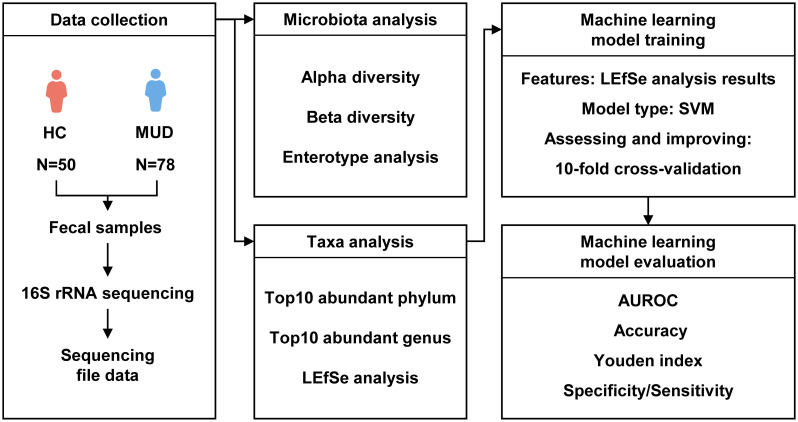
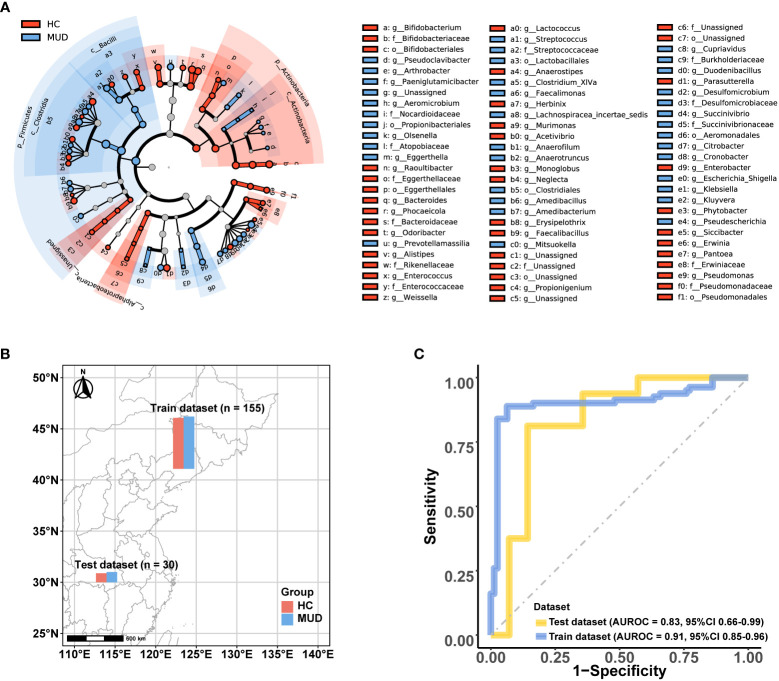
Fecal samples from 78 MUD patients and 50 sex- and age-matched healthy controls (HCs) were analyzed by 16S rDNA sequencing to identify gut microbial characteristics that could help differentiate MUD patients from HCs. Based on these microbial features, we developed a machine learning model to help identify MUD patients. We also used public data to verify the model; these data were downloaded from a published study conducted in Wuhan, China (with 16 MUD patients and 14 HCs). Furthermore, we explored the gut microbial features of MUD patients within the first three months of withdrawal to identify the withdrawal period of MUD patients based on microbial features.
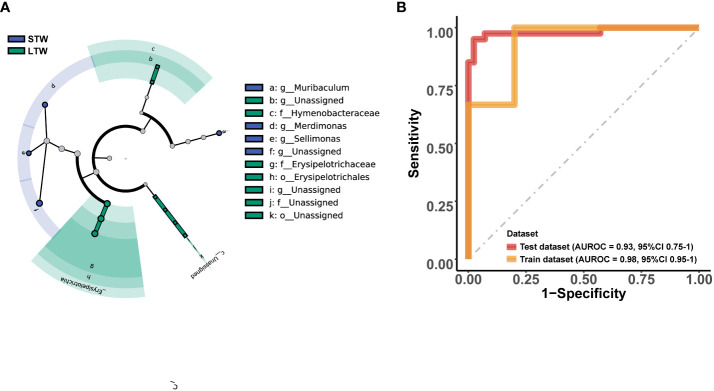
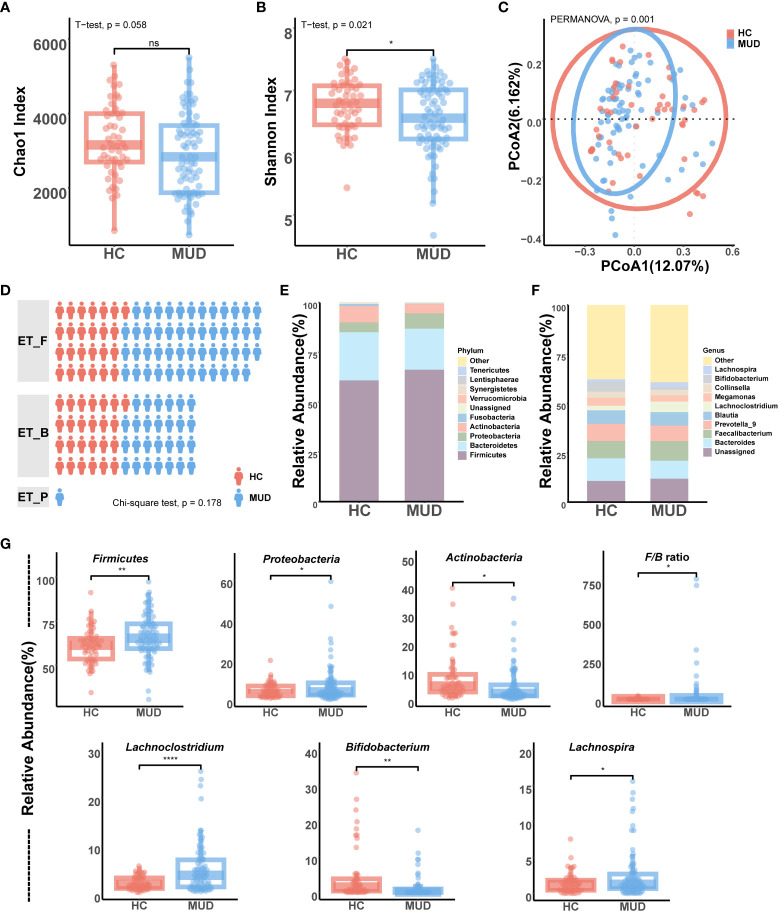
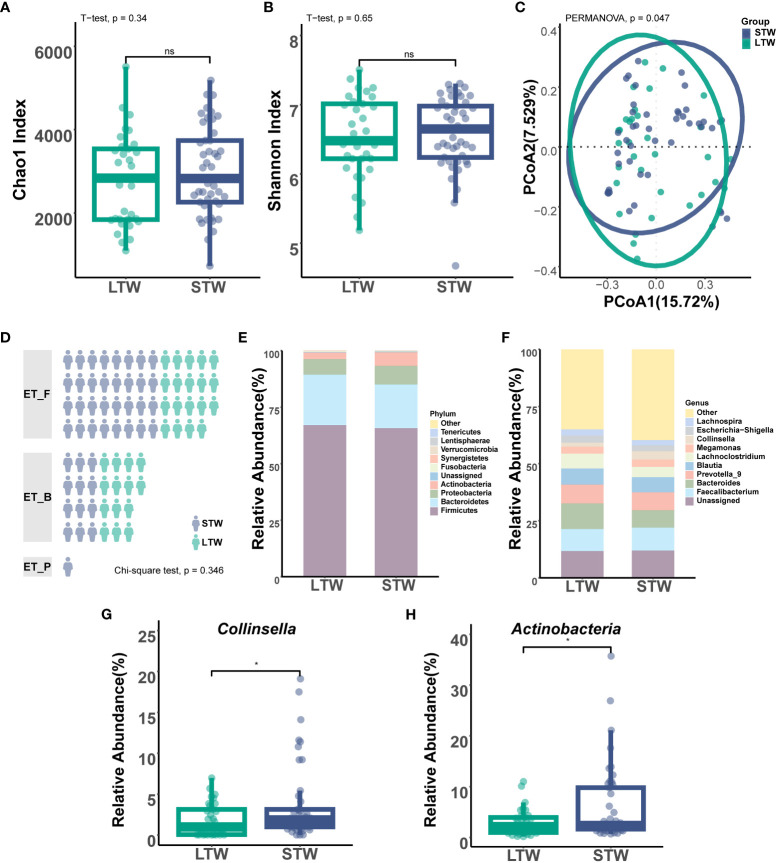
MUD patients exhibited significant gut dysbiosis, including decreased richness and evenness and changes in the abundance of certain microbes, such as and . Based on the gut microbiota features of MUD patients, we developed a machine learning model that demonstrated exceptional performance with an AUROC of 0.906 for identifying MUD patients. Additionally, when tested using an external and cross-regional dataset, the model achieved an AUROC of 0.830. Moreover, MUD patients within the first three months of withdrawal exhibited specific gut microbiota features, such as the significant enrichment of . The machine learning model had an AUROC of 0.930 for identifying the withdrawal period of MUD patients.
In conclusion, the gut microbiota is a promising biomarker for identifying MUD and thus represents a potential approach to improving the identification of MUD patients. Future longitudinal studies are needed to validate these findings.
甲基苯丙胺使用障碍(MUD)对公共健康构成了相当大的威胁,由于当前依赖于自我报告症状的诊断系统的主观性,其识别仍然具有挑战性。最近的研究表明,MUD 患者可能存在肠道菌群失调,肠道微生物可能参与 MUD 的病理过程。我们旨在检查 MUD 患者的肠道菌群失调,并利用肠道微生物群特征生成机器学习模型,以帮助识别 MUD 患者。
通过 16S rDNA 测序分析 78 例 MUD 患者和 50 名年龄和性别匹配的健康对照(HC)的粪便样本,以鉴定可帮助区分 MUD 患者和 HCs 的肠道微生物特征。基于这些微生物特征,我们开发了一种机器学习模型来帮助识别 MUD 患者。我们还使用公共数据验证了该模型;这些数据是从中国武汉发表的一项研究中下载的(有 16 名 MUD 患者和 14 名 HCs)。此外,我们还探索了 MUD 患者在戒断的头三个月内的肠道微生物特征,以根据微生物特征确定 MUD 患者的戒断期。
MUD 患者表现出明显的肠道菌群失调,包括丰富度和均匀度降低以及某些微生物丰度的变化,如 和 。基于 MUD 患者的肠道微生物群特征,我们开发了一种机器学习模型,该模型在识别 MUD 患者方面表现出优异的性能,AUROC 为 0.906。此外,当使用外部和跨区域数据集进行测试时,该模型的 AUROC 为 0.830。此外,MUD 患者在戒断的头三个月内表现出特定的肠道微生物群特征,如 的显著富集。机器学习模型在识别 MUD 患者的戒断期方面的 AUROC 为 0.930。
总之,肠道微生物群是识别 MUD 的有前途的生物标志物,因此代表了改善 MUD 患者识别的潜在方法。需要进一步进行纵向研究来验证这些发现。