Department of Neurology, Mayo Clinic, Rochester, MN, United States.
Department of Laboratory Medicine and Pathology, Mayo Clinic, Rochester, MN, United States.
Front Immunol. 2023 Sep 18;14:1243946. doi: 10.3389/fimmu.2023.1243946. eCollection 2023.
The development of new autoantigen discovery techniques, like programmable phage immunoprecipitation sequencing (PhIP-Seq), has accelerated the discovery of neural-specific autoantibodies. Herein, we report the identification of a novel biomarker for paraneoplastic neurologic syndrome (PNS), Sloan-Kettering-Virus-Family-Transcriptional-Corepressor-2 (SKOR2)-IgG, utilizing PhIP-Seq. We have also performed a thorough clinical validation using normal, healthy, and disease/cancer control samples.
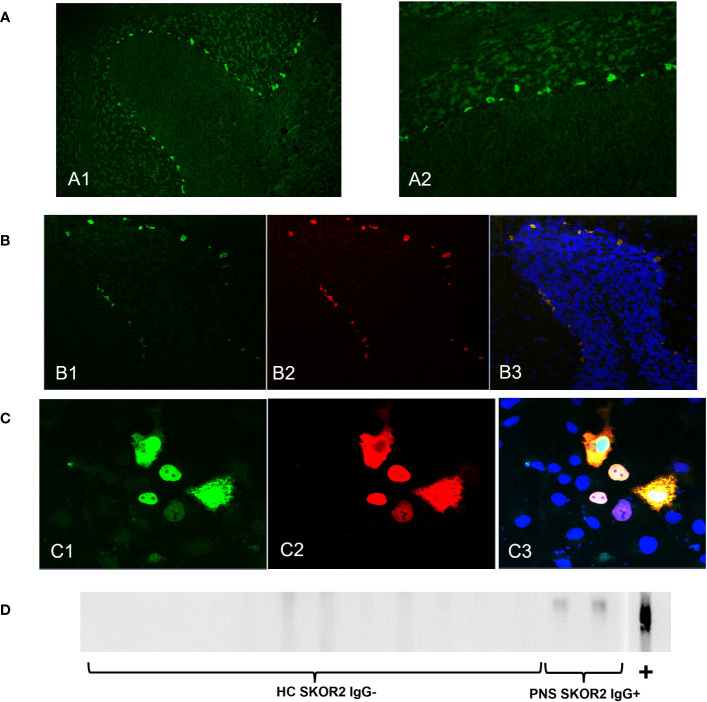
Stored samples with unclassified staining at the junction of the Purkinje cell and the granule cell layers were analyzed by PhIP-Seq for putative autoantigen identification. The autoantigen was confirmed by recombinant antigen-expressing cell-based assay (CBA), Western blotting, and tissue immunofluorescence assay colocalization.
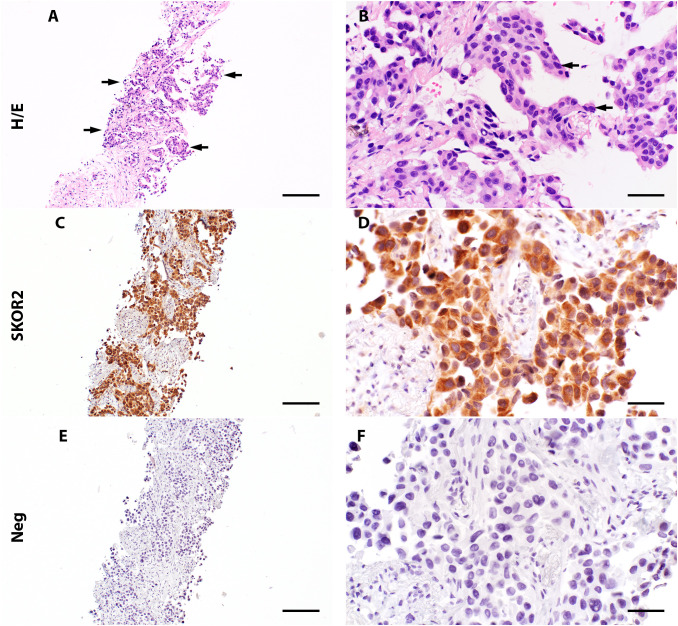
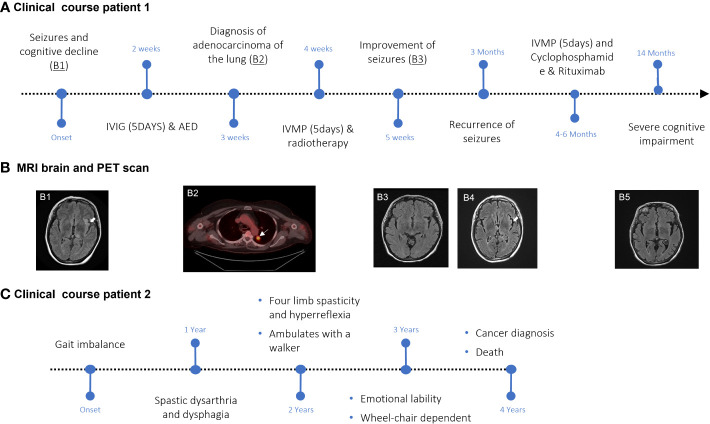
PhIP-Seq data revealed SKOR2 as the candidate autoantigen. The target antigen was confirmed by a recombinant SKOR-2-expressing, and cell lysate Western blot. Furthermore, IgG from both patient samples colocalized with a commercial SKOR2-specific IgG on cryosections of the mouse brain. Both SKOR2 IgG-positive patients had central nervous system involvement, one presenting with encephalitis and seizures (Patient 1) and the other with cognitive dysfunction, spastic ataxia, dysarthria, dysphagia, and pseudobulbar affect (Patient 2). They had a refractory progressive course and were diagnosed with adenocarcinoma (Patient 1: lung, Patient 2: gallbladder). Sera from adenocarcinoma patients without PNS (n=30) tested for SKOR2-IgG were negative.
SKOR2 IgG represents a novel biomarker for PNS associated with adenocarcinoma. Identification of additional SKOR2 IgG-positive cases will help categorize the associated neurological phenotype and the risk of underlying malignancy.
新的自身抗原发现技术的发展,如可编程噬菌体免疫沉淀测序(PhIP-Seq),加速了神经特异性自身抗体的发现。在此,我们报告了一种新的副肿瘤神经系统综合征(PNS)生物标志物的鉴定,即Sloan-Kettering-Virus-Family-Transcriptional-Corepressor-2(SKOR2)-IgG,利用 PhIP-Seq 技术。我们还使用正常、健康和疾病/癌症对照样本进行了全面的临床验证。
通过 PhIP-Seq 分析在浦肯野细胞和颗粒细胞层交界处具有未分类染色的储存样本,以鉴定潜在的自身抗原。通过重组抗原表达细胞基础测定(CBA)、Western blot 和组织免疫荧光测定共定位来确认自身抗原。
PhIP-Seq 数据显示 SKOR2 是候选自身抗原。目标抗原通过表达 SKOR-2 的重组抗原和细胞裂解物 Western blot 得到确认。此外,来自两名患者样本的 IgG 与小鼠脑组织冷冻切片上的商业 SKOR2 特异性 IgG 共定位。两名 SKOR2 IgG 阳性患者均有中枢神经系统受累,一名表现为脑炎和癫痫(患者 1),另一名表现为认知功能障碍、痉挛性共济失调、构音障碍、吞咽困难和假性延髓影响(患者 2)。他们的病情呈难治性进行性发展,并被诊断为腺癌(患者 1:肺癌,患者 2:胆囊癌)。未发生 PNS 的腺癌患者(n=30)的血清检测 SKOR2-IgG 均为阴性。
SKOR2 IgG 代表与腺癌相关的 PNS 的新型生物标志物。鉴定更多的 SKOR2 IgG 阳性病例将有助于分类相关的神经表型和潜在恶性肿瘤的风险。