Division of Microbial Ecology, Department of Microbiology and Ecosystem Science, Research Network Chemistry meets Microbiology, University of Vienna, Vienna, Austria.
Department of Biology, University of Konstanz, Konstanz, Germany.
ISME J. 2018 Jun;12(7):1729-1742. doi: 10.1038/s41396-018-0077-1. Epub 2018 Feb 23.
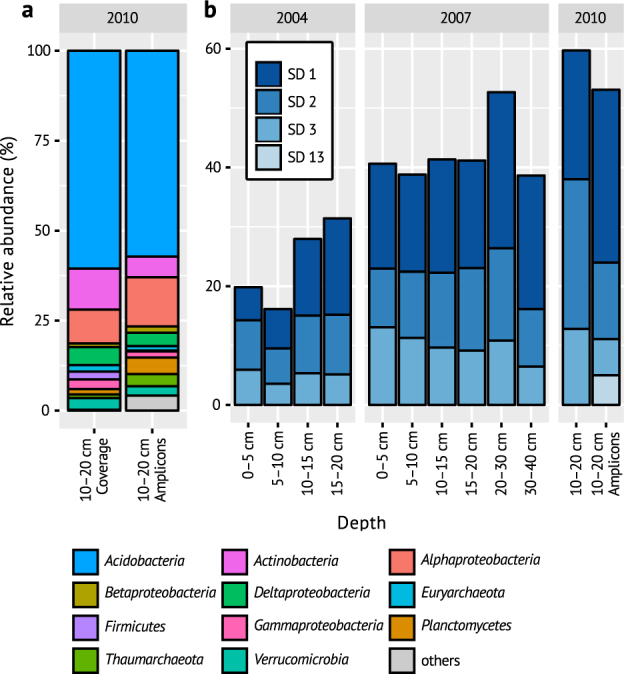
Sulfur-cycling microorganisms impact organic matter decomposition in wetlands and consequently greenhouse gas emissions from these globally relevant environments. However, their identities and physiological properties are largely unknown. By applying a functional metagenomics approach to an acidic peatland, we recovered draft genomes of seven novel Acidobacteria species with the potential for dissimilatory sulfite (dsrAB, dsrC, dsrD, dsrN, dsrT, dsrMKJOP) or sulfate respiration (sat, aprBA, qmoABC plus dsr genes). Surprisingly, the genomes also encoded DsrL, which so far was only found in sulfur-oxidizing microorganisms. Metatranscriptome analysis demonstrated expression of acidobacterial sulfur-metabolism genes in native peat soil and their upregulation in diverse anoxic microcosms. This indicated an active sulfate respiration pathway, which, however, might also operate in reverse for dissimilatory sulfur oxidation or disproportionation as proposed for the sulfur-oxidizing Desulfurivibrio alkaliphilus. Acidobacteria that only harbored genes for sulfite reduction additionally encoded enzymes that liberate sulfite from organosulfonates, which suggested organic sulfur compounds as complementary energy sources. Further metabolic potentials included polysaccharide hydrolysis and sugar utilization, aerobic respiration, several fermentative capabilities, and hydrogen oxidation. Our findings extend both, the known physiological and genetic properties of Acidobacteria and the known taxonomic diversity of microorganisms with a DsrAB-based sulfur metabolism, and highlight new fundamental niches for facultative anaerobic Acidobacteria in wetlands based on exploitation of inorganic and organic sulfur molecules for energy conservation.
硫循环微生物会影响湿地中有机物的分解,从而影响这些具有全球重要意义的环境中温室气体的排放。然而,它们的身份和生理特性在很大程度上是未知的。通过对酸性泥炭地应用功能宏基因组学方法,我们获得了具有异化亚硫酸盐呼吸(dsrAB、dsrC、dsrD、dsrN、dsrT、dsrMKJOP)或硫酸盐呼吸(sat、aprBA、qmoABC 加 dsr 基因)潜力的 7 种新型 Acidobacteria 种的草案基因组。令人惊讶的是,这些基因组还编码了 DsrL,迄今为止,它只在硫氧化微生物中发现过。宏转录组分析表明,酸杆菌硫代谢基因在原生泥炭土中表达,并在多种缺氧微宇宙中上调。这表明存在活跃的硫酸盐呼吸途径,但正如已提出的,对于异化硫氧化或歧化作用,该途径也可能反向运行,如硫氧化的 Desulfurivibrio alkaliphilus 就是如此。仅携带亚硫酸盐还原基因的 Acidobacteria 还编码了从有机磺酸盐中释放亚硫酸盐的酶,这表明有机硫化合物是补充能源。进一步的代谢潜力包括多糖水解和糖利用、需氧呼吸、几种发酵能力和氢气氧化。我们的发现既扩展了 Acidobacteria 的已知生理和遗传特性,也扩展了基于 DsrAB 硫代谢的具有微生物的已知分类多样性,并强调了基于利用无机和有机硫分子进行能量保存的湿地中兼性厌氧 Acidobacteria 的新基础生态位。