Department of Research, Norwegian Air Ambulance Foundation, Oslo, Norway.
Faculty of Health Sciences, University of Stavanger, Stavanger, Norway.
Scand J Trauma Resusc Emerg Med. 2023 Oct 5;31(1):53. doi: 10.1186/s13049-023-01121-w.
Norway has a diverse population pattern and often long transport distances from injury sites to hospitals. Also, previous studies have found an increased risk of trauma-related mortality in remote areas in Norway. Studies on urban vs. remote differences on trauma outcomes from other countries are sparse and they report conflicting results.The aim of the present study was to investigate differences in prehospital time intervals in urban and remote areas in Norway and assess how prehospital time and urban vs. remote settings were associated with mortality in the Norwegian trauma population.
We performed a population-based study of trauma cases included in the Norwegian Trauma Registry from 2015 to 2020. 28,988 patients met the inclusion criteria. Differences in study population characteristics and prehospital time intervals (response time, on-scene time and transport time) were analyzed. The Norwegian Centrality Index score was used for urban vs. remote classification. Descriptive statistics and relevant non-parametric tests with effect size measurements were used. A binary logistic regression model, adjusted for confounding factors, was performed.
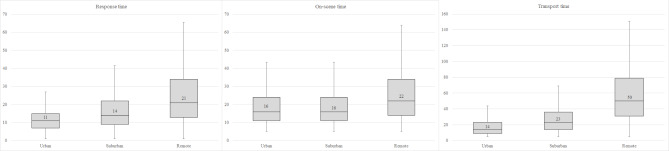
The prehospital time intervals increased significantly from urban to remote areas.Adjusted for control variables we found a significant relationship between prolonged on-scene time and higher odds of mortality. Also, suburban areas compared with remote areas were associated with higher odds of mortality.
In this nationwide study comparing prehospital time intervals in urban and remote areas, we found that prehospital time intervals in remote areas exceeded those in urban areas. Prolonged on-scene time was found to be associated with higher odds of mortality, but remoteness itself was not.
挪威的人口分布模式多样,受伤地点与医院之间的交通距离往往很长。此外,先前的研究发现,挪威偏远地区的创伤相关死亡率较高。关于其他国家城市与偏远地区创伤结局差异的研究较少,且结果相互矛盾。本研究旨在调查挪威城市和偏远地区院前时间间隔的差异,并评估院前时间以及城市与偏远地区环境与挪威创伤人群死亡率之间的关系。
我们对 2015 年至 2020 年纳入挪威创伤登记处的创伤病例进行了一项基于人群的研究。符合纳入标准的患者共 28988 例。分析了研究人群特征和院前时间间隔(反应时间、现场时间和转运时间)的差异。使用挪威中心性指数评分进行城市与偏远地区的分类。采用描述性统计和相关非参数检验,并进行效应量测量。采用二元逻辑回归模型,调整混杂因素。
从城市到偏远地区,院前时间间隔显著增加。调整了控制变量后,我们发现现场时间延长与死亡率升高显著相关。与偏远地区相比,郊区的死亡率更高。
在这项比较城市和偏远地区院前时间间隔的全国性研究中,我们发现偏远地区的院前时间间隔长于城市地区。发现现场时间延长与死亡率升高相关,但偏远地区本身与死亡率升高无关。