• 文献检索
  • 文档翻译
  • 深度研究
  • 学术资讯
  • Suppr Zotero 插件Zotero 插件
  • 邀请有礼
  • 套餐&价格
  • 历史记录
应用&插件
Suppr Zotero 插件Zotero 插件浏览器插件Mac 客户端Windows 客户端微信小程序
定价
高级版会员购买积分包购买API积分包
服务
文献检索文档翻译深度研究API 文档MCP 服务
关于我们
关于 Suppr公司介绍联系我们用户协议隐私条款
关注我们

Suppr 超能文献

核心技术专利:CN118964589B侵权必究
粤ICP备2023148730 号-1Suppr @ 2026

文献检索

告别复杂PubMed语法,用中文像聊天一样搜索,搜遍4000万医学文献。AI智能推荐,让科研检索更轻松。

立即免费搜索

文件翻译

保留排版,准确专业,支持PDF/Word/PPT等文件格式,支持 12+语言互译。

免费翻译文档

深度研究

AI帮你快速写综述,25分钟生成高质量综述,智能提取关键信息,辅助科研写作。

立即免费体验

基于深度学习的术后胶质母细胞瘤MRI分割算法:肿瘤负荷评估的一种有前景的新工具。

Deep learning-based algorithm for postoperative glioblastoma MRI segmentation: a promising new tool for tumor burden assessment.

作者信息

Bianconi Andrea, Rossi Luca Francesco, Bonada Marta, Zeppa Pietro, Nico Elsa, De Marco Raffaele, Lacroce Paola, Cofano Fabio, Bruno Francesco, Morana Giovanni, Melcarne Antonio, Ruda Roberta, Mainardi Luca, Fiaschi Pietro, Garbossa Diego, Morra Lia

机构信息

Neurosurgery, Department of Neuroscience, University of Turin, via Cherasco 15, 10126, Turin, Italy.

Dipartimento di Automatica e Informatica, Politecnico di Torino, Turin, Italy.

出版信息

Brain Inform. 2023 Oct 6;10(1):26. doi: 10.1186/s40708-023-00207-6.

DOI:10.1186/s40708-023-00207-6
PMID:37801128
原文链接:https://pmc.ncbi.nlm.nih.gov/articles/PMC10558414/
Abstract

OBJECTIVE

Clinical and surgical decisions for glioblastoma patients depend on a tumor imaging-based evaluation. Artificial Intelligence (AI) can be applied to magnetic resonance imaging (MRI) assessment to support clinical practice, surgery planning and prognostic predictions. In a real-world context, the current obstacles for AI are low-quality imaging and postoperative reliability. The aim of this study is to train an automatic algorithm for glioblastoma segmentation on a clinical MRI dataset and to obtain reliable results both pre- and post-operatively.

METHODS

The dataset used for this study comprises 237 (71 preoperative and 166 postoperative) MRIs from 71 patients affected by a histologically confirmed Grade IV Glioma. The implemented U-Net architecture was trained by transfer learning to perform the segmentation task on postoperative MRIs. The training was carried out first on BraTS2021 dataset for preoperative segmentation. Performance is evaluated using DICE score (DS) and Hausdorff 95% (H95).

RESULTS

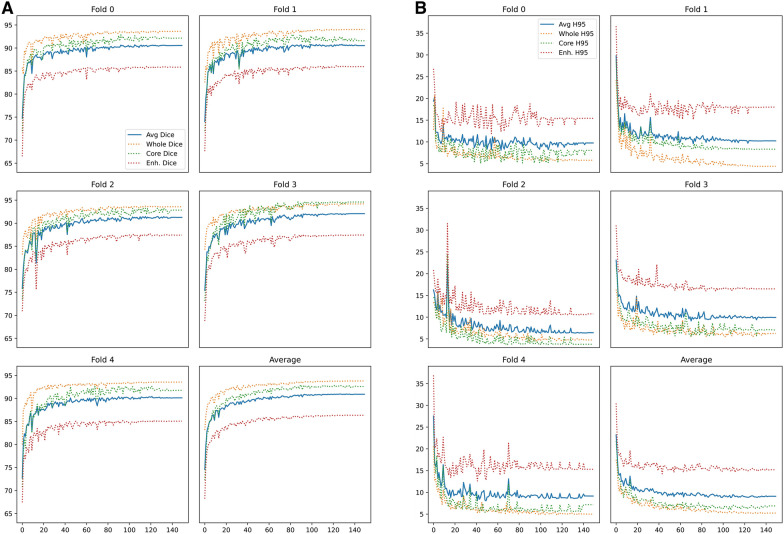
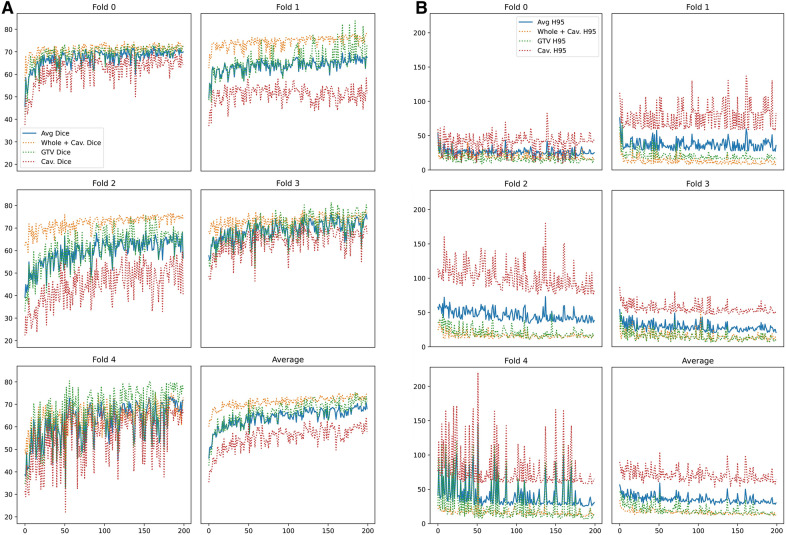
In preoperative scenario, overall DS is 91.09 (± 0.60) and H95 is 8.35 (± 1.12), considering tumor core, enhancing tumor and whole tumor (ET and edema). In postoperative context, overall DS is 72.31 (± 2.88) and H95 is 23.43 (± 7.24), considering resection cavity (RC), gross tumor volume (GTV) and whole tumor (WT). Remarkably, the RC segmentation obtained a mean DS of 63.52 (± 8.90) in postoperative MRIs.

CONCLUSIONS

The performances achieved by the algorithm are consistent with previous literature for both pre-operative and post-operative glioblastoma's MRI evaluation. Through the proposed algorithm, it is possible to reduce the impact of low-quality images and missing sequences.

摘要

目的

胶质母细胞瘤患者的临床和手术决策取决于基于肿瘤成像的评估。人工智能(AI)可应用于磁共振成像(MRI)评估,以支持临床实践、手术规划和预后预测。在实际应用中,AI目前面临的障碍是成像质量低和术后可靠性问题。本研究的目的是在临床MRI数据集上训练一种用于胶质母细胞瘤分割的自动算法,并在术前和术后均获得可靠结果。

方法

本研究使用的数据集包括来自71例经组织学确诊为IV级胶质瘤患者的237张MRI图像(71例术前和166例术后)。通过迁移学习训练所实现的U-Net架构,以在术后MRI图像上执行分割任务。首先在BraTS2021数据集上进行术前分割训练。使用DICE评分(DS)和Hausdorff 95%(H95)评估性能。

结果

在术前情况下,考虑肿瘤核心、强化肿瘤和整个肿瘤(增强肿瘤和水肿),总体DS为91.09(±0.60),H95为8.35(±1.12)。在术后情况下,考虑切除腔(RC)、大体肿瘤体积(GTV)和整个肿瘤(WT),总体DS为72.31(±2.88),H95为23.43(±7.24)。值得注意的是,术后MRI图像中RC分割的平均DS为63.52(±8.90)。

结论

该算法在术前和术后胶质母细胞瘤的MRI评估中所取得的性能与先前文献一致。通过所提出的算法,可以减少低质量图像和缺失序列的影响。
https://cdn.ncbi.nlm.nih.gov/pmc/blobs/7de5/10558414/07675b8bfdbd/40708_2023_207_Fig6_HTML.jpg
https://cdn.ncbi.nlm.nih.gov/pmc/blobs/7de5/10558414/a1f65cdf351a/40708_2023_207_Fig1_HTML.jpg
https://cdn.ncbi.nlm.nih.gov/pmc/blobs/7de5/10558414/3e0dada79d9f/40708_2023_207_Fig2_HTML.jpg
https://cdn.ncbi.nlm.nih.gov/pmc/blobs/7de5/10558414/46e4010f73d1/40708_2023_207_Fig3_HTML.jpg
https://cdn.ncbi.nlm.nih.gov/pmc/blobs/7de5/10558414/331ced8697d8/40708_2023_207_Fig4_HTML.jpg
https://cdn.ncbi.nlm.nih.gov/pmc/blobs/7de5/10558414/21f17cd3f5bc/40708_2023_207_Fig5_HTML.jpg
https://cdn.ncbi.nlm.nih.gov/pmc/blobs/7de5/10558414/07675b8bfdbd/40708_2023_207_Fig6_HTML.jpg
https://cdn.ncbi.nlm.nih.gov/pmc/blobs/7de5/10558414/a1f65cdf351a/40708_2023_207_Fig1_HTML.jpg
https://cdn.ncbi.nlm.nih.gov/pmc/blobs/7de5/10558414/3e0dada79d9f/40708_2023_207_Fig2_HTML.jpg
https://cdn.ncbi.nlm.nih.gov/pmc/blobs/7de5/10558414/46e4010f73d1/40708_2023_207_Fig3_HTML.jpg
https://cdn.ncbi.nlm.nih.gov/pmc/blobs/7de5/10558414/331ced8697d8/40708_2023_207_Fig4_HTML.jpg
https://cdn.ncbi.nlm.nih.gov/pmc/blobs/7de5/10558414/21f17cd3f5bc/40708_2023_207_Fig5_HTML.jpg
https://cdn.ncbi.nlm.nih.gov/pmc/blobs/7de5/10558414/07675b8bfdbd/40708_2023_207_Fig6_HTML.jpg

相似文献

1
Deep learning-based algorithm for postoperative glioblastoma MRI segmentation: a promising new tool for tumor burden assessment.基于深度学习的术后胶质母细胞瘤MRI分割算法:肿瘤负荷评估的一种有前景的新工具。
Brain Inform. 2023 Oct 6;10(1):26. doi: 10.1186/s40708-023-00207-6.
2
A Novel Approach for Fully Automatic Intra-Tumor Segmentation With 3D U-Net Architecture for Gliomas.一种采用3D U-Net架构对胶质瘤进行全自动肿瘤内分割的新方法。
Front Comput Neurosci. 2020 Feb 18;14:10. doi: 10.3389/fncom.2020.00010. eCollection 2020.
3
Postoperative glioma segmentation in CT image using deep feature fusion model guided by multi-sequence MRIs.基于多序列 MRI 引导的深度特征融合模型的 CT 图像术后脑肿瘤分割。
Eur Radiol. 2020 Feb;30(2):823-832. doi: 10.1007/s00330-019-06441-z. Epub 2019 Oct 24.
4
Application of deep learning for automatic segmentation of brain tumors on magnetic resonance imaging: a heuristic approach in the clinical scenario.深度学习在磁共振成像脑肿瘤自动分割中的应用:临床场景中的启发式方法。
Neuroradiology. 2021 Aug;63(8):1253-1262. doi: 10.1007/s00234-021-02649-3. Epub 2021 Jan 26.
5
A hybrid feature selection-based approach for brain tumor detection and automatic segmentation on multiparametric magnetic resonance images.一种基于混合特征选择的方法用于多参数磁共振图像上的脑肿瘤检测与自动分割。
Med Phys. 2021 Nov;48(11):6614-6626. doi: 10.1002/mp.15026. Epub 2021 Sep 24.
6
Deep learning automates bidimensional and volumetric tumor burden measurement from MRI in pre- and post-operative glioblastoma patients.深度学习自动实现术前和术后胶质母细胞瘤患者 MRI 的二维和体积肿瘤负担测量。
Comput Biol Med. 2023 Mar;154:106603. doi: 10.1016/j.compbiomed.2023.106603. Epub 2023 Feb 2.
7
Layered deep learning for automatic mandibular segmentation in cone-beam computed tomography.基于分层深度学习的锥形束计算机断层扫描下颌骨自动分割。
J Dent. 2021 Nov;114:103786. doi: 10.1016/j.jdent.2021.103786. Epub 2021 Aug 20.
8
Deep learning for segmentation of the cervical cancer gross tumor volume on magnetic resonance imaging for brachytherapy.磁共振成像引导近距离治疗中宫颈癌大体肿瘤体积的深度学习分割。
Radiat Oncol. 2023 May 29;18(1):91. doi: 10.1186/s13014-023-02283-8.
9
Fully automated brain resection cavity delineation for radiation target volume definition in glioblastoma patients using deep learning.基于深度学习的全自动化脑切除腔勾画在胶质母细胞瘤患者放射靶区定义中的应用。
Radiat Oncol. 2020 May 6;15(1):100. doi: 10.1186/s13014-020-01553-z.
10
Clinical Evaluation of a Multiparametric Deep Learning Model for Glioblastoma Segmentation Using Heterogeneous Magnetic Resonance Imaging Data From Clinical Routine.基于临床常规的多模态磁共振成像数据的胶质母细胞瘤分割的多参数深度学习模型的临床评估。
Invest Radiol. 2018 Nov;53(11):647-654. doi: 10.1097/RLI.0000000000000484.

引用本文的文献

1
A Review on Deep Learning Methods for Glioma Segmentation, Limitations, and Future Perspectives.胶质瘤分割的深度学习方法、局限性及未来展望综述
J Imaging. 2025 Aug 11;11(8):269. doi: 10.3390/jimaging11080269.
2
Development and validation of a deep learning algorithm for discriminating glioma recurrence from radiation necrosis on MRI.一种用于在磁共振成像(MRI)上鉴别胶质瘤复发与放射性坏死的深度学习算法的开发与验证
Front Oncol. 2025 Jun 6;15:1573700. doi: 10.3389/fonc.2025.1573700. eCollection 2025.
3
BrainTumNet: multi-task deep learning framework for brain tumor segmentation and classification using adaptive masked transformers.

本文引用的文献

1
Deep learning automates bidimensional and volumetric tumor burden measurement from MRI in pre- and post-operative glioblastoma patients.深度学习自动实现术前和术后胶质母细胞瘤患者 MRI 的二维和体积肿瘤负担测量。
Comput Biol Med. 2023 Mar;154:106603. doi: 10.1016/j.compbiomed.2023.106603. Epub 2023 Feb 2.
2
AAPM task group report 273: Recommendations on best practices for AI and machine learning for computer-aided diagnosis in medical imaging.AAPM 工作组报告 273:关于医学影像计算机辅助诊断中人工智能和机器学习的最佳实践建议。
Med Phys. 2023 Feb;50(2):e1-e24. doi: 10.1002/mp.16188. Epub 2023 Jan 6.
3
Post-operative glioblastoma multiforme segmentation with uncertainty estimation.
BrainTumNet:用于脑肿瘤分割与分类的多任务深度学习框架,采用自适应掩码变换器。
Front Oncol. 2025 May 20;15:1585891. doi: 10.3389/fonc.2025.1585891. eCollection 2025.
4
Deep learning in neurosurgery: a systematic literature review with a structured analysis of applications across subspecialties.神经外科中的深度学习:一项系统的文献综述,并对各亚专业的应用进行结构化分析。
Front Neurol. 2025 Apr 16;16:1532398. doi: 10.3389/fneur.2025.1532398. eCollection 2025.
5
Integrating quantitative DCE-MRI parameters and radiomic features for improved IDH mutation prediction in gliomas.整合定量动态对比增强磁共振成像(DCE-MRI)参数和影像组学特征以改善胶质瘤中异柠檬酸脱氢酶(IDH)突变预测
Front Oncol. 2025 Mar 11;15:1530144. doi: 10.3389/fonc.2025.1530144. eCollection 2025.
6
Deep learning-based postoperative glioblastoma segmentation and extent of resection evaluation: Development, external validation, and model comparison.基于深度学习的术后胶质母细胞瘤分割及切除范围评估:开发、外部验证和模型比较。
Neurooncol Adv. 2024 Nov 16;6(1):vdae199. doi: 10.1093/noajnl/vdae199. eCollection 2024 Jan-Dec.
7
Development and Evaluation of Automated Artificial Intelligence-Based Brain Tumor Response Assessment in Patients with Glioblastoma.胶质母细胞瘤患者基于人工智能的脑肿瘤反应自动评估的开发与评估
AJNR Am J Neuroradiol. 2025 May 2;46(5):990-998. doi: 10.3174/ajnr.A8580.
8
Repurposing the Public BraTS Dataset for Postoperative Brain Tumour Treatment Response Monitoring.重新利用公共 BraTS 数据集进行术后脑瘤治疗反应监测。
Tomography. 2024 Sep 1;10(9):1397-1410. doi: 10.3390/tomography10090105.
9
Super-resolution reconstruction improves multishell diffusion: using radiomics to predict adult-type diffuse glioma IDH and grade.超分辨率重建改善多壳层扩散:利用放射组学预测成人型弥漫性胶质瘤的异柠檬酸脱氢酶(IDH)状态和分级。
Front Oncol. 2024 Sep 4;14:1435204. doi: 10.3389/fonc.2024.1435204. eCollection 2024.
10
Deep Learning for MRI Segmentation and Molecular Subtyping in Glioblastoma: Critical Aspects from an Emerging Field.胶质母细胞瘤中用于MRI分割和分子亚型分析的深度学习:新兴领域的关键方面
Biomedicines. 2024 Aug 16;12(8):1878. doi: 10.3390/biomedicines12081878.
具有不确定性估计的多形性胶质母细胞瘤术后分割
Front Hum Neurosci. 2022 Nov 3;16:932441. doi: 10.3389/fnhum.2022.932441. eCollection 2022.
4
Prognostic Analysis of the IDH1 G105G (rs11554137) SNP in IDH-Wildtype Glioblastoma.IDH 野生型胶质母细胞瘤中 IDH1 G105G(rs11554137) SNP 的预后分析。
Genes (Basel). 2022 Aug 12;13(8):1439. doi: 10.3390/genes13081439.
5
SynthStrip: skull-stripping for any brain image.SynthStrip:用于任何脑图像的头骨剥离。
Neuroimage. 2022 Oct 15;260:119474. doi: 10.1016/j.neuroimage.2022.119474. Epub 2022 Jul 13.
6
Elderly Gliobastoma Patients: The Impact of Surgery and Adjuvant Treatments on Survival: A Single Institution Experience.老年胶质母细胞瘤患者:手术及辅助治疗对生存的影响:单机构经验
Brain Sci. 2022 May 11;12(5):632. doi: 10.3390/brainsci12050632.
7
Systematic Review on Tumor Microenvironment in Glial Neoplasm: From Understanding Pathogenesis to Future Therapeutic Perspectives.胶质肿瘤肿瘤微环境的系统综述:从发病机制的理解到未来的治疗前景。
Int J Mol Sci. 2022 Apr 9;23(8):4166. doi: 10.3390/ijms23084166.
8
Deep learning-based convolutional neural network for intramodality brain MRI synthesis.基于深度学习的卷积神经网络用于单模态脑 MRI 合成。
J Appl Clin Med Phys. 2022 Apr;23(4):e13530. doi: 10.1002/acm2.13530. Epub 2022 Jan 19.
9
Glioblastoma Surgery Imaging-Reporting and Data System: Standardized Reporting of Tumor Volume, Location, and Resectability Based on Automated Segmentations.胶质母细胞瘤手术影像报告与数据系统:基于自动分割的肿瘤体积、位置及可切除性的标准化报告
Cancers (Basel). 2021 Jun 8;13(12):2854. doi: 10.3390/cancers13122854.
10
Robust Deep Learning-based Segmentation of Glioblastoma on Routine Clinical MRI Scans Using Sparsified Training.基于稀疏训练的常规临床MRI扫描胶质母细胞瘤的稳健深度学习分割
Radiol Artif Intell. 2020 Sep 30;2(5):e190103. doi: 10.1148/ryai.2020190103. eCollection 2020 Sep.