Key laboratory of Carcinogenesis and Translational Research (Ministry of Education/Beijing), Department of Radiation Oncology, Peking University Cancer Hospital & Institute, Beijing, 100142, China.
Research and Development Department, MedMind Technology Co., Ltd, Beijing, 100083, China.
Radiat Oncol. 2023 Oct 6;18(1):164. doi: 10.1186/s13014-023-02350-0.
Manual clinical target volume (CTV) and gross tumor volume (GTV) delineation for rectal cancer neoadjuvant radiotherapy is pivotal but labor-intensive. This study aims to propose a deep learning (DL)-based workflow towards fully automated clinical target volume (CTV) and gross tumor volume (GTV) delineation for rectal cancer neoadjuvant radiotherapy.
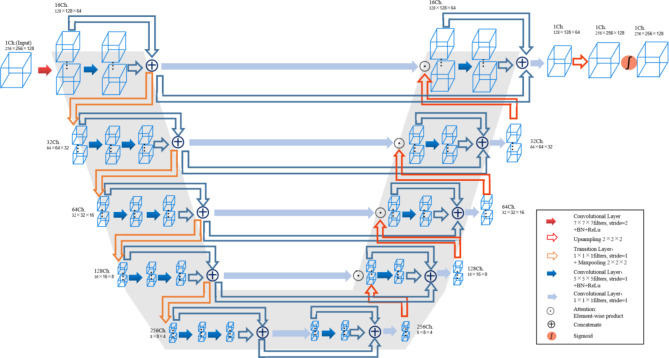
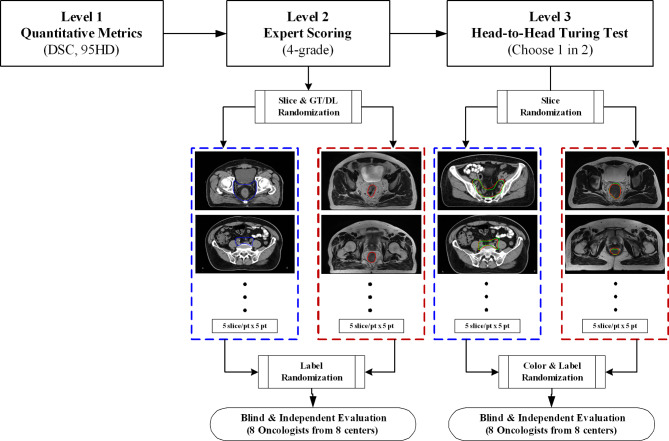
MATERIALS & METHODS: We retrospectively included 141 patients with Stage II-III mid-low rectal cancer and randomly grouped them into training (n = 121) and testing (n = 20) cohorts. We adopted a divide-and-conquer strategy to address CTV and GTV segmentation using two separate DL models with DpuUnet as backend-one model for CTV segmentation in the CT domain, and the other for GTV in the MRI domain. The workflow was validated using a three-level multicenter-involved blind and randomized evaluation scheme. Dice similarity coefficient (DSC) and 95th percentile Hausdorff distance (95HD) metrics were calculated in Level 1, four-grade expert scoring was performed in Level 2, and head-to-head Turing test in Level 3.
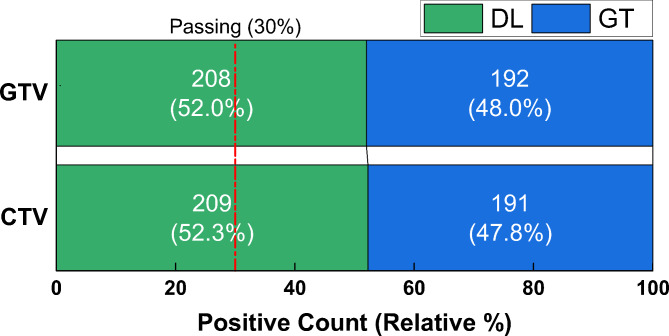
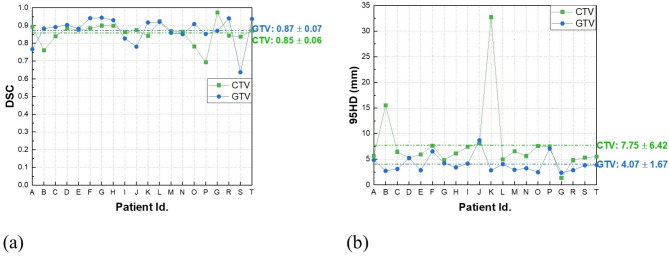
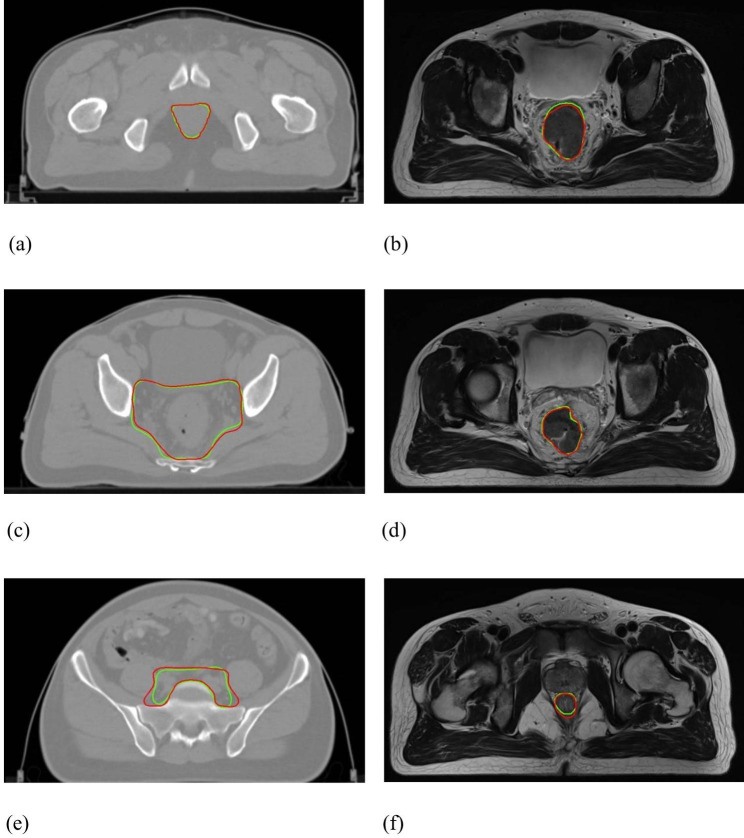
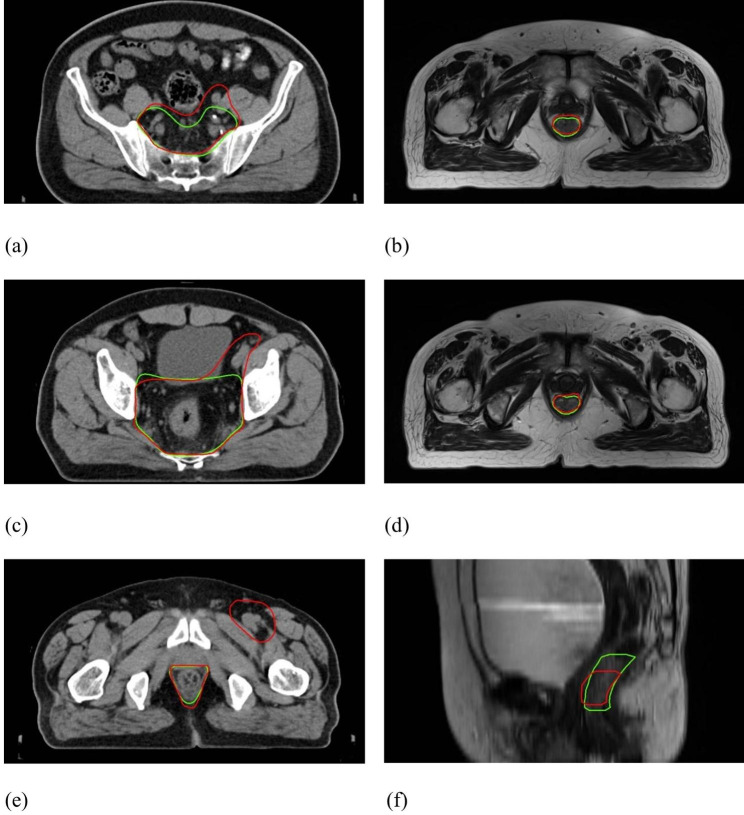
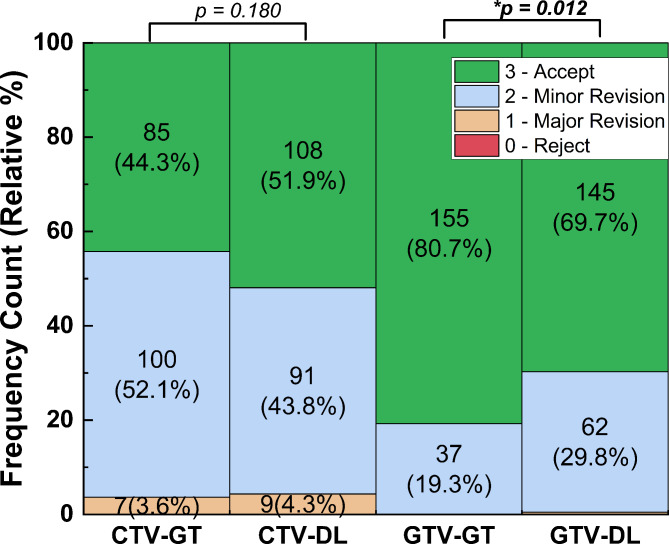
For the DL-based CTV contours over the testing cohort, the DSC and 95HD (mean ± SD) were 0.85 ± 0.06 and 7.75 ± 6.42 mm respectively, and 96.4% cases achieved clinical viable scores (≥ 2). The positive rate in the Turing test was 52.3%. For GTV, the DSC and 95HD were 0.87 ± 0.07 and 4.07 ± 1.67 mm respectively, and 100% of the DL-based contours achieved clinical viable scores (≥ 2). The positive rate in the Turing test was 52.0%.
The proposed DL-based workflow exhibited promising accuracy and excellent clinical viability towards automated CTV and GTV delineation for rectal cancer neoadjuvant radiotherapy.
直肠癌新辅助放疗的手动临床靶区(CTV)和大体肿瘤靶区(GTV)勾画至关重要,但非常耗时。本研究旨在提出一种基于深度学习(DL)的工作流程,实现直肠癌新辅助放疗CTV 和 GTV 的全自动勾画。
我们回顾性纳入了 141 例 II-III 期中低位直肠癌患者,并将其随机分为训练组(n=121)和测试组(n=20)。我们采用分而治之的策略,使用两个具有 DpuUnet 作为后端的独立 DL 模型来解决 CTV 和 GTV 分割问题,一个模型用于 CT 域中的 CTV 分割,另一个用于 MRI 域中的 GTV 分割。该工作流程采用三级多中心参与的盲法和随机评估方案进行验证。在第 1 级计算了 Dice 相似系数(DSC)和 95%Hausdorff 距离(95HD)度量,在第 2 级进行了四级专家评分,在第 3 级进行了头对头的图灵测试。
对于测试队列的基于 DL 的 CTV 轮廓,DSC 和 95HD(平均值±标准差)分别为 0.85±0.06 和 7.75±6.42mm,96.4%的病例获得了临床可行评分(≥2)。图灵测试的阳性率为 52.3%。对于 GTV,DSC 和 95HD 分别为 0.87±0.07 和 4.07±1.67mm,100%的基于 DL 的轮廓获得了临床可行评分(≥2)。图灵测试的阳性率为 52.0%。
所提出的基于 DL 的工作流程在自动勾画直肠癌新辅助放疗的 CTV 和 GTV 方面表现出了有前景的准确性和出色的临床可行性。