Department of Pediatrics, School of Medicine and Public Health, University of Wisconsin-Madison, Madison, WI, United States.
Department of Veterinary and Biomedical Sciences, College of Veterinary Medicine, University of Minnesota-Twin Cities, St. Paul, MN, United States.
Front Immunol. 2023 Sep 22;14:1267638. doi: 10.3389/fimmu.2023.1267638. eCollection 2023.
Zika virus (ZIKV) infection during pregnancy results in a spectrum of birth defects and neurodevelopmental deficits in prenatally exposed infants, with no clear understanding of why some pregnancies are more severely affected. Differential control of maternal ZIKV infection may explain the spectrum of adverse outcomes.
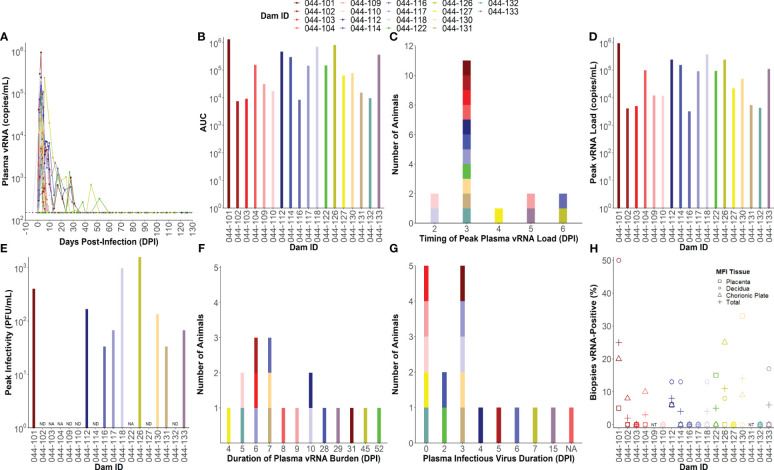
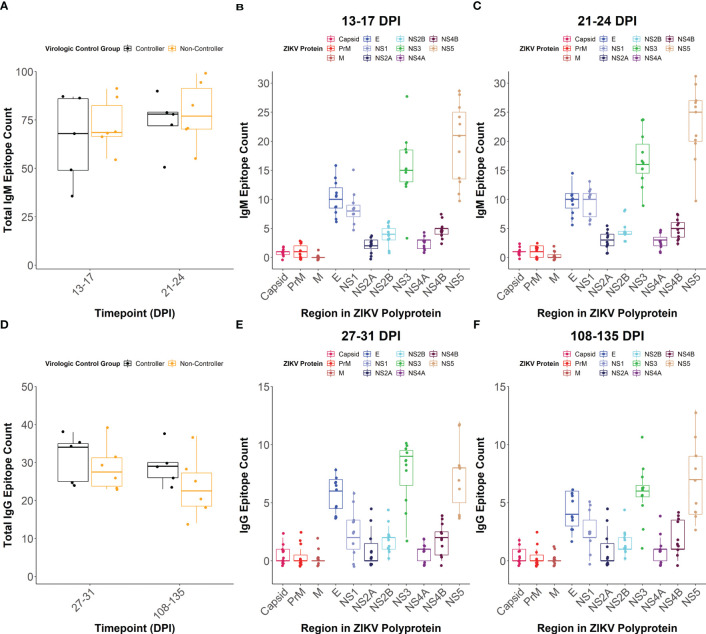
Here, we investigated whether the magnitude and breadth of the maternal ZIKV-specific antibody response is associated with better virologic control using a rhesus macaque model of prenatal ZIKV infection. We inoculated 18 dams with an Asian-lineage ZIKV isolate (PRVABC59) at 30-45 gestational days. Plasma vRNA and infectious virus kinetics were determined over the course of pregnancy, as well as vRNA burden in the maternal-fetal interface (MFI) at delivery. Binding and neutralizing antibody assays were performed to determine the magnitude of the ZIKV-specific IgM and IgG antibody responses throughout pregnancy, along with peptide microarray assays to define the breadth of linear ZIKV epitopes recognized.
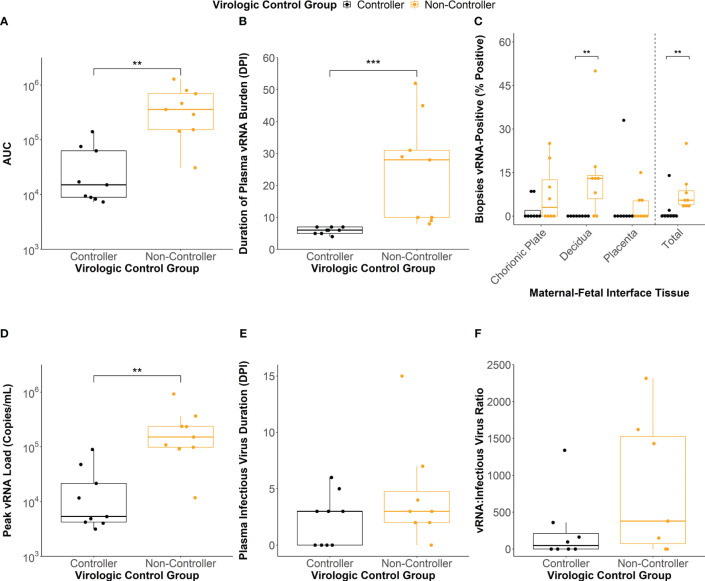
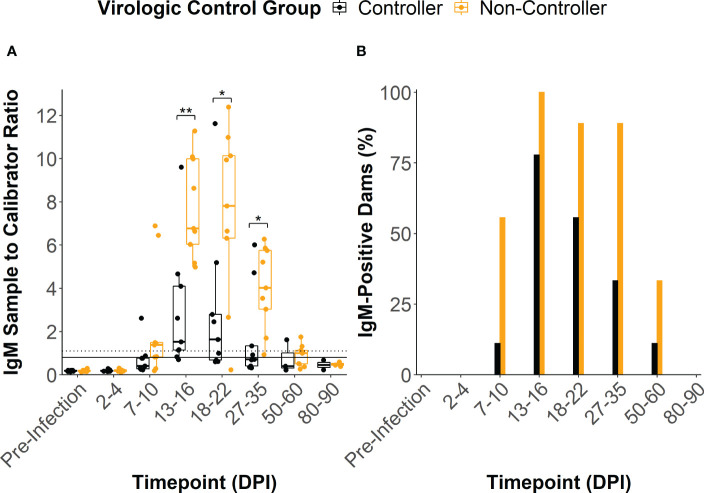
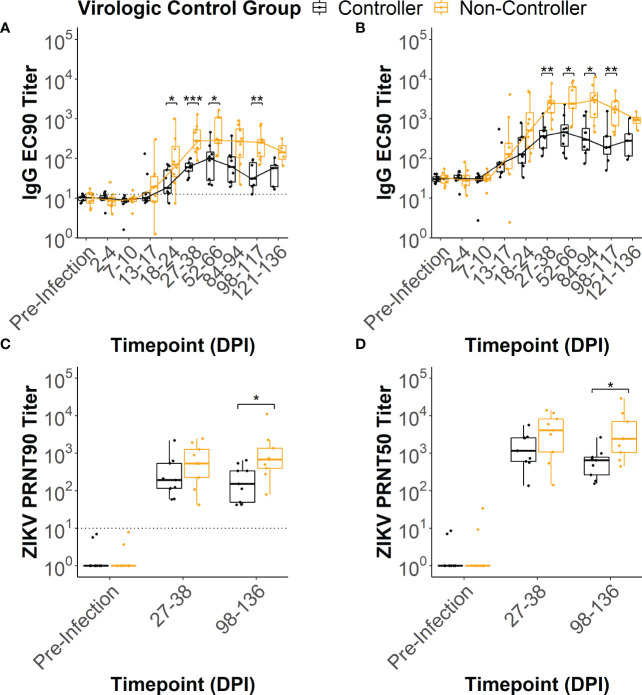
Dams with better virologic control (n= 9) cleared detectable infectious virus and vRNA from the plasma by 7 days post-infection (DPI) and had a lower vRNA burden in the MFI at delivery. In comparison, dams with worse virologic control (n= 9) still cleared detectable infectious virus from the plasma by 7 DPI but had vRNA that persisted longer, and had higher vRNA burden in the MFI at delivery. The magnitudes of the ZIKV-specific antibody responses were significantly lower in the dams with better virologic control, suggesting that higher antibody titers are not associated with better control of ZIKV infection. Additionally, the breadth of the ZIKV linear epitopes recognized did not differ between the dams with better and worse control of ZIKV infection.
Thus, the magnitude and breadth of the maternal antibody responses do not seem to impact maternal virologic control. This may be because control of maternal infection is determined in the first 7 DPI, when detectable infectious virus is present and before robust antibody responses are generated. However, the presence of higher ZIKV-specific antibody titers in dams with worse virologic control suggests that these could be used as a biomarker of poor maternal control of infection and should be explored further.
Zika 病毒(ZIKV)感染孕妇可导致胎儿出现一系列出生缺陷和神经发育障碍,而对于为什么有些孕妇的感染更严重,目前尚不清楚。母体 ZIKV 感染的差异控制可能解释了不良结局的范围。
在这里,我们通过灵长类动物模型研究了母体 ZIKV 特异性抗体反应的幅度和广度是否与更好的病毒学控制有关,该模型用于产前 ZIKV 感染。我们在 30-45 天的妊娠期用亚洲谱系 ZIKV 分离株(PRVABC59)接种 18 只母猴。在整个妊娠过程中确定了血浆 vRNA 和传染性病毒动力学,以及分娩时母胎界面(MFI)的 vRNA 负荷。进行了结合和中和抗体检测,以确定整个妊娠过程中 ZIKV 特异性 IgM 和 IgG 抗体反应的幅度,以及肽微阵列检测以确定识别的线性 ZIKV 表位的广度。
具有更好病毒学控制的母猴(n=9)在感染后 7 天(DPI)即可从血浆中清除可检测到的传染性病毒和 vRNA,并且在分娩时 MFI 中的 vRNA 负荷较低。相比之下,病毒学控制较差的母猴(n=9)仍可在 7 DPI 时从血浆中清除可检测到的传染性病毒,但 vRNA 持续时间更长,并且在分娩时 MFI 中的 vRNA 负荷更高。具有更好病毒学控制的母猴的 ZIKV 特异性抗体反应幅度明显较低,表明较高的抗体滴度与 ZIKV 感染的控制无关。此外,具有更好和更差 ZIKV 感染控制的母猴之间识别的 ZIKV 线性表位的广度没有差异。
因此,母体抗体反应的幅度和广度似乎不会影响母体的病毒学控制。这可能是因为在可检测到传染性病毒存在且尚未产生强大的抗体反应时,母体感染的控制发生在第 7 天内。然而,在病毒学控制较差的母猴中存在更高的 ZIKV 特异性抗体滴度表明,这些可以作为母体感染控制不良的生物标志物,应进一步探讨。