Nuraini Nuning, Soekotjo Fadiya Nadhilah, Alifia Almira, Sukandar Kamal Khairudin, Lestari Bony Wiem
Department of Mathematics, Institut Teknologi Bandung, Bandung, 40132, Indonesia.
Research Center for Care and Control of Infectious Disease, Universitas Padjadjaran, Bandung, 40161, Indonesia.
Heliyon. 2023 Sep 9;9(9):e20009. doi: 10.1016/j.heliyon.2023.e20009. eCollection 2023 Sep.
Primary and booster vaccinations are crucial in COVID-19 control. This study aimed to assess the minimum booster coverage to hamper potential surge of COVID-19 cases in 2023 in Indonesia, a low-resource setting country.
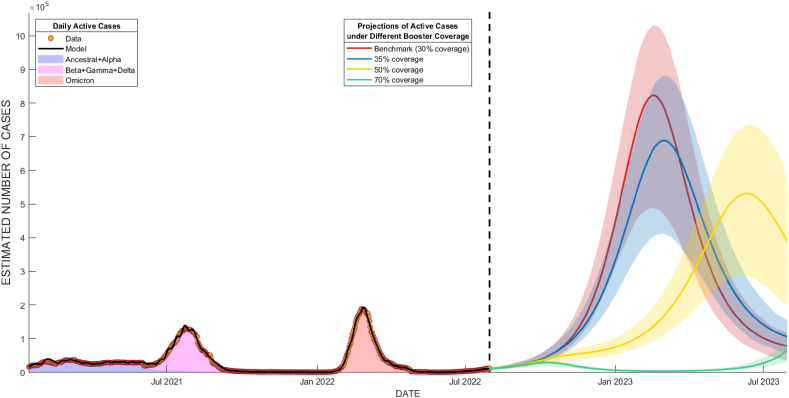
We used a modified SEIR compartment model to assess different scenarios in booster coverage across West Java population: 35%, 50%, and 70%. We fitted the model, then we calculated the potential active cases in 2023 if each scenario was met before 2022 ends. A heat map of predicted cases from various booster coverages and time frames was produced and matched with vaccination rate's function to determine feasible time frames.
A minimum of 70% booster coverage in West Java is needed to reduce 90% of potential COVID-19 cases and avert possible surge in 2023. The booster doses should be distributed before February 2023 to achieve its optimum preventive effect. Delays in achieving minimum booster coverage is acceptable, but higher booster coverage will be required.
For better COVID-19 control in Indonesia, booster vaccination is warranted, as presented by a case study in West Java. Sufficient vaccine supplies, infrastructure, and healthcare workers should be ensured to support a successful booster vaccination program.
新冠疫苗的初次接种和加强接种对于控制新冠疫情至关重要。本研究旨在评估在资源匮乏的印度尼西亚,为遏制2023年新冠病例可能出现的激增情况所需的最低加强针接种覆盖率。
我们使用了一个经过修改的SEIR compartment模型来评估西爪哇省不同加强针接种覆盖率的情景:35%、50%和70%。我们对模型进行了拟合,然后计算了如果在2022年底前实现每种情景,2023年可能出现的活跃病例数。绘制了不同加强针接种覆盖率和时间框架下预测病例的热图,并将其与接种率函数相匹配,以确定可行的时间框架。
西爪哇省至少需要70%的加强针接种覆盖率,才能减少90%的潜在新冠病例,并避免2023年可能出现的激增。加强针应在2023年2月前分发,以达到最佳预防效果。推迟实现最低加强针接种覆盖率是可以接受的,但需要更高的加强针接种覆盖率。
正如西爪哇省的案例研究所示,为了在印度尼西亚更好地控制新冠疫情,加强针接种是必要的。应确保有足够的疫苗供应、基础设施和医护人员,以支持成功的加强针接种计划。