Center for Healthy Aging, Pennsylvania State University, University Park, PA 16802.
Earth, Atmospheric, and Planetary Sciences Department and the Institute for a Sustainable Future, Purdue University, West Lafayette, IN 47907.
Proc Natl Acad Sci U S A. 2023 Oct 17;120(42):e2305427120. doi: 10.1073/pnas.2305427120. Epub 2023 Oct 9.
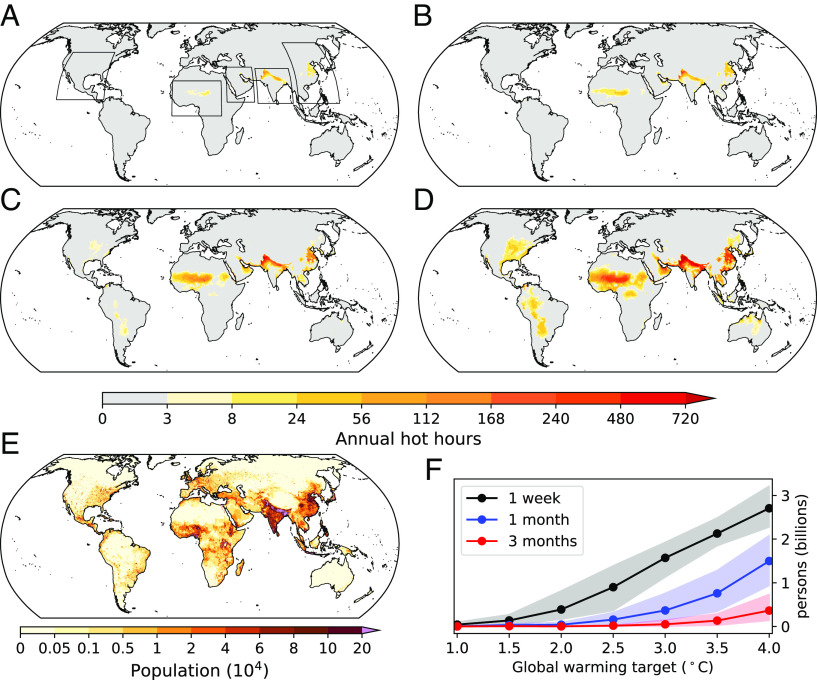
As heatwaves become more frequent, intense, and longer-lasting due to climate change, the question of breaching thermal limits becomes pressing. A wet-bulb temperature (T) of 35 °C has been proposed as a theoretical upper limit on human abilities to biologically thermoregulate. But, recent-empirical-research using human subjects found a significantly lower maximum T at which thermoregulation is possible even with minimal metabolic activity. Projecting future exposure to this empirical critical environmental limit has not been done. Here, using this more accurate threshold and the latest coupled climate model results, we quantify exposure to dangerous, potentially lethal heat for future climates at various global warming levels. We find that humanity is more vulnerable to moist heat stress than previously proposed because of these lower thermal limits. Still, limiting warming to under 2 °C nearly eliminates exposure and risk of widespread uncompensable moist heatwaves as a sharp rise in exposure occurs at 3 °C of warming. Parts of the Middle East and the Indus River Valley experience brief exceedances with only 1.5 °C warming. More widespread, but brief, dangerous heat stress occurs in a +2 °C climate, including in eastern China and sub-Saharan Africa, while the US Midwest emerges as a moist heat stress hotspot in a +3 °C climate. In the future, moist heat extremes will lie outside the bounds of past human experience and beyond current heat mitigation strategies for billions of people. While some physiological adaptation from the thresholds described here is possible, additional behavioral, cultural, and technical adaptation will be required to maintain healthy lifestyles.
随着气候变化导致热浪变得更加频繁、强烈和持久,突破热极限的问题变得迫在眉睫。有人提出,湿球温度(T)达到 35°C 是人类生物热调节能力的理论上限。但是,最近使用人类受试者的实证研究发现,即使代谢活动最少,也存在一个明显更低的最大 T 值,在这个 T 值下仍有可能进行热调节。目前还没有对未来暴露于这一经验临界环境极限进行预测。在这里,我们使用更准确的阈值和最新的耦合气候模型结果,定量评估了在不同全球变暖水平下未来气候下人类面临的危险、潜在致命热暴露情况。我们发现,由于这些更低的热极限,人类比之前提出的更容易受到潮湿热应激的影响。尽管如此,将变暖限制在 2°C 以下,几乎可以消除因变暖 3°C 而导致的广泛无法承受的潮湿热浪的暴露和风险。中东和印度河流域的部分地区在变暖 1.5°C 时就会出现短暂的超标。在 2°C 的气候条件下,更广泛但短暂的危险热应激会发生,包括中国东部和撒哈拉以南非洲,而美国中西部在 3°C 的气候条件下则成为潮湿热应激热点。在未来,潮湿的极端高温将超出过去人类经验的范围,也超出了目前数十亿人缓解热应激的策略范围。虽然从这里描述的阈值来看,一些生理适应是可能的,但为了维持健康的生活方式,还需要额外的行为、文化和技术适应。