Gong Wei, Murphy William J, Meinke Deanna K, Feng Huiling Amy, Stephenson Mark R
Division of Field Studies and Engineering, National Institute for Occupational Safety and Health, Cincinnati, Ohio.
Stephenson and Stephenson Research and Consulting, LLC, Batavia, Ohio.
Semin Hear. 2023 Jun 1;44(4):470-484. doi: 10.1055/s-0043-1769586. eCollection 2023 Nov.
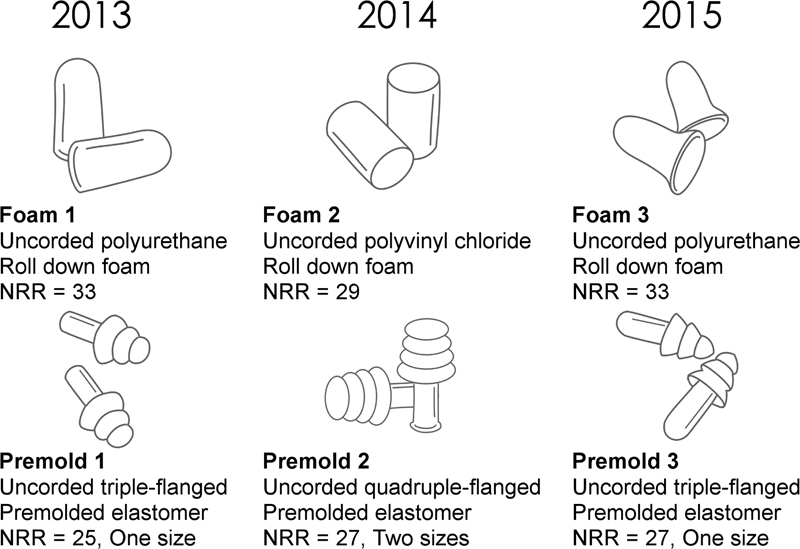
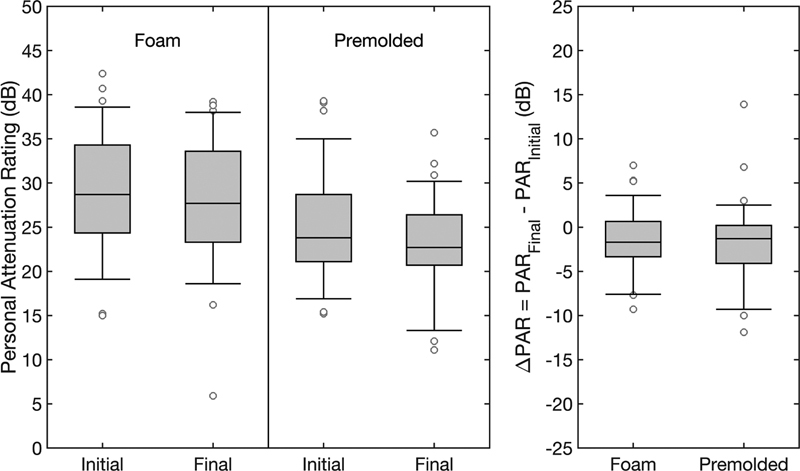
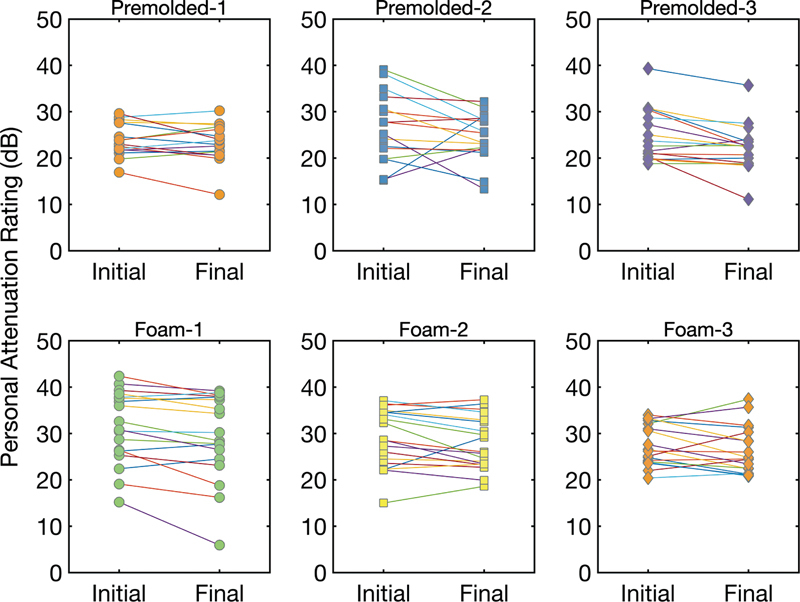
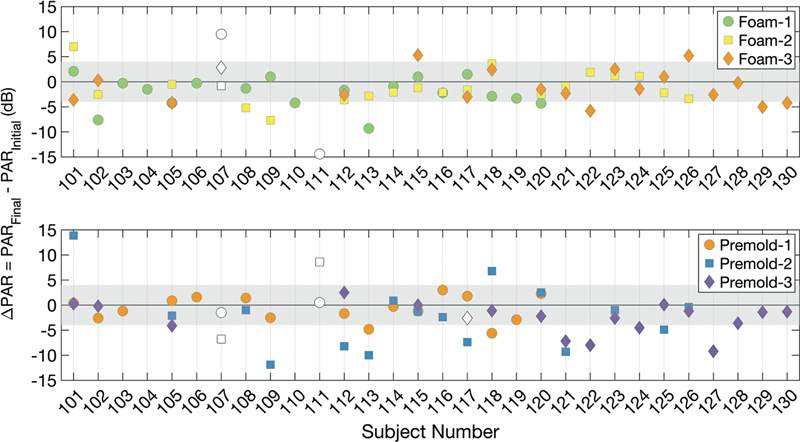
Workers rely on hearing protection devices to prevent occupational noise-induced hearing loss. This study aimed to evaluate changes in attenuation over time for properly fit devices when worn by workers exposed to hazardous noise. Earplug fit testing was accomplished on 30 workers at a brewery facility with three types of foam and three types of premolded earplugs. The personal attenuation ratings (PARs) were measured before and after a 2-hour work period while exposed to hazardous noise levels. The minimum acceptable initial PAR was 15 dB. Average decreases in PAR ranged from -0.7 to -2.6 dB across all six earplug types. Significant changes in PAR were observed for the Foam-1 ( = 0.009) and Premold-3 ( = 0.004) earplugs. A linear mixed regression model using HPD type and study year as fixed effects and subject as random effect was not significant for either fixed effect ( = 0.05). Ninety-five percent of the final PAR measurements maintained the target attenuation of 15 dB. Properly fitting earplugs can be effective at reducing worker's noise exposures over time. The potential for a decrease in attenuation during the work shift should be considered when training workers and establishing the adequacy of protection from hazardous noise exposures.
工人们依靠听力保护装置来预防职业性噪声所致听力损失。本研究旨在评估在暴露于危险噪声的工人佩戴时,合适的装置随时间的衰减变化情况。在一家啤酒厂设施中,对30名工人使用三种类型的泡沫耳塞和三种类型的预成型耳塞进行耳塞佩戴适配测试。在暴露于危险噪声水平的2小时工作时段前后测量个人衰减评级(PAR)。可接受的最低初始PAR为15dB。在所有六种耳塞类型中,PAR的平均下降范围为-0.7至-2.6dB。观察到泡沫耳塞-1(P = 0.009)和预成型耳塞-3(P = 0.004)的PAR有显著变化。以听力保护装置类型和研究年份作为固定效应、个体作为随机效应的线性混合回归模型,对于任何一个固定效应均无显著性(P = 0.05)。95%的最终PAR测量值维持了15dB的目标衰减。合适佩戴的耳塞在长期减少工人噪声暴露方面可能是有效的。在培训工人以及确定免受危险噪声暴露的防护是否充分时,应考虑工作班次期间衰减降低的可能性。