Rabizadeh Soghra, Heidari Firouzeh, Karimi Reza, Rajab Armin, Rahimi-Dehgolan Shahram, Yadegar Amirhossein, Mohammadi Fatemeh, Mirmiranpour Hossein, Esteghamati Alireza, Nakhjavani Manouchehr
Endocrinology and Metabolism Research Center (EMRC) Vali-Asr Hospital, Tehran University of Medical Sciences Tehran Iran.
Food Sci Nutr. 2023 Jun 30;11(10):5967-5977. doi: 10.1002/fsn3.3530. eCollection 2023 Oct.
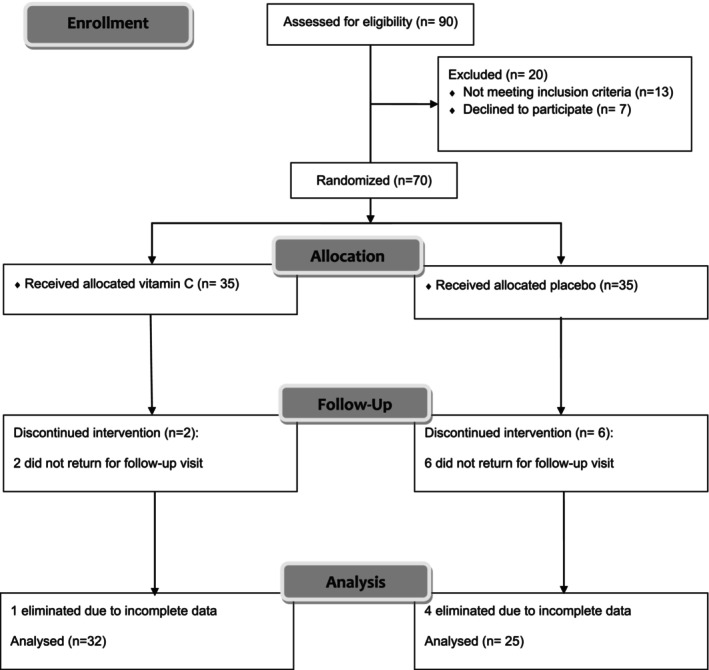
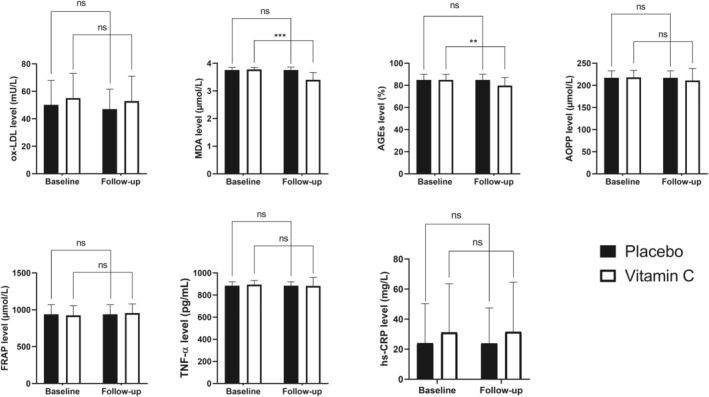
This study evaluated how daily vitamin C administration impacts systemic oxidative stress and inflammation and its safety in T2D patients. This randomized, double-blinded, placebo-controlled, parallel-arm clinical trial included 70 patients with T2D. They were allocated to receive either 500 mg/day of vitamin C or a matching placebo for 8 weeks. Of the 70 subjects assigned to the trial, 57 were included in the statistical analysis (vitamin C: = 32, placebo: = 25). Inflammatory and oxidative markers, including advanced glycation end products (AGEs), malondialdehyde (MDA), advanced oxidation protein products (AOPP), oxidized low-density lipoprotein (ox-LDL), highly sensitive C-reactive protein (hs-CRP), tumor necrosis factor-α (TNF-α), and ferric reducing ability of plasma (FRAP) were measured at baseline and the end of the trial. In addition, vitamin C tolerance was evaluated. A nutritionist visited all participants for a standard diabetic regimen. Following vitamin C supplementation, the serum levels of MDA (-value < .001) and AGEs (-value = .002) demonstrated a significant decrease after controlling for multiple confounders, including age, blood pressure, waist circumference, HbA1C, TG, and LDL-C, while no significant changes were observed for AOPP (-value = .234) and ox-LDL (-value = .480). The FRAP showed an increasing trend as an antioxidant marker but was not statistically significant (-value = .312). The hs-CRP and TNF-α had no significant changes (-value: .899 and .454, respectively). Also, no major adverse events were observed. Vitamin C supplementation may be beneficial in reducing AGEs and MDA in patients with T2D.
本研究评估了每日补充维生素C对2型糖尿病(T2D)患者全身氧化应激和炎症的影响及其安全性。这项随机、双盲、安慰剂对照、平行组临床试验纳入了70例T2D患者。他们被分配接受每日500毫克维生素C或匹配的安慰剂,为期8周。在分配到试验的70名受试者中,57名被纳入统计分析(维生素C组:n = 32,安慰剂组:n = 25)。在基线和试验结束时测量了炎症和氧化标志物,包括晚期糖基化终产物(AGEs)、丙二醛(MDA)、晚期氧化蛋白产物(AOPP)、氧化型低密度脂蛋白(ox-LDL)、高敏C反应蛋白(hs-CRP)、肿瘤坏死因子-α(TNF-α)和血浆铁还原能力(FRAP)。此外,还评估了维生素C耐受性。一名营养师对所有参与者进行标准糖尿病治疗方案的指导。补充维生素C后,在控制了包括年龄、血压、腰围、糖化血红蛋白(HbA1C)、甘油三酯(TG)和低密度脂蛋白胆固醇(LDL-C)等多个混杂因素后,血清MDA水平(P值<0.001)和AGEs水平(P值 = 0.002)显著降低,而AOPP(P值 = 0.234)和ox-LDL(P值 = 0.480)未观察到显著变化。FRAP作为抗氧化标志物呈上升趋势,但无统计学意义(P值 = 0.312)。hs-CRP和TNF-α无显著变化(P值分别为0.899和0.454)。此外,未观察到重大不良事件。补充维生素C可能有助于降低T2D患者的AGEs和MDA水平。