Jeyalan Visvesh, Austin David, Loh Shu Xian, Wangsaputra Vincent Kharisma, Spyridopoulos Ioakim
Academic Cardiovascular Unit, The James Cook University Hospital, Middlesbrough TS4 3BW, UK.
Translational and Clinical Research Institute, Newcastle University, Newcastle upon Tyne NE2 4HH, UK.
Cells. 2023 Sep 28;12(19):2377. doi: 10.3390/cells12192377.
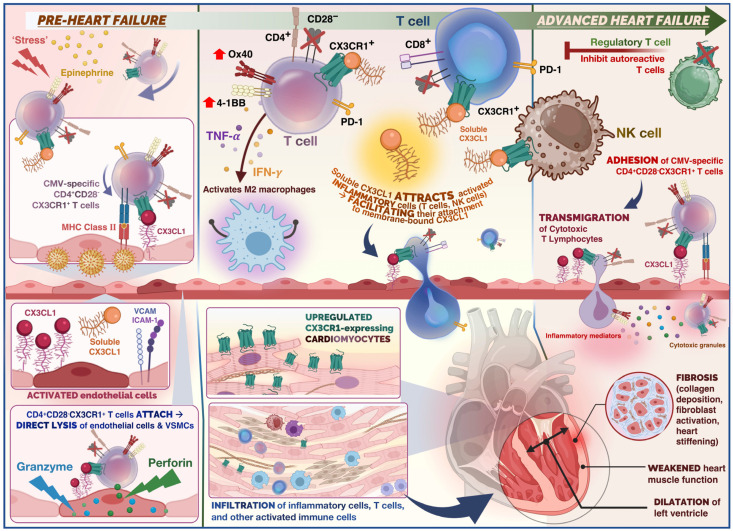
Dilated cardiomyopathy (DCM) is a cardiac condition with structural and functional impairment, where either the left ventricle or both ventricular chambers are enlarged, coinciding with reduced systolic pump function (reduced ejection fraction, rEF). The prevalence of DCM is more than 1:250 individuals, and mortality largely due to heart failure in two-third of cases, and sudden cardiac death in one-third of patients. Damage to the myocardium, whether from a genetic or environmental cause such as viruses, triggers inflammation and recruits immune cells to the heart to repair the myocardium. Examination of myocardial biopsy tissue often reveals an inflammatory cell infiltrate, T lymphocyte (T cell) infiltration, or other activated immune cells. Despite medical therapy, adverse outcomes for DCM remain. The evidence base and existing literature suggest that upregulation of CXCR1, migration of immune cells, together with cytomegalovirus (CMV) seropositivity is associated with worse outcomes in patients with dilated cardiomyopathy. We hypothesise that this potentially occurs through cardiac inflammation and fibrosis, resulting in adverse remodelling. Immune modulators to target this pathway may potentially improve outcomes above and beyond current guideline-recommended therapy.
扩张型心肌病(DCM)是一种伴有结构和功能损害的心脏疾病,其左心室或两个心室腔均扩大,同时伴有收缩泵功能降低(射血分数降低,rEF)。DCM的患病率超过1/250,在三分之二的病例中,死亡主要归因于心力衰竭,在三分之一的患者中,死亡原因是心源性猝死。心肌损伤,无论是由遗传因素还是病毒等环境因素引起,都会引发炎症,并吸引免疫细胞至心脏以修复心肌。对心肌活检组织的检查通常会发现炎性细胞浸润、T淋巴细胞(T细胞)浸润或其他活化的免疫细胞。尽管进行了药物治疗,但DCM的不良预后仍然存在。证据基础和现有文献表明,CXCR1上调、免疫细胞迁移以及巨细胞病毒(CMV)血清学阳性与扩张型心肌病患者的不良预后相关。我们推测,这可能是通过心脏炎症和纤维化导致不良重塑而发生的。针对该途径的免疫调节剂可能会在当前指南推荐的治疗基础上进一步改善预后。