Department of Medical Specialties I, "Grigore T. Popa" University of Medicine and Pharmacy, 700115 Iasi, Romania.
Clinical Rehabilitation Hospital, 700661 Iasi, Romania.
Nutrients. 2023 Sep 28;15(19):4201. doi: 10.3390/nu15194201.
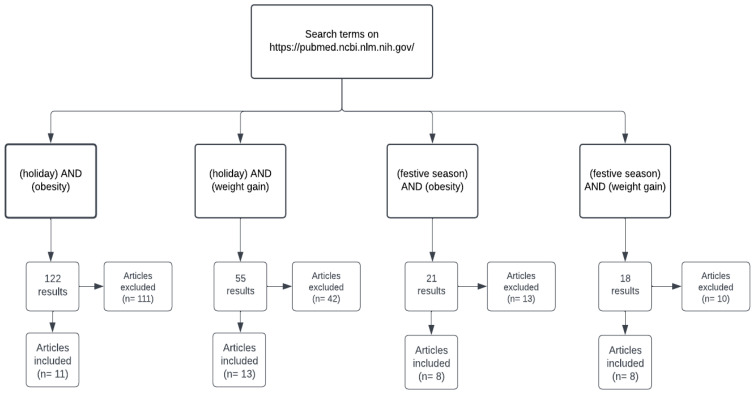
(1) Background: There has been a growing interest in understanding the causes of obesity and developing effective prevention strategies. Lifestyle change programs are often considered the gold standard for weight reduction, and they can help individuals with obesity achieve an annual weight loss of around 8-10%. The aim of this review was to evaluate the effect of food during the winter holidays. This knowledge will serve as a valuable foundation for the development of targeted interventions and prevention programs. (2) Methods: We conducted a systematic search of the literature via one database (PubMed). The search was limited to studies published in English in the last 10 years, with adult participants, but without specifying limits regarding the study design. We excluded articles that addressed intermittent fasting diets or weight loss intervention methods during the holidays through various diets. (3) In separate sections, we analyzed the psychological causes of gaining weight during the winter holidays, behavioral patterns, prevention strategies and the nutritional composition of the different types of food served during the festive period. Results: Using the combination of the terms "holiday and obesity", "holiday and weight gain", "festive season and obesity", and "festive season and weight gain" we obtained 216 results involving the addressed topic. Thus, only ten articles remained after screening, with a total of 4627 participants. Most participants experienced weight fluctuations during the study period, particularly during holidays. One concerning observation was that most of the weight gained during these periods was maintained even after the end of the studies, especially in those with obesity. A supervised exercise program and a controlled diet at work over the Christmas period are effective strategies for avoiding weight gain and its deleterious effects in people with metabolic syndrome or weight problems. (4) In addition, attention must be focused on the psycho-social factors during the holidays because for some people it is a stressful period and can cause a much higher caloric consumption. The simplest method to approach during the holidays is to implement small tips and tricks during this period that will prevent individuals from gaining extra pounds. Conclusions: It is essential to acknowledge that obesity is a multifaceted condition that requires a comprehensive and multidisciplinary approach to address its underlying factors and provide ongoing assistance to individuals in their weight-management endeavors. Even the most effective short-term interventions are likely to produce continued positive outcomes with persistent intervention and support.
(1) 背景:人们越来越关注肥胖的原因,并开发有效的预防策略。生活方式改变计划通常被认为是减肥的金标准,它们可以帮助肥胖者实现每年 8-10%的体重减轻。本综述的目的是评估冬季假期期间食物的影响。这一知识将为制定有针对性的干预和预防计划提供有价值的基础。(2) 方法:我们通过一个数据库(PubMed)进行了系统的文献搜索。搜索仅限于过去 10 年以英语发表的、有成人参与者的研究,但对研究设计没有具体限制。我们排除了通过各种饮食在假期中解决间歇性禁食饮食或减肥干预方法的文章。(3) 我们分别分析了冬季假期体重增加的心理原因、行为模式、预防策略以及节日期间供应的不同类型食物的营养成分。结果:使用“假期和肥胖”、“假期和体重增加”、“节日季节和肥胖”以及“节日季节和体重增加”的组合术语,我们获得了涉及该主题的 216 个结果。因此,经过筛选后只剩下 10 篇文章,共有 4627 名参与者。大多数参与者在研究期间经历了体重波动,尤其是在假期期间。一个令人担忧的观察结果是,在这些期间增加的体重大部分在研究结束后仍保持不变,尤其是在肥胖者中。在圣诞节期间进行监督锻炼计划和控制饮食是避免体重增加及其对代谢综合征或体重问题患者的有害影响的有效策略。(4) 此外,必须关注假期期间的心理社会因素,因为对某些人来说,这是一个压力大的时期,可能导致更高的卡路里摄入。假期期间最简单的方法是在此期间实施一些小技巧和窍门,以防止个人增加额外的体重。结论:必须认识到,肥胖是一种多方面的疾病,需要采用全面和多学科的方法来解决其根本原因,并为个人的体重管理努力提供持续的帮助。即使是最有效的短期干预措施,如果持续干预和支持,也可能产生持续的积极结果。