Medical Nutrition, Department of Medical Sciences, College of Allied Health Professions, University of Nebraska Medical Center, Omaha, NE 68198, USA.
Physical Therapy, Department of Health and Rehabilitation Sciences, College of Allied Health Professions, University of Nebraska Medical Center, Omaha, NE 68198, USA.
Nutrients. 2023 Oct 7;15(19):4277. doi: 10.3390/nu15194277.
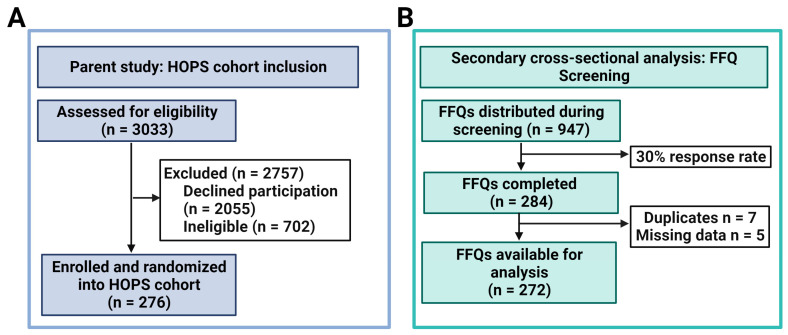
Little is known about the inflammatory potential of diet and its relation to bone health. This cross-sectional study examined the association between the inflammatory potential of diet and bone-related outcomes in midwestern, post-menopausal women enrolled in the Heartland Osteoporosis Prevention Study (HOPS) randomized controlled trial. Dietary intake from the HOPS cohort was used to calculate Dietary Inflammatory Index (DII) scores, which were energy-adjusted (E-DII) and analyzed by quartile. The association between E-DII and lumbar and hip bone mineral density (BMD) and lumbar trabecular bone scores (TBS; bone structure) was assessed using ANCOVA, with pairwise comparison to adjust for relevant confounders (age, education, race/ethnicity, smoking history, family history of osteoporosis/osteopenia, BMI, physical activity, and calcium intake). The cohort included 272 women, who were predominately white (89%), educated (78% with college degree or higher), with a mean BMI of 27 kg/m, age of 55 years, and E-DII score of -2.0 ± 1.9 (more anti-inflammatory). After adjustment, E-DII score was not significantly associated with lumbar spine BMD ( = 0.53), hip BMD ( = 0.29), or TBS at any lumbar location ( > 0.05). Future studies should examine the longitudinal impact of E-DII scores and bone health in larger, more diverse cohorts.
人们对饮食的炎症潜力及其与骨骼健康的关系知之甚少。这项横断面研究调查了饮食炎症潜力与中西部绝经后妇女骨质疏松预防研究(HOPS)随机对照试验中骨相关结局之间的关系。HOPS 队列的饮食摄入量用于计算饮食炎症指数(DII)评分,这些评分经过能量调整(E-DII)并按四分位数进行分析。使用协方差分析(ANCOVA)评估 E-DII 与腰椎和髋部骨密度(BMD)以及腰椎小梁骨评分(TBS;骨结构)之间的关联,并进行两两比较以调整相关混杂因素(年龄、教育程度、种族/族裔、吸烟史、骨质疏松/骨量减少家族史、BMI、身体活动和钙摄入量)。该队列包括 272 名女性,她们主要是白人(89%),受过教育(78%具有大学学历或更高学历),平均 BMI 为 27kg/m,年龄为 55 岁,E-DII 评分为-2.0±1.9(更具抗炎性)。调整后,E-DII 评分与腰椎骨密度( = 0.53)、髋骨骨密度( = 0.29)或任何腰椎部位的 TBS 均无显著相关性( > 0.05)。未来的研究应在更大、更多样化的队列中检查 E-DII 评分和骨骼健康的纵向影响。