Department of Psychology, Faculty of Science, University of Tübingen, Schleichstr. 4, 72076, Tübingen, Germany.
Department of Psychology, Humboldt University at Berlin, Berlin, Germany.
Mem Cognit. 2024 Feb;52(2):444-458. doi: 10.3758/s13421-023-01473-9. Epub 2023 Oct 16.
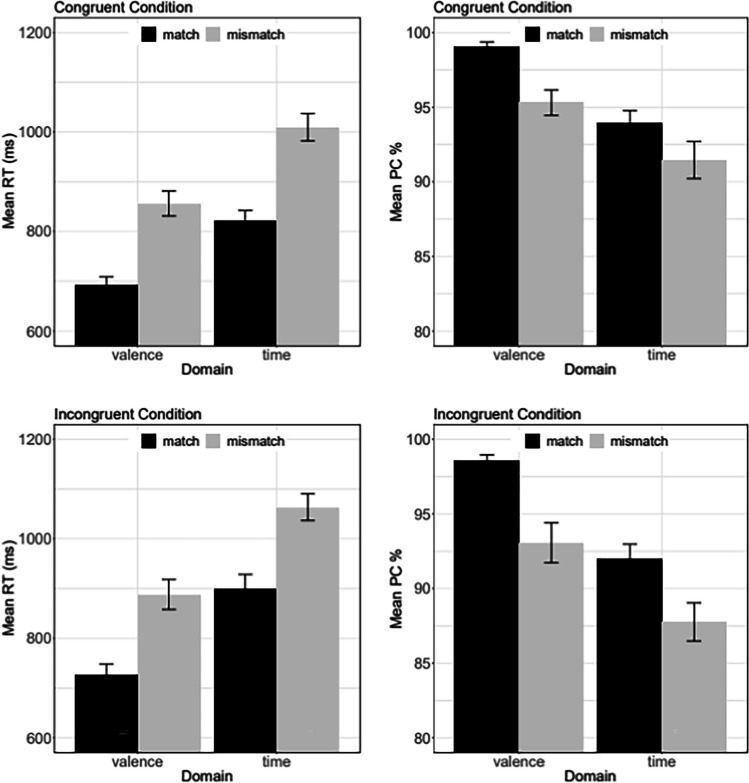
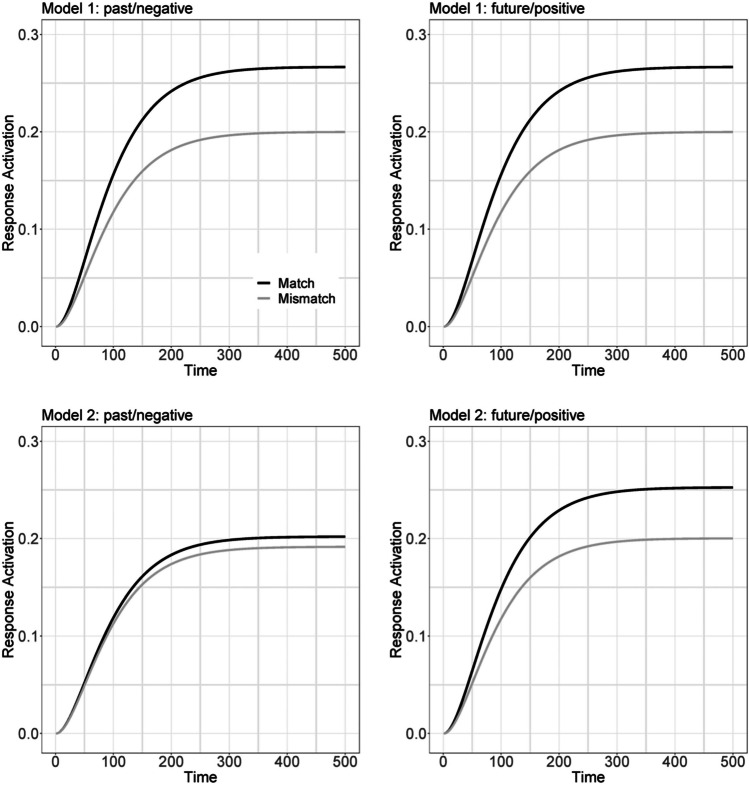
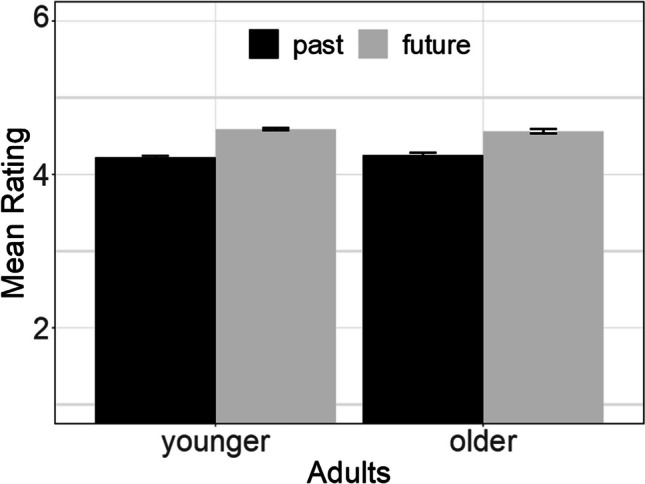
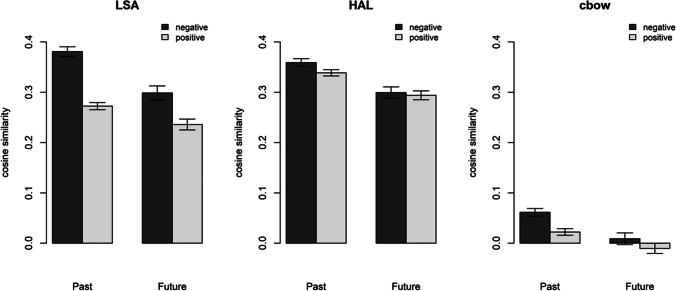
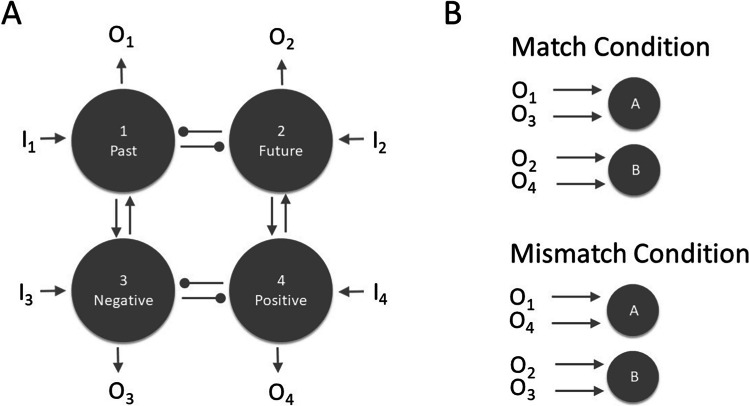
Five experiments investigated the association between time and valence. In the first experiment, participants classified temporal expressions (e.g., past, future) and positively or negatively connotated words (e.g., glorious, nasty) based on temporal reference or valence. They responded slower and made more errors in the mismatched condition (positive/past mapped to one hand, negative/future to the other) compared with the matched condition (positive/future to one hand, negative/past to the other hand). Experiment 2 confirmed the generalization of the match effect to nonspatial responses, while Experiment 3 found no reversal of this effect for left-handers. Overall, the results of the three experiments indicate a robust match effect, associating the past with negative valence and the future with positive valence. Experiment 4 involved rating the valence of time-related words, showing higher ratings for future-related words. Additionally, Experiment 5 employed latent semantic analysis and revealed that linguistic experiences are unlikely to be the source of this time-valence association. An interactive activation model offers a quantitative explanation of the match effect, potentially arising from a favorable perception of the future over the past.
五个实验研究了时间和情绪之间的关系。在第一个实验中,参与者根据时间参考或情绪对时间表达(例如过去、未来)和具有积极或消极含义的词(例如光荣、讨厌)进行分类。与匹配条件(积极/未来对应一只手,消极/过去对应另一只手)相比,在不匹配条件(积极/过去对应一只手,消极/未来对应另一只手)下,参与者的反应速度较慢,错误更多。实验 2 证实了这种匹配效应可以推广到非空间反应,而实验 3 发现这种效应对于左撇子没有反转。总的来说,这三个实验的结果表明存在一种强大的匹配效应,即将过去与消极情绪联系起来,将未来与积极情绪联系起来。实验 4 涉及对与时间相关的单词的情绪进行评分,结果表明与未来相关的单词得到了更高的评分。此外,实验 5 采用潜在语义分析,揭示了语言经验不太可能是这种时间-情绪关联的来源。一个交互式激活模型提供了对匹配效应的定量解释,这种效应可能源于人们对未来的积极感知超过了过去。