Hangzhou Traditional Chinese Medicine Hospital Affiliated to Zhejiang Chinese Medical University, 310000, Hangzhou, China.
Hangzhou Center for Disease Control and Prevention, 310021, Hangzhou, China.
BMC Microbiol. 2023 Oct 17;23(1):294. doi: 10.1186/s12866-023-03027-0.
Staphylococcus aureus expresses numerous toxins, many of which are strongly believed to be responsible for specific symptoms and even diseases, making it significant in the pathogenesis of human health. Enterotoxins, which are vital toxins, are associated with foodborne illnesses that manifest through symptoms like vomiting and diarrhea. In the present study, 264 S. aureus isolates obtained from various retail foods in Hangzhou, China were further investigated the profiles of enterotoxin genes and genetic backgrounds.
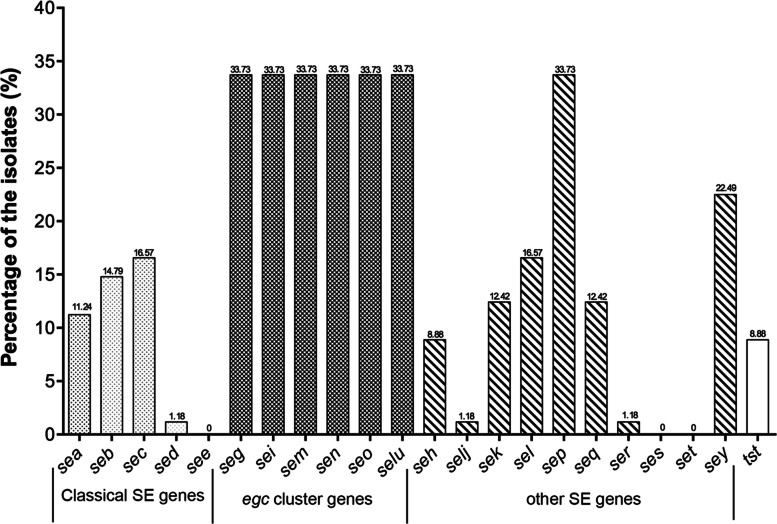
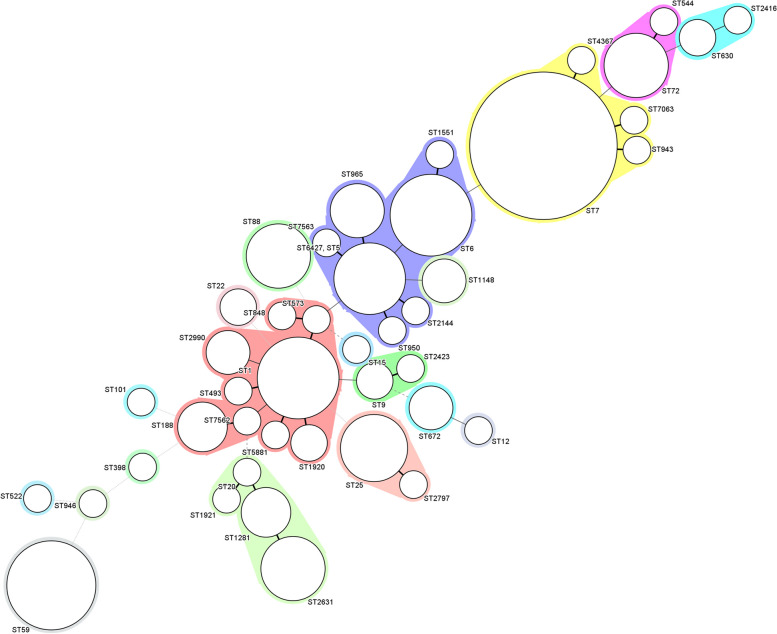
Approximately, 64.02% of the isolates from diverse sources contained at least one Staphylococcal Enterotoxin (SE) genes, displaying a total of 36 distinct combinations. Enterotoxin gene cluster (egc) encoded enterotoxin genes, normally designated by seg, sei, sem, sen, seo and selu, plus with sep were more frequently detected (33.73%, each). In contrast, see, ses and set were absent in any of the isolates tested. A total of 44 sequence types (STs), 20 clonal complexes (CCs) and 66 different staphylococcal protein A (spa) types (including six novel types) were identified among those 169 SE-positive isolates. Moreover, nineteen methicillin-resistant Staphylococcus aureus (MRSA) isolates were identified. The majority of those isolates belonged to the CC59-Sccmec IVa cluster and carried the seb-sek-seq gene cluster. The egc cluster, either coexisting with or without other enterotoxin genes, was observed in all isolates allocated into CC5, CC9, CC20, CC25, CC72 and ST672. Irrespective of the spa types and origins of the food, it appeared that seh was a distinct genetic element present in isolates belonging to the CC1 clonal lineage.
The results not only proposed a suspected relationship between distribution of enterotoxigenic strains and genetic backgrounds, but also attributed the presence of novel enterotoxins to potential hazards in food safety.
金黄色葡萄球菌表达多种毒素,其中许多毒素被强烈认为是导致特定症状甚至疾病的原因,因此在人类健康发病机制中具有重要意义。肠毒素是重要的毒素,与食源性疾病有关,这些疾病表现为呕吐和腹泻等症状。在本研究中,进一步调查了来自中国杭州各种零售食品的 264 株金黄色葡萄球菌分离株的肠毒素基因谱和遗传背景。
来自不同来源的分离株中,约有 64.02%至少含有一种葡萄球菌肠毒素(SE)基因,显示出 36 种不同的组合。肠毒素基因簇(egc)编码肠毒素基因,通常由 seg、sei、sem、sen、seo 和 selu 加上 sep 表示,更为常见(33.73%,每个)。相比之下,在任何测试的分离株中都没有发现 see、ses 和 set。在 169 株 SE 阳性分离株中,共鉴定出 44 种序列型(ST)、20 种克隆复合体(CC)和 66 种不同的葡萄球菌蛋白 A(spa)型(包括 6 种新型)。此外,还鉴定出 19 株耐甲氧西林金黄色葡萄球菌(MRSA)分离株。这些分离株大多属于 CC59-Sccmec IVa 群,携带 seb-sek-seq 基因簇。在所有归入 CC5、CC9、CC20、CC25、CC72 和 ST672 的分离株中都观察到 egc 簇,或与其他肠毒素基因共存,或不存在。无论 spa 型和食品来源如何,seh 似乎都是属于 CC1 克隆谱系的分离株中存在的独特遗传元件。
这些结果不仅提出了肠毒素菌株的分布与遗传背景之间的可疑关系,还将新型肠毒素的存在归因于食品安全的潜在危害。