Soltani Soheil, Cheng Brian, Osunkoya Adeboye O, Robles Francisco E
Wallace H. Coulter Department of Biomedical Engineering, Georgia Institute of Technology and Emory University, Atlanta, GA 30332, USA.
Departments of Pathology and Urology, Emory University School of Medicine, Atlanta, GA 30322, USA.
BME Front. 2022 Sep 2;2022:9847962. doi: 10.34133/2022/9847962. eCollection 2022.
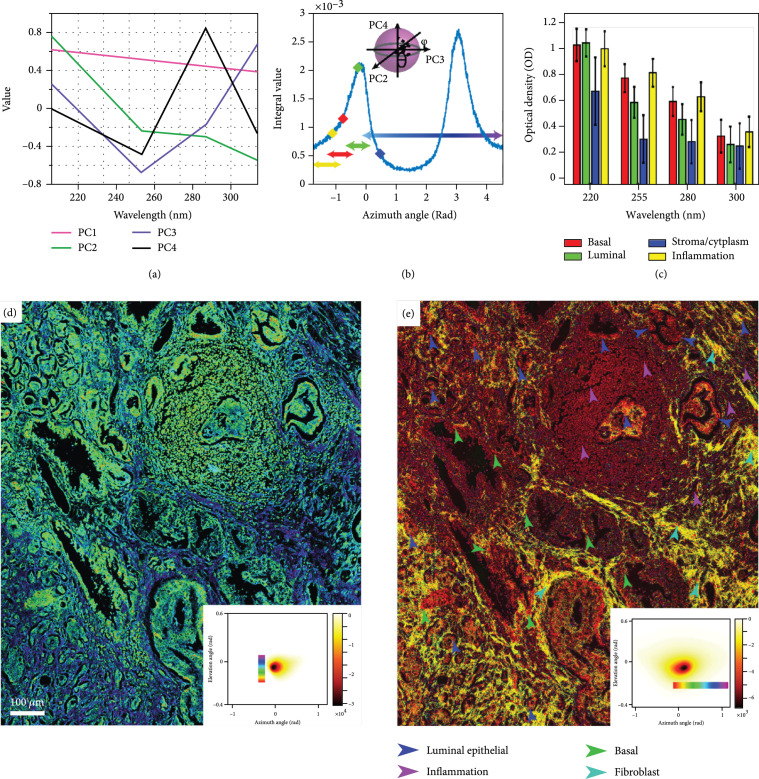
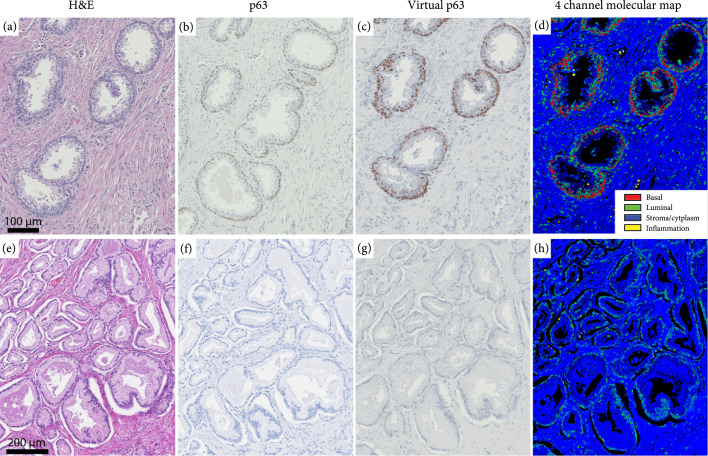
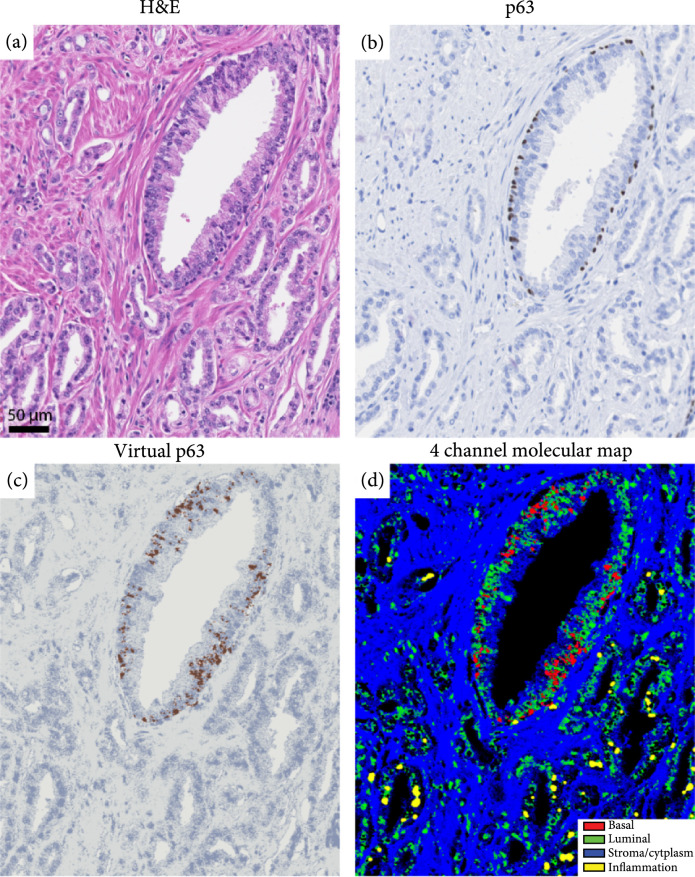
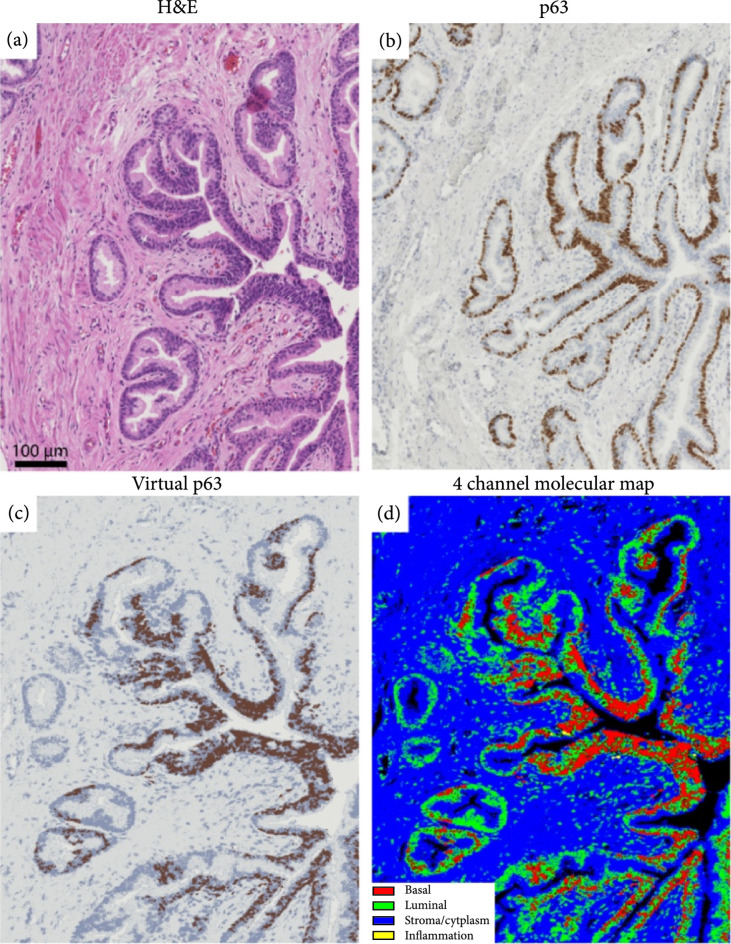
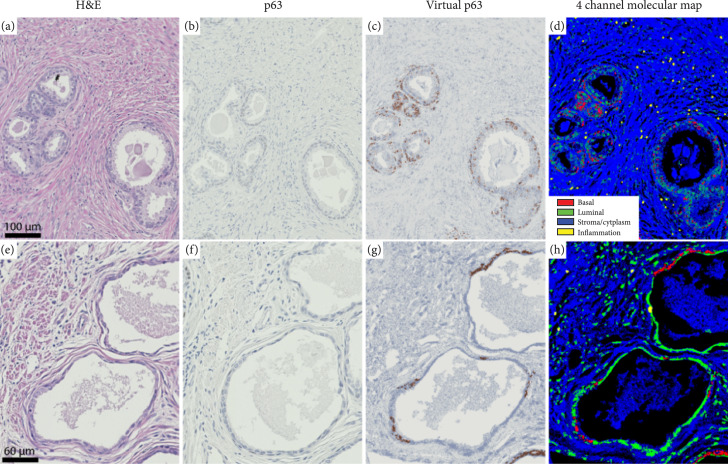
. Identifying benign mimics of prostatic adenocarcinoma remains a significant diagnostic challenge. In this work, we developed an approach based on label-free, high-resolution molecular imaging with multispectral deep ultraviolet (UV) microscopy which identifies important prostate tissue components, including basal cells. This work has significant implications towards improving the pathologic assessment and diagnosis of prostate cancer. . One of the most important indicators of prostate cancer is the absence of basal cells in glands and ducts. However, identifying basal cells using hematoxylin and eosin (H&E) stains, which is the standard of care, can be difficult in a subset of cases. In such situations, pathologists often resort to immunohistochemical (IHC) stains for a definitive diagnosis. However, IHC is expensive and time-consuming and requires more tissue sections which may not be available. In addition, IHC is subject to false-negative or false-positive stains which can potentially lead to an incorrect diagnosis. . We leverage the rich molecular information of label-free multispectral deep UV microscopy to uniquely identify basal cells, luminal cells, and inflammatory cells. The method applies an unsupervised geometrical representation of principal component analysis to separate the various components of prostate tissue leading to multiple image representations of the molecular information. . Our results show that this method accurately and efficiently identifies benign and malignant glands with high fidelity, free of any staining procedures, based on the presence or absence of basal cells. We further use the molecular information to directly generate a high-resolution virtual IHC stain that clearly identifies basal cells, even in cases where IHC stains fail. . Our simple, low-cost, and label-free deep UV method has the potential to improve and facilitate prostate cancer diagnosis by enabling robust identification of basal cells and other important prostate tissue components.
识别前列腺腺癌的良性模拟物仍然是一项重大的诊断挑战。在这项工作中,我们开发了一种基于无标记、高分辨率分子成像的方法,采用多光谱深紫外(UV)显微镜来识别重要的前列腺组织成分,包括基底细胞。这项工作对改善前列腺癌的病理评估和诊断具有重要意义。前列腺癌最重要的指标之一是腺体和导管中不存在基底细胞。然而,使用苏木精和伊红(H&E)染色(这是标准的诊断方法)来识别基底细胞,在某些情况下可能会很困难。在这种情况下,病理学家通常会采用免疫组织化学(IHC)染色来进行明确诊断。然而,IHC成本高、耗时,并且需要更多可能无法获得的组织切片。此外,IHC可能会出现假阴性或假阳性染色,这可能会导致错误的诊断。我们利用无标记多光谱深紫外显微镜丰富的分子信息来独特地识别基底细胞、管腔细胞和炎症细胞。该方法应用主成分分析的无监督几何表示来分离前列腺组织的各种成分,从而得到分子信息的多种图像表示。我们的结果表明,基于基底细胞的存在与否,该方法能够准确、高效地以高保真度识别良性和恶性腺体,无需任何染色程序。我们进一步利用分子信息直接生成高分辨率的虚拟IHC染色,即使在IHC染色失败的情况下也能清晰地识别基底细胞。我们简单、低成本且无标记的深紫外方法有潜力通过可靠地识别基底细胞和其他重要的前列腺组织成分来改善和促进前列腺癌的诊断。