You Peiting, Li Xiang, Zhang Fan, Li Quanzheng
Massachusetts General Hospital and Harvard Medical School, Boston, MA, USA.
Beijing International Center for Mathematical Research (BICMR), Peking University, Beijing, China.
BME Front. 2022 Mar 8;2022:9814824. doi: 10.34133/2022/9814824. eCollection 2022.
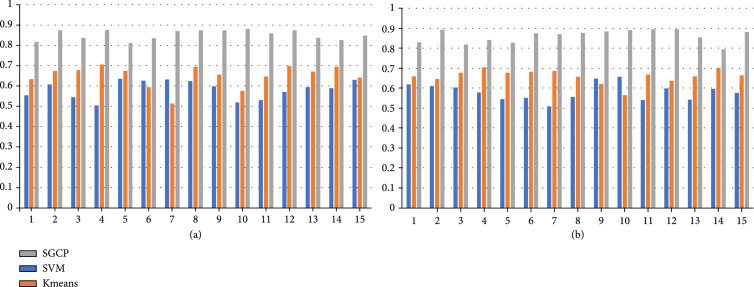
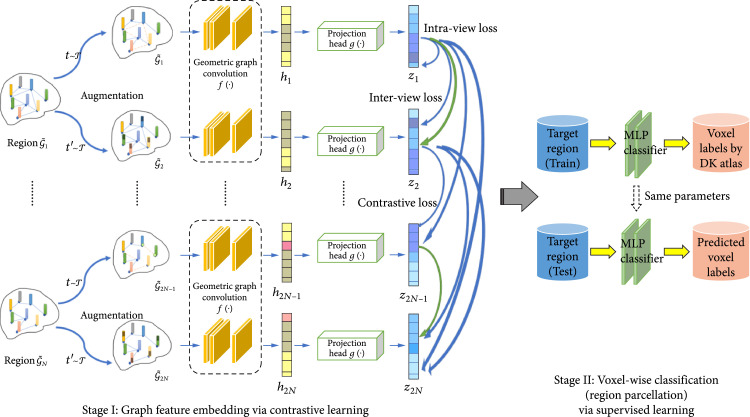
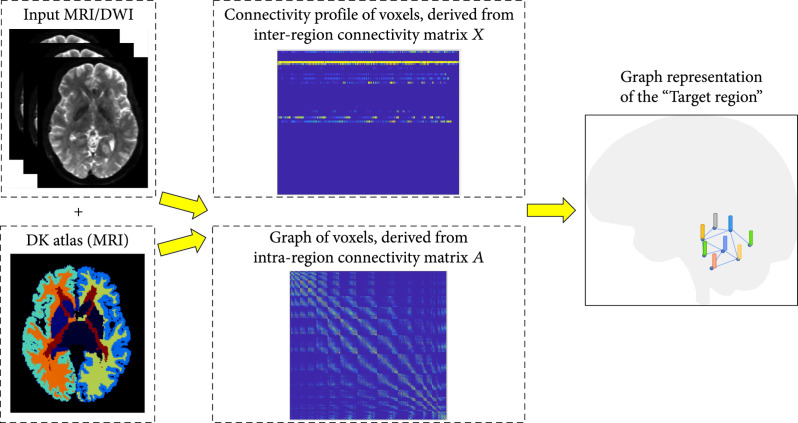
. Objective of this work is the development and evaluation of a cortical parcellation framework based on tractography-derived brain structural connectivity. . The proposed framework utilizes novel spatial-graph representation learning methods for solving the task of cortical parcellation, an important medical image analysis and neuroscientific problem. . The concept of "connectional fingerprint" has motivated many investigations on the connectivity-based cortical parcellation, especially with the technical advancement of diffusion imaging. Previous studies on multiple brain regions have been conducted with promising results. However, performance and applicability of these models are limited by the relatively simple computational scheme and the lack of effective representation of brain imaging data. . We propose the Spatial-graph Convolution Parcellation (SGCP) framework, a two-stage deep learning-based modeling for the graph representation brain imaging. In the first stage, SGCP learns an effective embedding of the input data through a self-supervised contrastive learning scheme with the backbone encoder of a spatial-graph convolution network. In the second stage, SGCP learns a supervised classifier to perform voxel-wise classification for parcellating the desired brain region. . SGCP is evaluated on the parcellation task for 5 brain regions in a 15-subject DWI dataset. Performance comparisons between SGCP, traditional parcellation methods, and other deep learning-based methods show that SGCP can achieve superior performance in all the cases. . Consistent good performance of the proposed SGCP framework indicates its potential to be used as a general solution for investigating the regional/subregional composition of human brain based on one or more connectivity measurements.
这项工作的目标是开发和评估一种基于纤维束成像衍生的脑结构连接性的皮质分区框架。所提出的框架利用新颖的空间图表示学习方法来解决皮质分区任务,这是一个重要的医学图像分析和神经科学问题。“连接指纹”的概念激发了许多关于基于连接性的皮质分区的研究,特别是随着扩散成像技术的进步。先前对多个脑区的研究已经取得了有希望的结果。然而,这些模型的性能和适用性受到相对简单的计算方案以及缺乏对脑成像数据的有效表示的限制。我们提出了空间图卷积分区(SGCP)框架,这是一种基于深度学习的两阶段图表示脑成像建模方法。在第一阶段,SGCP通过与空间图卷积网络的主干编码器的自监督对比学习方案学习输入数据的有效嵌入。在第二阶段,SGCP学习一个监督分类器来进行体素级分类,以划分所需的脑区。SGCP在一个包含15名受试者的扩散加权成像(DWI)数据集中对5个脑区的分区任务进行了评估。SGCP、传统分区方法和其他基于深度学习的方法之间的性能比较表明,SGCP在所有情况下都能实现卓越的性能。所提出的SGCP框架始终表现出良好的性能,这表明它有潜力作为一种通用解决方案,用于基于一种或多种连接性测量来研究人类大脑的区域/亚区域组成。