Peeples Joshua K, Jameson Julie F, Kotta Nisha M, Grasman Jonathan M, Stoppel Whitney L, Zare Alina
Department of Electrical and Computer Engineering, University of Florida, Gainesville, FL 32611, USA.
Department of Chemical Engineering, University of Florida, Gainesville, FL 32611, USA.
BME Front. 2022 Jun 3;2022:9854084. doi: 10.34133/2022/9854084. eCollection 2022.
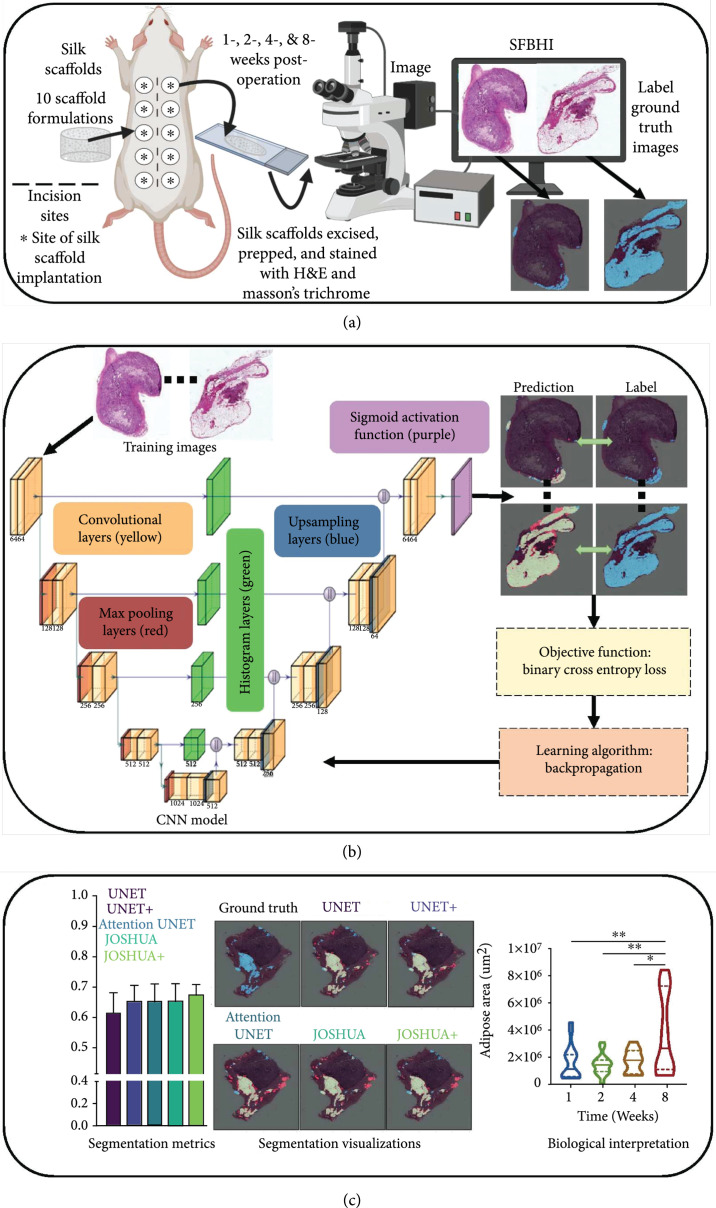
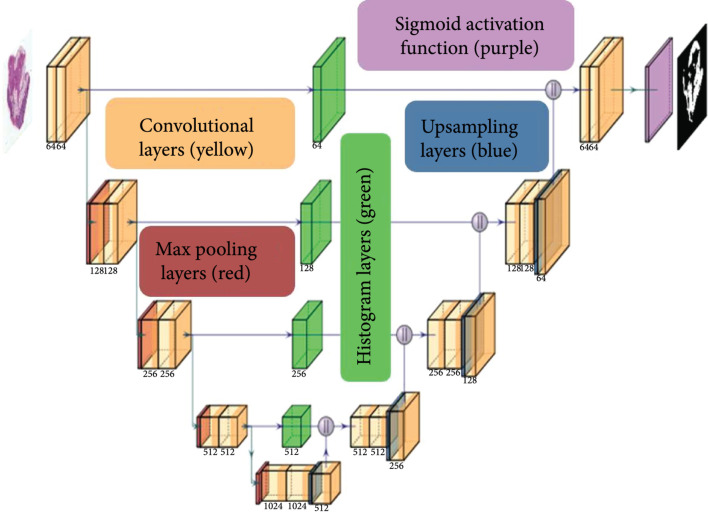
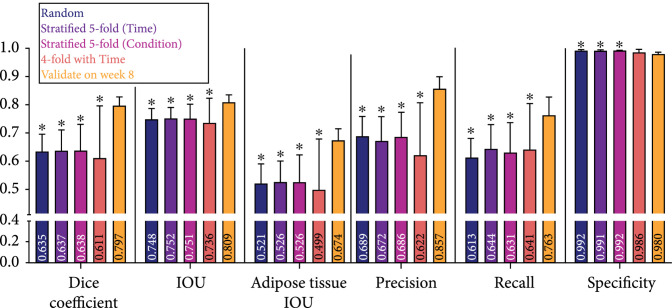
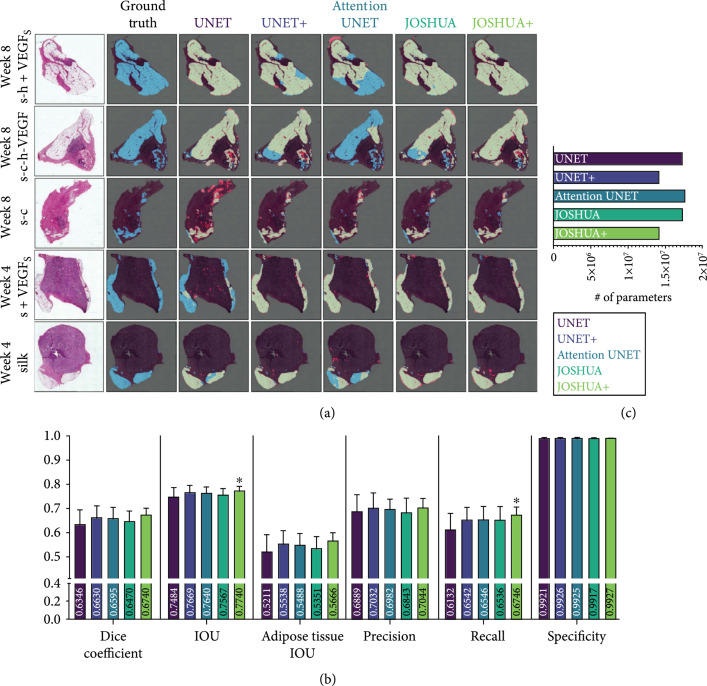
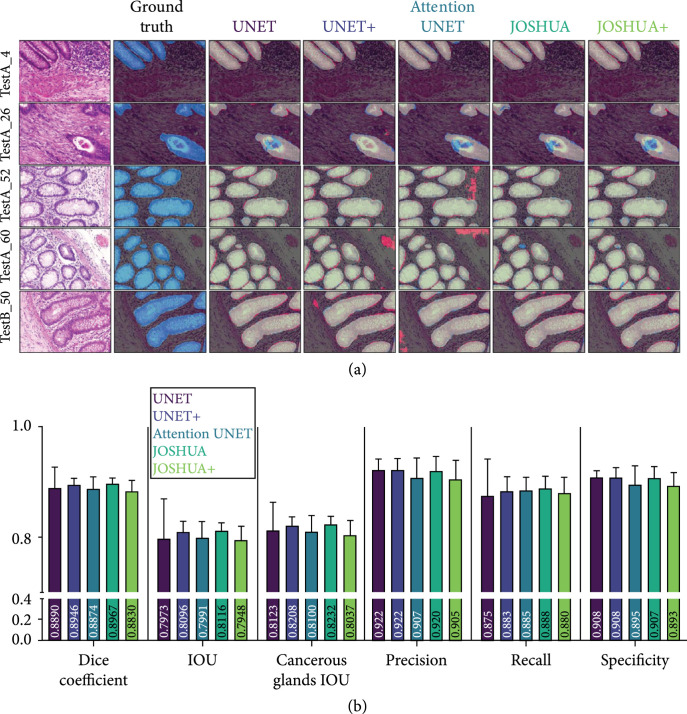
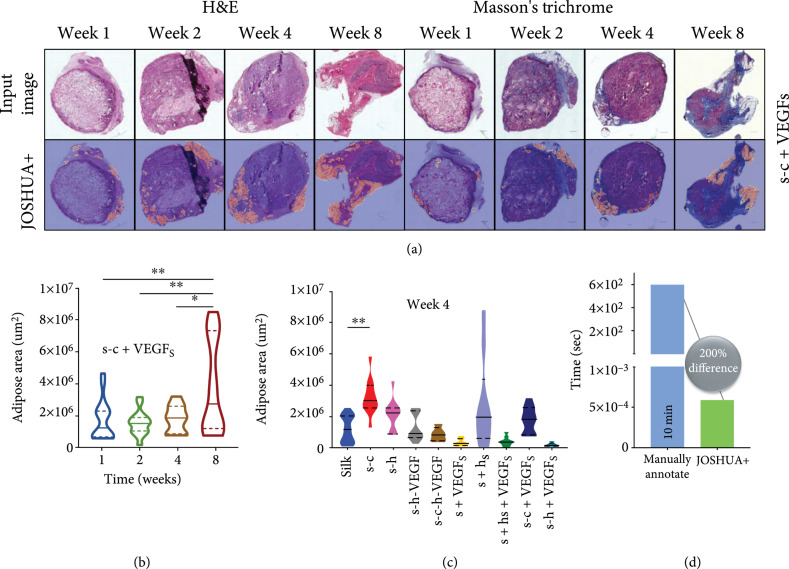
. We aim to develop a machine learning algorithm to quantify adipose tissue deposition at surgical sites as a function of biomaterial implantation. . To our knowledge, this study is the first investigation to apply convolutional neural network (CNN) models to identify and segment adipose tissue in histological images from silk fibroin biomaterial implants. . When designing biomaterials for the treatment of various soft tissue injuries and diseases, one must consider the extent of adipose tissue deposition. In this work, we analyzed adipose tissue accumulation in histological images of sectioned silk fibroin-based biomaterials excised from rodents following subcutaneous implantation for 1, 2, 4, or 8 weeks. Current strategies for quantifying adipose tissue after biomaterial implantation are often tedious and prone to human bias during analysis. . We used CNN models with novel spatial histogram layer(s) that can more accurately identify and segment regions of adipose tissue in hematoxylin and eosin (H&E) and Masson's trichrome stained images, allowing for determination of the optimal biomaterial formulation. We compared the method, Jointly Optimized Spatial Histogram UNET Architecture (JOSHUA), to the baseline UNET model and an extension of the baseline model, attention UNET, as well as to versions of the models with a supplemental attention-inspired mechanism (JOSHUA+ and UNET+). . The inclusion of histogram layer(s) in our models shows improved performance through qualitative and quantitative evaluation. . Our results demonstrate that the proposed methods, JOSHUA and JOSHUA+, are highly beneficial for adipose tissue identification and localization. The new histological dataset and code used in our experiments are publicly available.
我们旨在开发一种机器学习算法,以量化手术部位的脂肪组织沉积情况,作为生物材料植入的函数。据我们所知,本研究是首次将卷积神经网络(CNN)模型应用于识别和分割丝素蛋白生物材料植入物组织学图像中的脂肪组织。在设计用于治疗各种软组织损伤和疾病的生物材料时,必须考虑脂肪组织沉积的程度。在这项工作中,我们分析了从皮下植入1、2、4或8周后的啮齿动物身上切除的丝素蛋白基生物材料切片的组织学图像中的脂肪组织积累情况。目前生物材料植入后量化脂肪组织的策略通常很繁琐,且在分析过程中容易出现人为偏差。我们使用了带有新型空间直方图层的CNN模型,该模型能够更准确地识别和分割苏木精和伊红(H&E)以及Masson三色染色图像中的脂肪组织区域,从而确定最佳的生物材料配方。我们将联合优化空间直方图UNET架构(JOSHUA)方法与基线UNET模型、基线模型的扩展注意力UNET以及具有补充注意力启发机制的模型版本(JOSHUA+和UNET+)进行了比较。我们模型中包含直方图层通过定性和定量评估显示出了更好的性能。我们的结果表明,所提出的方法JOSHUA和JOSHUA+对脂肪组织的识别和定位非常有益。我们实验中使用的新组织学数据集和代码已公开可用。