Department of Mathematics and Statistics, UiT - The Arctic University of Norway, Tromsø, Norway.
Physics of Ice, Climate and Earth, Niels Bohr Institute, University of Copenhagen, Copenhagen, Denmark.
Nature. 2023 Oct;622(7983):528-536. doi: 10.1038/s41586-023-06503-9. Epub 2023 Oct 18.
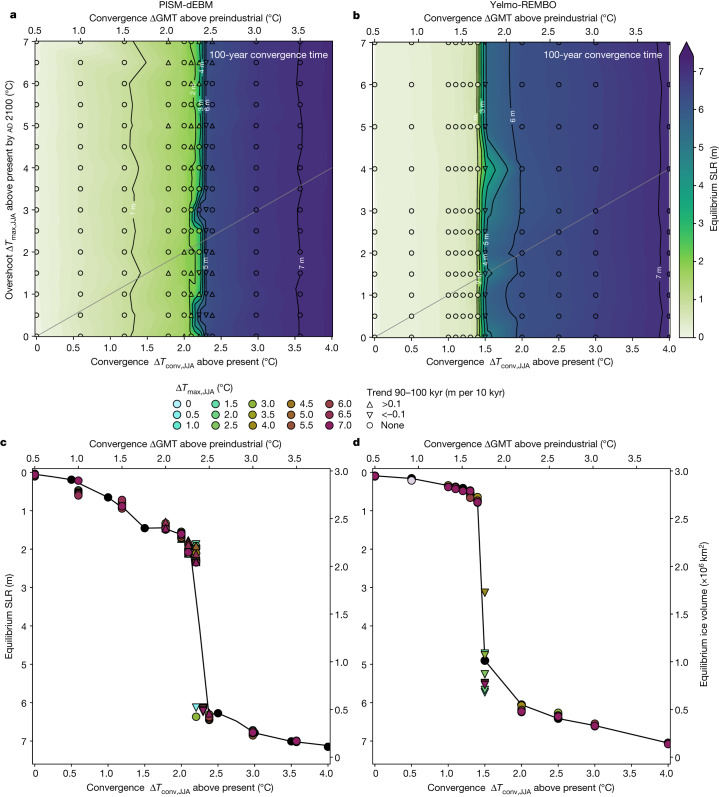
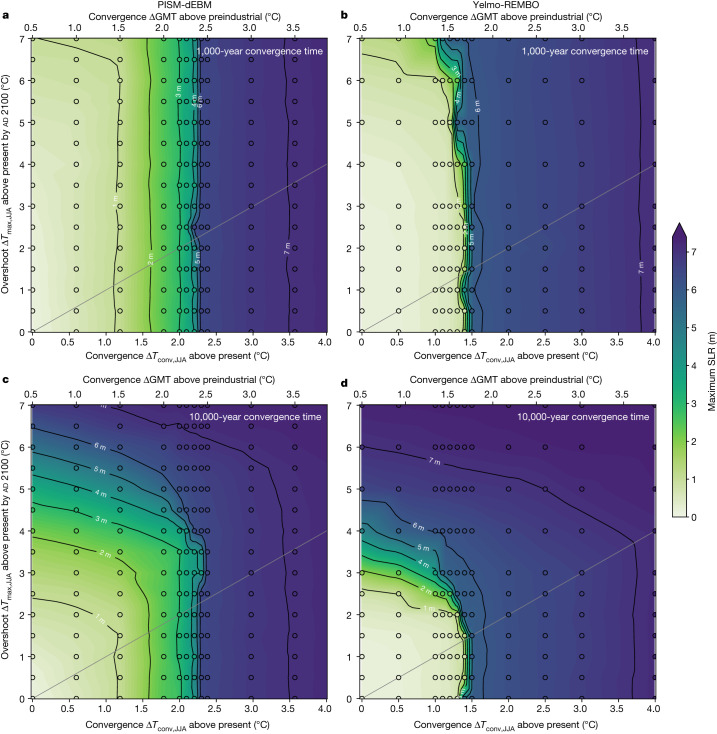
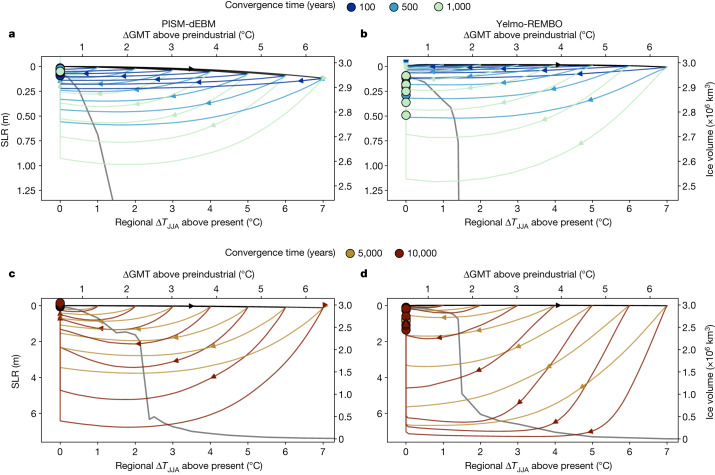
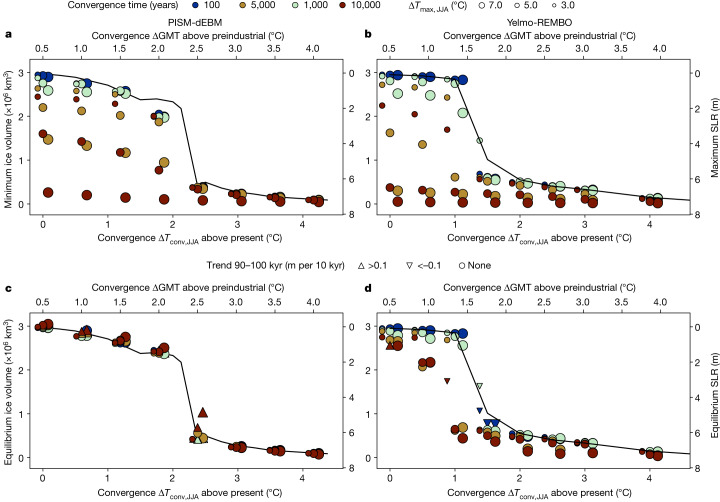
Melting of the Greenland ice sheet (GrIS) in response to anthropogenic global warming poses a severe threat in terms of global sea-level rise (SLR). Modelling and palaeoclimate evidence suggest that rapidly increasing temperatures in the Arctic can trigger positive feedback mechanisms for the GrIS, leading to self-sustained melting, and the GrIS has been shown to permit several stable states. Critical transitions are expected when the global mean temperature (GMT) crosses specific thresholds, with substantial hysteresis between the stable states. Here we use two independent ice-sheet models to investigate the impact of different overshoot scenarios with varying peak and convergence temperatures for a broad range of warming and subsequent cooling rates. Our results show that the maximum GMT and the time span of overshooting given GMT targets are critical in determining GrIS stability. We find a threshold GMT between 1.7 °C and 2.3 °C above preindustrial levels for an abrupt ice-sheet loss. GrIS loss can be substantially mitigated, even for maximum GMTs of 6 °C or more above preindustrial levels, if the GMT is subsequently reduced to less than 1.5 °C above preindustrial levels within a few centuries. However, our results also show that even temporarily overshooting the temperature threshold, without a transition to a new ice-sheet state, still leads to a peak in SLR of up to several metres.
由于人为引起的全球变暖,格陵兰冰原(GrIS)的融化对全球海平面上升(SLR)构成了严重威胁。模型和古气候证据表明,北极地区温度的迅速升高可能引发格陵兰冰原的正反馈机制,导致自我维持的融化,而且已经证明格陵兰冰原存在几个稳定状态。当全球平均温度(GMT)超过特定阈值时,预计会出现关键转变,在稳定状态之间存在很大的滞后。在这里,我们使用两个独立的冰原模型来研究在广泛的变暖范围和随后的冷却速率下,具有不同峰值和收敛温度的不同超调情景的影响。我们的研究结果表明,最大 GMT 和给定 GMT 目标的超调时间跨度对于确定 GrIS 稳定性至关重要。我们发现,在工业化前水平以上 1.7°C 至 2.3°C 的温度下,冰原突然损失的阈值 GMT。即使最大 GMT 超过工业化前水平 6°C 或更高,如果 GMT 在几百年内降低到工业化前水平以上 1.5°C 以下,仍然可以大大减轻格陵兰冰原的损失。然而,我们的研究结果还表明,即使暂时超过温度阈值,而没有过渡到新的冰原状态,仍然会导致海平面上升峰值达到数米。