Department of Agronomy, Agrifood Campus of International Excellence CeiA3, University of Cordoba, Rabanales Campus, Celestino Mutis Building, E-14071, Córdoba, Spain.
Department of Botany, Ecology and Plant Physiology, Agrifood Campus of International Excellence CeiA3, University of Cordoba, Rabanales Campus, Celestino Mutis Building, E-14071, Córdoba, Spain.
Ann Bot. 2023 Dec 5;132(6):1145-1158. doi: 10.1093/aob/mcad163.
Olive (Olea europaea subsp. europaea var. europaea) is the most extensively cultivated fruit crop worldwide. It is considered a wind-pollinated and strictly outcrossing crop. Thus, elevated pollen production is crucial to guarantee optimum fruit set and yield. Despite these facts, the variability of pollen production within the cultivated olive has been scarcely studied. This study aimed to characterize this feature by analysing a representative set of worldwide olive cultivars.
We evaluated the average number of pollen grains per anther in 57 principal cultivars over three consecutive years. We applied a standard generalized linear model (GLM) approach to study the influence of cultivar, year and the previous year's fruit load on the amount of pollen per anther. Additionally, the K-means method was used for cluster analysis to group cultivars based on their pollen production capacity.
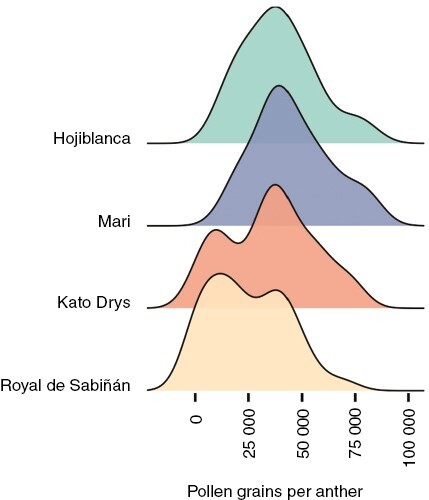
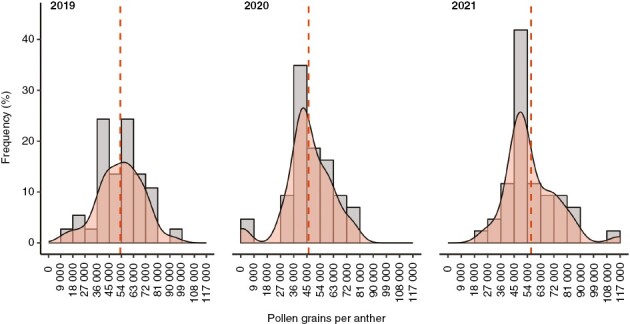
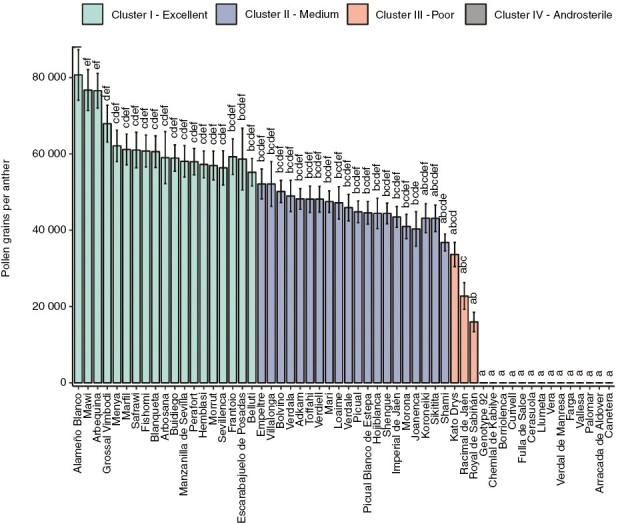
Pollen production per anther was highly variable among olive cultivars. The cultivar significantly accounted for 51.3 % of the variance in pollen production and the year for 0.3 %. The interaction between the two factors explained 8.4 % of the variance, indicating that not all cultivars were equally stable in producing pollen across the years. The previous year's fruit load and its interaction with the year were significant, but barely accounted for 1.5 % of the variance. Olive cultivars were classified into four clusters according to their capacity to produce pollen. Interestingly, the fourth cluster was composed of male-sterile cultivars, which presumably share this character by inheritance.
Pollen production per anther varied extensively within the cultivated olive. This variation was mainly driven by the cultivar and its interaction with the year. The differential capacity of olive cultivars to produce pollen should be considered not only for designing new orchards but also gardens where this species is used as an ornamental.
油橄榄(Olea europaea subsp. europaea var. europaea)是全球范围内种植最广泛的水果作物。它被认为是一种风媒传粉且严格异花授粉的作物。因此,花粉产量的增加对于保证最佳的果实结实率和产量至关重要。尽管如此,栽培油橄榄内花粉产量的变异性研究甚少。本研究旨在通过分析一组具有代表性的世界油橄榄品种来描述这一特征。
我们在连续三年评估了 57 个主要品种每个花药的平均花粉粒数。我们应用标准的广义线性模型(GLM)方法来研究品种、年份和前一年果实负载对每个花药花粉数量的影响。此外,使用 K-均值方法进行聚类分析,根据花粉生产能力对品种进行分组。
每个花药的花粉产量在油橄榄品种间高度可变。品种对花粉产量的变异有 51.3%的解释能力,年份的解释能力为 0.3%。两个因素之间的相互作用解释了 8.4%的变异,表明并非所有品种在多年间花粉产量都同样稳定。前一年的果实负载及其与年份的相互作用显著,但仅解释了 1.5%的变异。根据产生花粉的能力,将油橄榄品种分为四个类群。有趣的是,第四类群由雄性不育品种组成,它们可能通过遗传共享这一特征。
栽培油橄榄内每个花药的花粉产量差异很大。这种变异性主要由品种及其与年份的相互作用驱动。油橄榄品种产生花粉的能力差异不仅应在设计新果园时考虑,还应在将该物种用作观赏植物的花园中考虑。