
儿童期邻里贫困状况可预测青少年功能性大脑网络结构。
Neighborhood poverty during childhood prospectively predicts adolescent functional brain network architecture.
机构信息
Department of Psychology, University of Michigan, Ann Arbor, MI, USA.
Department of Psychiatry, University of Michigan, Ann Arbor, MI, USA.
出版信息
Dev Cogn Neurosci. 2023 Dec;64:101316. doi: 10.1016/j.dcn.2023.101316. Epub 2023 Oct 14.
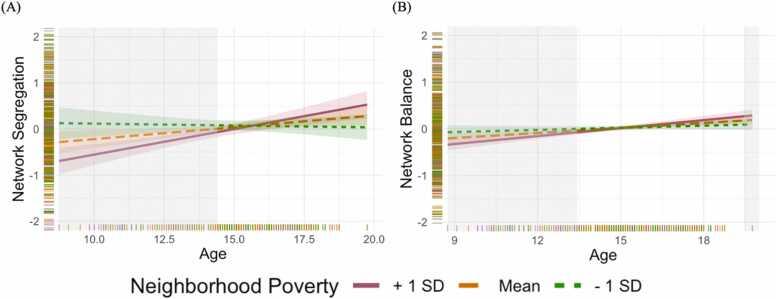
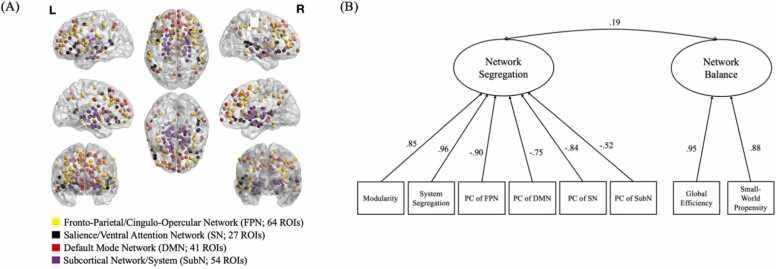
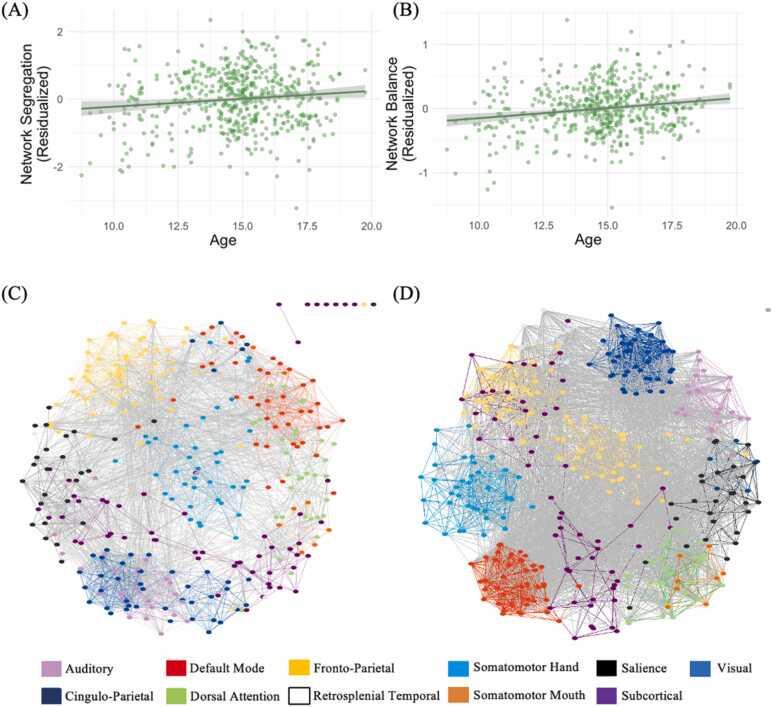
Family poverty has been associated with altered brain structure, function, and connectivity in youth. However, few studies have examined how disadvantage within the broader neighborhood may influence functional brain network organization. The present study leveraged a longitudinal community sample of 538 twins living in low-income neighborhoods to evaluate the prospective association between exposure to neighborhood poverty during childhood (6-10 y) with functional network architecture during adolescence (8-19 y). Using resting-state and task-based fMRI, we generated two latent measures that captured intrinsic brain organization across the whole-brain and network levels - network segregation and network segregation-integration balance. While age was positively associated with network segregation and network balance overall across the sample, these associations were moderated by exposure to neighborhood poverty. Specifically, these positive associations were observed only in youth from more, but not less, disadvantaged neighborhoods. Moreover, greater exposure to neighborhood poverty predicted reduced network segregation and network balance in early, but not middle or late, adolescence. These effects were detected both across the whole-brain system as well as specific functional networks, including fronto-parietal, default mode, salience, and subcortical systems. These findings indicate that where children live may exert long-reaching effects on the organization and development of the adolescent brain.
家庭贫困与年轻人的大脑结构、功能和连接改变有关。然而,很少有研究探讨更广泛的邻里环境劣势如何影响功能大脑网络组织。本研究利用生活在低收入社区的 538 对双胞胎的纵向社区样本,评估儿童期(6-10 岁)接触邻里贫困与青春期(8-19 岁)期间功能网络结构之间的前瞻性关联。使用静息态和任务态 fMRI,我们生成了两个潜在的衡量标准,分别捕捉整个大脑和网络层面的内在大脑组织——网络分离和网络分离-整合平衡。虽然年龄与整个样本的网络分离和网络平衡呈正相关,但这些关联受到邻里贫困暴露的调节。具体来说,这些正相关仅在来自较不利邻里环境的年轻人中观察到,但在不太不利的邻里环境中则没有。此外,更大程度的邻里贫困暴露预示着青少年早期(但不是中期或晚期)的网络分离和网络平衡减少。这些影响在整个大脑系统以及特定的功能网络中都被检测到,包括额顶叶、默认模式、突显和皮质下系统。这些发现表明,儿童居住的地方可能对青少年大脑的组织和发育产生深远的影响。

 Zotero 插件