Community Medicine Research Department/ Medical Research and Clinical Studies Institute, National Research Centre (Affiliation ID: 60014618), Public Health and Community Medicine, Dokki, P.O. 12622, Giza, Egypt.
Quantitative Methods Department - Aswan University, Aswan, Egypt.
BMC Pediatr. 2023 Oct 19;23(1):521. doi: 10.1186/s12887-023-04335-0.
Early childhood life is critical for optimal development and is the foundation of future well-being. Genetic, sociocultural, and environmental factors are important determinants of child development.
The objectives were to screen for suspected developmental delays (DDs) among Egyptian preschool children, and to explore the determinants of these delays based on sociodemographic, epidemiological, maternal, and child perinatal risk factors.
A national Egyptian cross-sectional developmental screening of a representative sample of preschool children (21,316 children) aged 12 to 71 months. The Revised Denver Prescreening Developmental Questionnaire (R-PDQ) followed by the Denver Developmental Screening Test, 2 edition (DDST) was used.
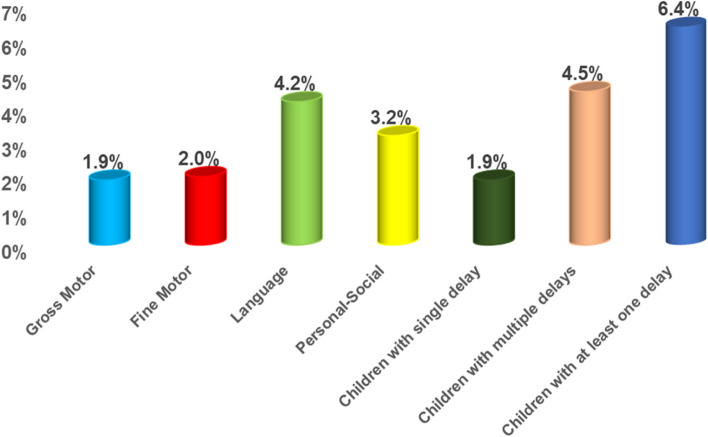
Each screened child manifested at least one of six developmental categories. Either typical development, gross motor delay (GM), fine motor adaptive delay (FMA), Language delay (L), Personal-social delay (PS), or multiple DDs. The prevalence of preschool children with at least one DD was 6.4%, while 4.5% had multiple DDs. Developmental language delay was the most prevalent, affecting 4.2% of children. The least affected domain was GM (1.9% of children). Boys were more likely to have DD than girls. Children in urban communities were more likely to have at least one DD than those in rural areas (OR = 1.28, 95%CI: 1.14-1.42), and children of middle social class than of low or high social class (OR = 1.49, 95%CI: 1.30-1.70 & OR = 1.40, 95%CI: 1.23-1.59 respectively). The strong perinatal predictors for at least one DD were children with a history of postnatal convulsions (OR = 2.68, 95%CI: 1.97-3.64), low birth weight (OR = 2.06, 95%CI: 1.69-2.52), or history of postnatal cyanosis (OR = 1.77, 95%CI: 1.26-2.49) and mothers had any health problem during pregnancy (OR = 1.73, 95%CI: 1.44-2.07). Higher paternal and maternal education decreased the odds of having any DD by 43% (OR = 0.57, 95% CI: 0.47-0.68) and 31% (OR = 0.69, 95%CI: 0.58-0.82) respectively.
This study demonstrates a considerable attempt to assess the types and the prevalence of DD among preschool children in Egypt. Perinatal factors are among the most common determinants of DD in preschool children and the majority could be preventable risk factors.
儿童早期生活对最佳发展至关重要,是未来幸福的基础。遗传、社会文化和环境因素是儿童发展的重要决定因素。
本研究旨在筛查埃及学龄前儿童疑似发育迟缓(DD),并根据社会人口学、流行病学、孕产妇和儿童围产期风险因素,探讨这些发育迟缓的决定因素。
本研究采用了全国性的埃及学龄前儿童发育筛查,共纳入了 21316 名年龄在 12 至 71 个月的儿童。使用修订后的丹佛发育筛查前问卷(R-PDQ),随后是丹佛发育筛查测试第 2 版(DDST)。
每个接受筛查的儿童在至少六个发育类别中表现出一种。要么是典型发育,要么是粗大运动延迟(GM)、精细运动适应性延迟(FMA)、语言延迟(L)、个人-社会延迟(PS)或多种 DD。至少有一种 DD 的学龄前儿童的患病率为 6.4%,而 4.5%的儿童有多发性 DD。发育性语言迟缓是最常见的,影响了 4.2%的儿童。受影响最小的领域是 GM(1.9%的儿童)。男孩比女孩更有可能患有 DD。城市社区的儿童比农村地区的儿童更有可能患有至少一种 DD(OR=1.28,95%CI:1.14-1.42),而社会阶层处于中产阶级的儿童比社会阶层处于低或高的儿童更有可能患有至少一种 DD(OR=1.49,95%CI:1.30-1.70 和 OR=1.40,95%CI:1.23-1.59)。至少有一种 DD 的强烈围产期预测因素是出生后有惊厥史(OR=2.68,95%CI:1.97-3.64)、低出生体重(OR=2.06,95%CI:1.69-2.52)或出生后发绀史(OR=1.77,95%CI:1.26-2.49)和母亲在怀孕期间有任何健康问题(OR=1.73,95%CI:1.44-2.07)。父亲和母亲较高的教育程度分别使发生任何 DD 的几率降低了 43%(OR=0.57,95%CI:0.47-0.68)和 31%(OR=0.69,95%CI:0.58-0.82)。
本研究表明,人们在评估埃及学龄前儿童 DD 的类型和患病率方面做出了相当大的努力。围产期因素是学龄前儿童 DD 的最常见决定因素之一,其中大多数是可预防的风险因素。