Kaggwa Mark Mohan, Najjuka Maria Sarah, Kesande Claire, Nyemara Novatus, Kule Moses, Mamum Mohammed A, Bongomin Felix, Ashaba Scholastic
Department of Psychiatry, Faculty of Medicine, Mbarara University of Science and Technology, Mbarara, Uganda.
African Centre for Suicide Prevention and Research, Mbarara, Uganda.
Discov Ment Health. 2022 Jul 4;2(1):15. doi: 10.1007/s44192-022-00018-x.
Whether the presence of caregivers during the hospital stay of patients with mental illness affects the length of hospital stay (LoS) remains inconclusive.
(1) To determine the average LoS and the associated factors, and (2) to determine the role of caregivers' presences during inpatient stay on LoS.
We conducted a cross-sectional study in two hospitals in Uganda; one with caregivers and the other without caregivers between July to November 2020. Mann-Whitney U test was used to compare LoS in the two selected hospitals and linear regression was used to determine factors associated with LoS.
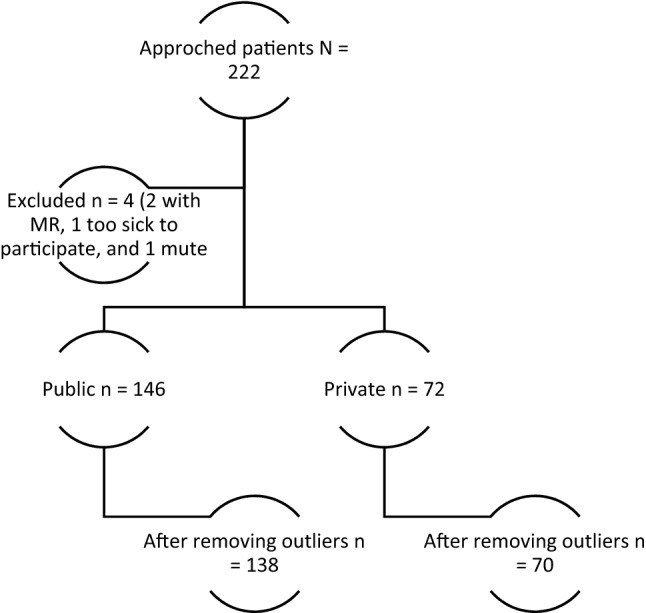
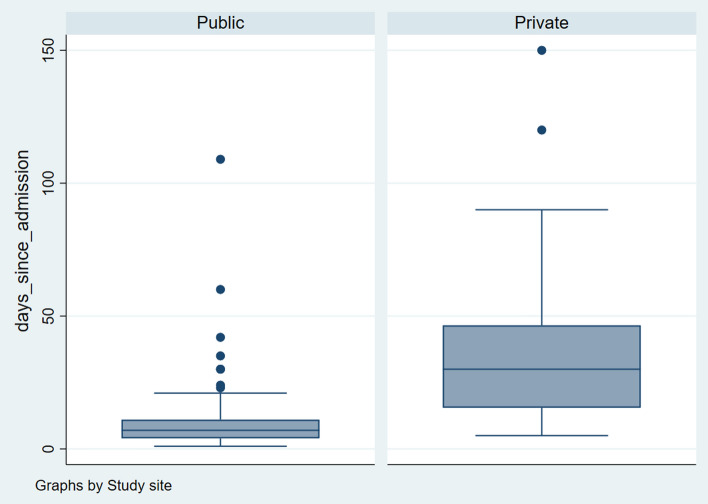
A total of 222 participants were enrolled, the majority were males (62.4%). Mean age was 36.3 (standard deviation (SD) = 13.1) years. The average LoS was 18.3 (SD = 22.3) days, with patients in a hospital without caregivers having a longer median LoS (i.e., (30 (interquartile range (IQR) = 30) vs. 7 (7) days; χ = 68.95, p < 0.001). The factors significantly associated a longer LoS among our study participants included; being admitted in a hospital without caregivers (adjusted coefficient [aCoef]: 14.88, 95% CI 7.98-21.79, p < 0.001), a diagnosis of schizophrenia (aCoef: 10.68, 95 %CI 5.53-15.83, p < 0.001), being separated or divorced (aCoef: 7.68, 95% CI 1.09-14.27, p = 0.023), and increase in money spent during the admission (aCoef: 0.14, 95% CI 0.09-0.18, p < 0.001).
Patients with mental illness in southwestern Uganda have a short LoS (below 28 days), and the stay was much shorter for patients with fulltime caregivers. We recommend caregivers presence during patient's hospital stay to reduce the LoS and minimize healthcare expenditure.
精神疾病患者住院期间护理人员的陪伴是否会影响住院时间(LoS)尚无定论。
(1)确定平均住院时间及相关因素,(2)确定住院期间护理人员陪伴对住院时间的作用。
2020年7月至11月,我们在乌干达的两家医院进行了一项横断面研究;一家医院有护理人员陪伴,另一家没有。采用曼-惠特尼U检验比较两家选定医院的住院时间,并使用线性回归确定与住院时间相关的因素。
共纳入222名参与者,大多数为男性(62.4%)。平均年龄为36.3岁(标准差(SD)=13.1)。平均住院时间为18.3天(SD=22.3),在没有护理人员陪伴的医院住院的患者中位住院时间更长(即30天(四分位间距(IQR)=30)对7天(7);χ=68.95,p<0.001)。在我们的研究参与者中,与较长住院时间显著相关的因素包括:在没有护理人员陪伴的医院住院(调整系数[aCoef]:14.88,95%置信区间7.98-21.79,p<0.001)、精神分裂症诊断(aCoef:10.68,95%置信区间5.53-15.83,p<0.001)、分居或离婚(aCoef:7.68,95%置信区间1.09-14.27,p=0.023)以及住院期间花费增加(aCoef:0.14,95%置信区间0.09-0.18,p<0.001)。
乌干达西南部的精神疾病患者住院时间较短(低于28天),有全职护理人员陪伴的患者住院时间更短。我们建议患者住院期间有护理人员陪伴,以缩短住院时间并尽量减少医疗费用。